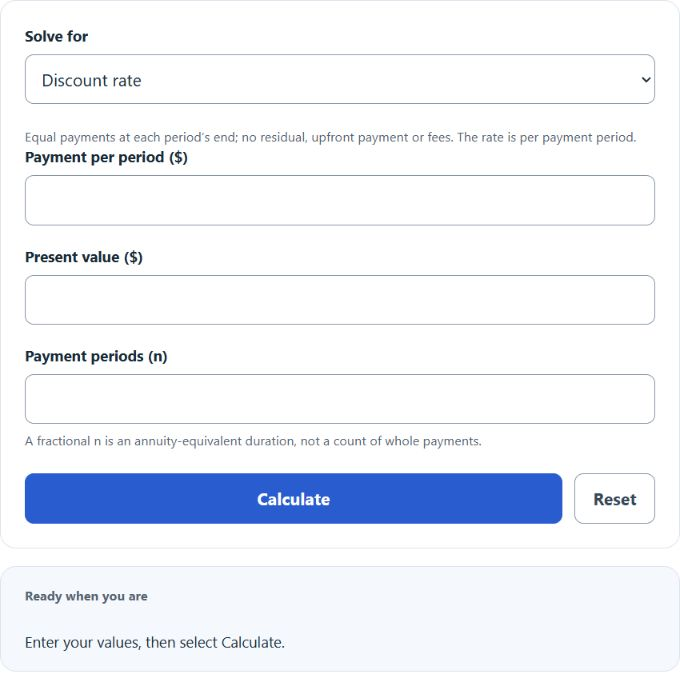
Calculate lease discount rate, present value, periodic payment, or number of payment periods by selecting the unknown value and entering the other three inputs. Payments are equal and occur at each period’s end; no residual value or fees are included.
Related Calculators
- Salvage Value Calculator
- Final Cost Calculator
- List Price Calculator
- Contingency Percentage Calculator
- All Business Calculators
Lease Discount Rate Formula
The lease discount rate is the rate per payment period that makes the present value of a stream of lease payments equal to the lease value or lease liability entered into the calculator. For this calculator, payments are assumed to occur at the end of each period, which is the standard ordinary annuity convention.
In this relationship, the discount rate is solved from the payment amount, present value, and number of payments. Because r appears in both the denominator and the exponent, there is no simple direct algebraic rearrangement for the rate. In practice, the solution is found with an iterative numerical method.
Here, r is the rate in decimal form per payment period, while DR is the same rate expressed as a percent.
Variable Definitions
- PV = present value of the lease payments
- PMT = periodic lease payment amount
- n = total number of lease payments
- r = lease discount rate per payment period in decimal form
- DR = lease discount rate per payment period as a percentage
How to Use the Calculator Correctly
- Enter the periodic lease payment exactly as it occurs in the contract.
- Enter the present value of the lease payment stream or lease liability you want to match.
- Enter the total number of payments.
- Make sure all units are aligned. If payments are monthly, the result is a monthly discount rate. If payments are quarterly, the result is a quarterly discount rate.
- Interpret the output as the implied financing rate that equates the payment stream to the present value.
Unit consistency is critical. If the payment is monthly, then n must be the number of months, and the resulting discount rate is also monthly. Do not mix an annual rate with monthly payments unless you convert everything to the same period first.
What the Result Means
The calculator finds the rate that answers this question: What periodic return would make these lease payments worth exactly this present value today? That rate can be used to evaluate financing cost, compare leasing alternatives, or reconcile a lease liability to a payment schedule.
- If the result is higher, the payment stream is being discounted more aggressively.
- If the result is lower, future payments are treated as more valuable today.
- If the present value is close to the total of all payments, the discount rate will be close to 0%.
This special case is useful as a quick check. When there is no discounting, present value equals the simple sum of the payments.
Useful Interpretation Checks
For a level-payment lease with end-of-period payments:
- If PV < PMT × n, the implied rate is typically positive.
- If PV = PMT × n, the implied rate is 0%.
- If PV > PMT × n, the implied rate is negative, which is mathematically possible but uncommon in standard lease analysis.
Example
Suppose the lease payment is $900 per month, the present value is $10,000, and there are 12 monthly payments. The calculator solves for the monthly rate that satisfies the annuity equation above. The implied periodic rate is approximately 1.20% per month.
If you want to translate a periodic rate into an annualized view, use the number of periods per year, denoted by m.
With a monthly rate of about 1.20%, the approximate nominal annual rate is 14.4%, while the effective annual rate is about 15.39% when monthly compounding is considered. This distinction matters when comparing lease rates to loan rates or investment returns quoted on an annual basis.
Related Formulas You May Need
If the discount rate is already known, you can solve for other lease variables directly.
To solve for present value:
To solve for the payment amount:
To solve for the total number of payments:
These relationships are all based on the same level-payment ordinary annuity structure, so they only apply when payment amounts are equal and the discount rate is constant over the term. A fractional n is an annuity-equivalent duration; an actual payment schedule needs whole payment dates and may require an adjusted final payment.
Beginning-of-Period Payments
If the lease payments are made at the beginning of each period instead of the end, the stream is an annuity due, not an ordinary annuity. In that case, the present value is higher because every payment is discounted for one less period.
If your contract requires beginning-of-period payments, be careful not to use an end-of-period model without adjusting for timing, or the implied rate may be misstated.
Common Input Mistakes
- Mixing annual and monthly units — monthly payments require a monthly rate.
- Using the wrong payment timing — end-of-period and beginning-of-period payments produce different results.
- Including non-lease items in PMT — taxes, maintenance, insurance, or one-time fees can distort the implied rate if they are bundled inconsistently.
- Assuming the result is annual — the calculator returns the rate per payment period, not automatically per year.
- Ignoring irregular cash flows — this model assumes equal payments and a constant rate throughout the term.
When This Calculator Is Most Useful
- Estimating the implied financing rate in a lease
- Backing into a discount rate from a known lease liability
- Checking whether a quoted payment stream is consistent with a target present value
- Comparing lease economics across different payment structures
- Converting payment schedules into a clearer financing interpretation
Quick FAQ
- Is the result annual or periodic?
- The result is periodic. A monthly lease returns a monthly rate; a quarterly lease returns a quarterly rate.
- Why is the rate not solved directly with simple algebra?
- The rate appears in more than one place in the annuity equation, including an exponent, so numerical iteration is typically required.
- Can the calculator return a negative rate?
- Yes. If the present value entered is greater than the undiscounted total of all payments, the implied rate can be negative.
- Does this work for uneven lease payments?
- No. This formula assumes equal payments each period. Irregular schedules require a cash-flow-by-cash-flow discounting approach.