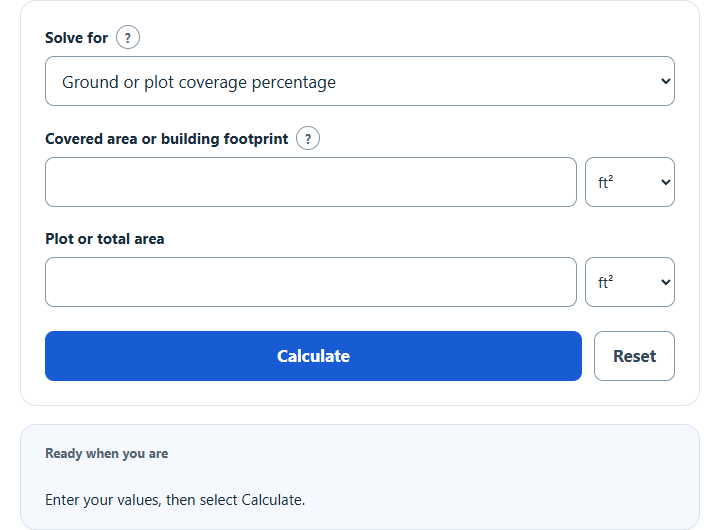
Calculate ground coverage or plot coverage percentage from building footprint and plot area, or estimate the material units needed to cover an area.
- All Math and Numbers Calculators
- All Area Calculators
- Gross Floor Area Calculator
- Lot Coverage Calculator
- Building Coverage Calculator
- Floor to Area Ratio Calculator
- Land to Building Ratio Calculator
Calculator Functions
| Function | What it does | What it requires |
|---|---|---|
| Ground or plot coverage percentage | Finds the share of a plot that buildings or other covered areas take up | Requires the covered area or building footprint, and the plot or total area |
| Material units needed | Finds how many cans, bags, rolls or boxes are needed to cover an area, rounded up to whole units | Requires the project area or its dimensions, and the coverage of one unit |
| Coverage area from quantity | Finds the area a quantity of material covers | Requires the material quantity and the coverage of one unit |
Areas can be entered in ft², m², yd², acres or hectares, and the two areas in a coverage percentage can use different units. Material units needed takes a known area, or the dimensions of a rectangle, circle or triangle in ft, m, yd or in. Both material functions have optional settings for an extra material allowance, coverage lost to overlap and a cost per unit.
Coverage Area Formulas
| C | Coverage (%) |
| Ac | Covered area: the ground-level footprint of the buildings, or whatever the applicable rule counts as covered |
| At | Total area of the plot or lot, in the same unit |
Ground or plot coverage percentage
Plot coverage, also called lot coverage or ground coverage, is the percentage of a lot’s area that buildings occupy [1]. A 1,500 ft² footprint on a 6,000 ft² lot is 1,500 ÷ 6,000 × 100 = 25%, a coverage ratio of 0.25, with 4,500 ft² left uncovered. A 150 m² footprint on a quarter-acre lot (1,011.71 m²) is 14.83%. The covered area cannot be larger than the total.
Material units needed
(R × (1 − o))
A is the project area, R is the area one unit of material covers, w is the extra material allowance and o is the coverage lost to overlap, both as decimals. The answer is rounded up to whole units. A 12 ft by 15 ft floor is 180 ft². At 40 ft² per box with a 10% allowance, 180 × 1.10 ÷ 40 = 4.95, so 5 boxes. The area of a rectangle is length × width, a circle is π × diameter² ÷ 4, and a triangle is base × perpendicular height ÷ 2.
Coverage area from quantity
Q is the quantity of material, which can be a fraction. Three cans that each cover 350 ft², with a 10% allowance held back, cover 3 × 350 ÷ 1.10 = 954.55 ft². Ten rolls of 100 ft² with 5% lost to overlap cover 950 ft².
How to Calculate Ground Coverage Area
Measure the footprint of every building on the plot at ground level and add them together. Measure the plot itself. Divide the total footprint by the plot area and multiply by 100. A house of 1,200 ft² and a garage of 300 ft² on a 6,000 ft² plot cover (1,200 + 300) ÷ 6,000 × 100 = 25% of it. What counts as covered depends on the local rule: one county’s code, for example, leaves the first 2 feet of roof overhang on the main building out of the covered area [1].
Limits of This Estimate
- A coverage percentage is only as good as the areas entered. Zoning rules differ on porches, decks, eaves, paving and accessory buildings, so the local definition decides what goes into the covered area.
- Material coverage rates come from the product label. Real coverage changes with the surface, the application method and the number of coats.
- The allowance and overlap are the user’s own assumptions. Overlap that is already built into a product’s stated coverage should not be entered again.
Sources
- Maricopa County, Arizona, Planning and Development, Lot Coverage Calculations (DD-2021-01): definition of lot coverage as a percentage of lot area, and an example of what a local rule leaves out