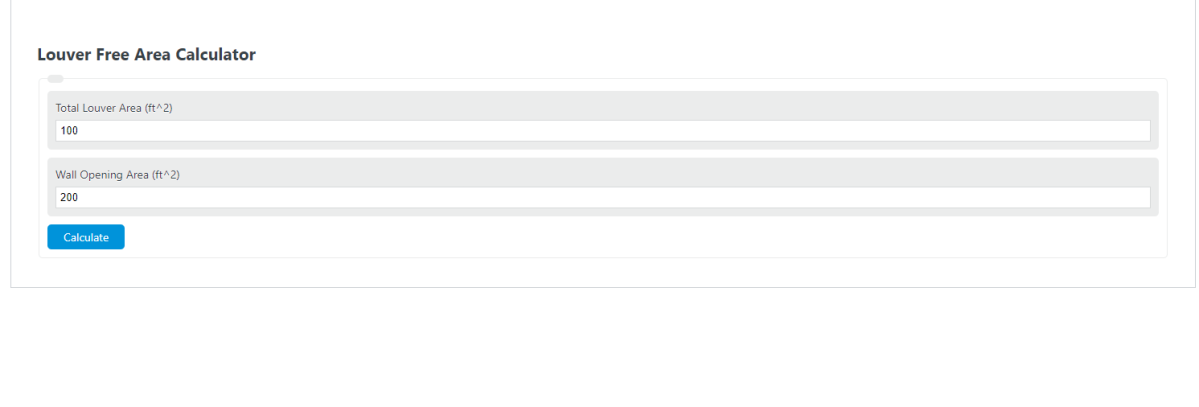
Calculate louver free area from width, height, and manufacturer free-area percentage, solve for required face area, and find airflow velocity in US and metric units.
- All Construction Calculators
- Window to Wall Ratio Calculator
- Floor to Area Ratio Calculator
- Lot Coverage Calculator
- Wall Angle Calculator
Louver Free Area Formula
The following equation is used to calculate the Free Area.
- Where LFR is the louver free area (%)
- TOLA is the total net free (open) area through the louver (excluding blades, frame, and supports) (any consistent area unit, e.g., ft² or m²)
- WOA is the gross wall/louver opening (face) area (any consistent area unit, e.g., ft² or m²)
To calculate louver free area, divide the total net free (open) area by the gross opening area, then multiply by 100.
What is Louver Free Area?
Definition:
The free area of a louver (also called net free area) is the net open area available for airflow through the louver after accounting for blades, frame, and supports. It is usually expressed as a percentage of the louver’s gross (nominal) face area (often the wall/rough opening).
Free area is used primarily to estimate airflow capacity and pressure drop. Solar control, privacy, and rain resistance depend mostly on blade geometry and louver type rather than free-area percentage alone.
For a given airflow, a higher free-area percentage generally lowers air velocity through the louver and can reduce pressure drop (potentially lowering fan energy). However, requirements such as wind-driven-rain performance, sight-proofing, security, or acoustics can require designs with lower free area.
Louvers are commonly categorized by blade operation (fixed vs. operable) and performance features (non-drainable vs. drainable, storm-resistant/wind-driven-rain rated, sight-proof, acoustic, etc.), and they are made from materials such as aluminum, steel, stainless steel, wood, or composites.
Most HVAC/architectural wall louvers use opaque blades (often metal). These can provide shading/visual screening and weather protection while still allowing airflow through the openings between blades.
Some designs incorporate perforated/expanded-metal elements or separate bird/insect screens. These can provide airflow with additional screening, but typically reduce free area and increase pressure drop compared with the same louver without a screen.
Free Area: Free area is typically published by the manufacturer for a specific louver model and nominal size (and may be listed with or without screens), often based on geometric calculation and/or AMCA 500‑L test data. To estimate net free area, multiply the gross opening area by the free-area percentage.
How to Calculate Louver Free Area?
Example Problem:
The following example outlines the steps and information needed to calculate Free Area.
First, determine the net (free) open area through the louver after accounting for blades, frame, and any screens/obstructions. For this example, this is found to be 10 ft^2.
Next, determine the total wall (gross) opening area. In this case, the wall opening has an area of 20 ft^2.
Finally, calculate the louver free area using the formula above:
LFR = (TOLA / WOA) * 100
LFR = (10 / 20) * 100
LFR = 50%