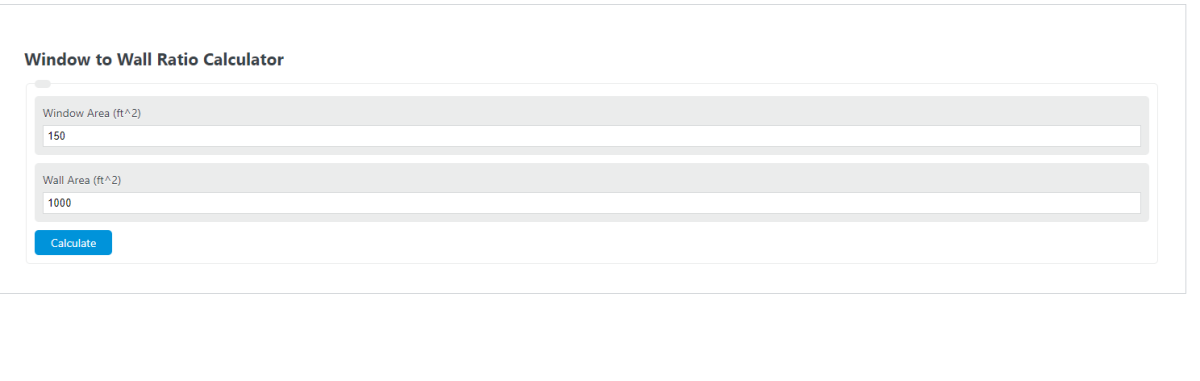
Calculate window-to-wall ratio, wall-to-window ratio, window area, or wall area from any two values with ft², m², in², or cm² units.
- All Construction Calculators
- Floor to Area Ratio Calculator
- Gross Floor Area Calculator
- Land to Building Ratio Calculator
- Louver Free Area Calculator
- Wall Area Calculator
Window to Wall Ratio Formula
The window to wall ratio (WWR) compares total glazed area to total gross exterior wall area. It is one of the fastest ways to describe how transparent a facade is and is commonly used during envelope design, daylight planning, HVAC load studies, and early energy analysis.
Where:
- Aw = total window or glazing area
- Awall = gross exterior wall area for the same facade or building section
- WWR% = glazing area expressed as a percentage of wall area
For this calculation, the wall area should be the gross exterior wall area, not the net opaque wall area after subtracting windows. In other words, measure the full wall surface first, then compare the glazing area inside that wall boundary to the total wall area.
Rearranged Equations
If you know the target ratio and need to solve for a missing value, these forms are useful:
How to Calculate Window to Wall Ratio
- Measure the total gross exterior wall area for the facade, room elevation, or full building being analyzed.
- Measure the total glazed area within that same boundary.
- Make sure both values use the same units, such as ft2, m2, in2, or cm2.
- Divide window area by wall area to get the raw ratio.
- Multiply by 100 to convert the result into a percentage.
If you are comparing multiple facades, calculate each one separately first. East, west, south, and north exposures can perform very differently even when the overall building WWR looks acceptable.
Example
If the total glazing area is 150 ft2 and the gross exterior wall area is 1,000 ft2, then:
A result of 15% means that 15% of the wall area is glazing and the remaining 85% is opaque wall or other non-glazed facade material.
Inverse Wall to Window Ratio
Some users also want the inverse comparison, which shows how much wall area exists for each unit of glazing area:
Using the same values:
This means there are about 6.67 square feet of wall for every 1 square foot of window.
How to Interpret the Result
There is no single perfect WWR for every project. The right value depends on climate, building type, facade orientation, shading strategy, glazing performance, and the level of daylight or view desired.
| WWR Range | General Interpretation |
|---|---|
| Under 20% | Lower glazing share, usually easier to control heat transfer, but daylight and views may be more limited. |
| 20% to 40% | Often a balanced range for many buildings when orientation, glass selection, and shading are handled well. |
| Over 40% | Higher daylight and view potential, but solar gain, glare, winter heat loss, and facade cost become more important design constraints. |
Why Window to Wall Ratio Matters
- Daylighting: More glazing can improve natural light penetration and reduce dependence on electric lighting during the day.
- Thermal performance: Windows usually transfer heat differently than opaque walls, so WWR strongly affects heating and cooling demand.
- Solar gain: High WWR on sun-exposed facades can increase cooling loads if shading and glass performance are not addressed.
- Visual comfort: Larger glazed areas can improve views, but may also increase glare.
- Facade cost: Curtain wall and high-glass designs often carry different material and installation costs than more opaque wall systems.
- Compliance and benchmarking: WWR is frequently used as a quick input for design reviews, code checks, and early performance comparisons.
Common Input Mistakes
- Using net wall area instead of gross exterior wall area.
- Mixing square feet and square meters in the same calculation.
- Including opaque spandrel panels as window area.
- Combining all facades when the analysis really needs a single orientation.
- Measuring rough openings instead of the actual glazing area required by your workflow.
- Forgetting to apply the same inclusion rules to every facade.
Practical Tips
- Use one consistent unit system from start to finish.
- Calculate WWR by facade first, then compute the whole-building value if needed.
- Document whether glazed doors, storefront systems, and curtain wall sections are included.
- Pair WWR with orientation, shading depth, and glass performance data for better design decisions.
- If wall area is zero, the ratio is undefined and cannot be calculated.