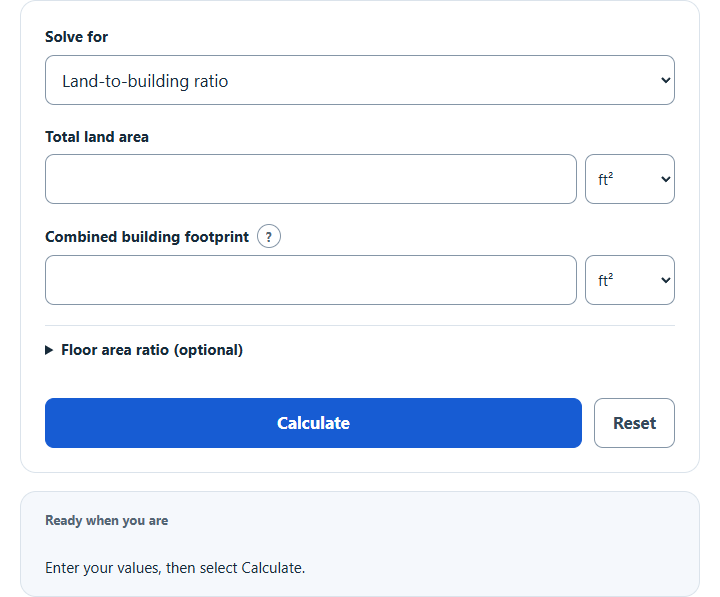
Calculate land-to-building ratio from lot area and building footprint, or the land or footprint for a target ratio, with lot coverage and optional FAR.
- All Construction Calculators
- Floor to Area Ratio Calculator
- Gross Floor Area Calculator
- Lot Coverage Calculator
- Cost Per Square Foot Calculator
- Parking Area Calculator
Land to Building Ratio Formula
The following formula is used to calculate a land to building ratio:
- Where L:B is the land to building ratio
- AL is the area of the land (ft^2)
- AB is the combined ground-level building footprint (ft²), using the same unit as AL
To calculate the land to building ratio, divide the area of the land by the area of the building.
What is land to building ratio?
Definition:
A land to building ratio is defined as the total square footage of a land parcel divided by the total area of the building footprint.
The ratio compares land area with building footprint. It does not establish whether further development is allowed; setbacks, floor-area limits, easements and other local requirements must be assessed separately. Land outside the footprint may include paving and other uses.
How to calculate a land to building ratio?
Example Problem:
The following example outlines how to calculate a land to building ratio.
First, determine the total square footage taken up by the building. In this case, the building footprint area is 5000 square feet.
Next, determine the area of the entire lot. In this example, the entire lot of land is 10,000 square feet.
Finally, calculate the land to building ratio using the formula above:
L:B = AL / AB
L:B = 10,000 / 5,000
L:B = 2:1