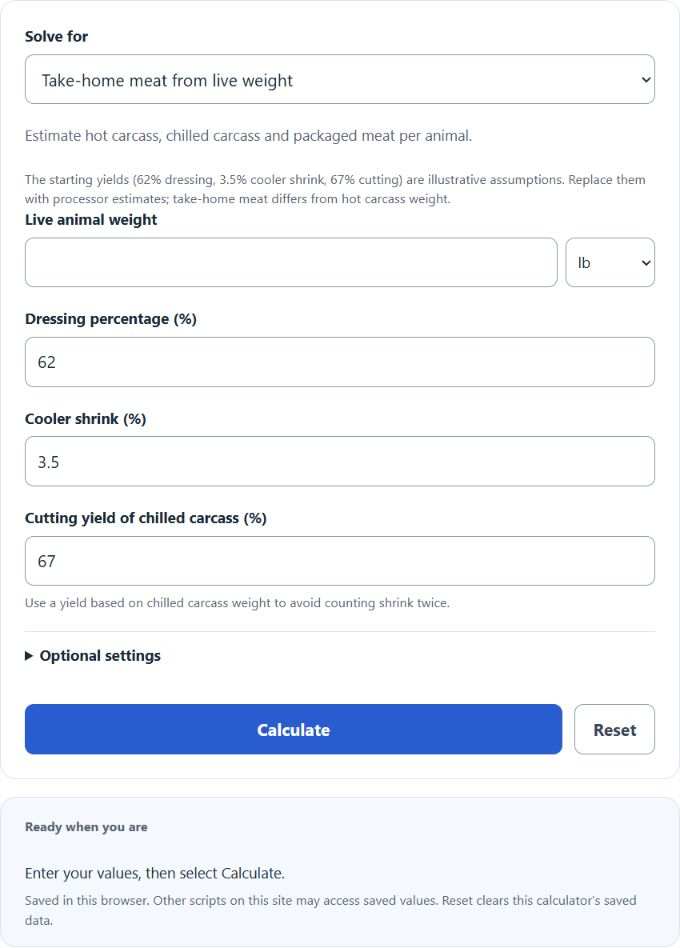
Estimate hanging weight and take-home beef from a cow’s live weight using typical yields, or work back to live weight from hanging weight.
- All Food and Cooking Calculators
- Dressing Percentage Calculator
- Meat Ratio Calculator
- Cow Gestation Calculator
Cow Live Weight Vs Meat Weight Formula
The calculator distinguishes hot carcass, chilled carcass and take-home packaged meat. Hot carcass includes bone and fat that may not reach the freezer.
Hot carcass = live weight × dressing / 100
Chilled carcass = hot carcass × (1 − cooler shrink / 100)
Take-home = chilled carcass × cutting yield / 100
Cutting yield must refer to the chilled carcass when cooler shrink is applied separately. For a take-home target, divide that target by all three yield factors to estimate required live weight. Dressing percentage from measured weights is hot carcass / live weight × 100. For a target hot carcass alone, live weight = target hot carcass / (dressing / 100).
Estimate live weight from tape measurements
Choose Tape to live weight when you have measurements for a beef animal. Measure heart girth around the chest just behind the front legs and shoulder blades. Measure body length from the point of the shoulder to the pin bone at the rump. Enter each measurement in inches or centimeters and choose pounds or kilograms for the results.
Square the heart girth in inches, multiply by the body length in inches and divide by 300 for estimated live weight in pounds. Divide each centimeter measurement by 2.54 before applying the formula. To express the result in kilograms, multiply the pound estimate by 0.45359237. The calculator then applies the dressing, shrink and cutting percentages to estimate the three processing weights.
For a heart girth of 70 in and a body length of 75 in, the estimate is 70 × 70 × 75 ÷ 300 = 1,225 lb live weight. At 62% dressing, 3.5% cooler shrink and 67% cutting yield, that gives about 759.50 lb hot carcass, 732.92 lb chilled carcass and 491.05 lb take-home meat. Use a scale for decisions that require an accurate live weight.
Choosing Yield Assumptions
Use processor estimates or measurements for comparable animals and cutting instructions. The starting 62% dressing, 3.5% shrink and 67% cutting values are illustrative assumptions, not cattle-type presets or guaranteed yields. Cutting, trimming, bone retention, animal condition and aging affect the result. The expandable sensitivity table changes only dressing percentage; its 60%, 62% and 64% rows are scenarios.
Examples
Example 1: Live weight through all three stages
For a 1,200 lb animal at 62% dressing, 3.5% cooler shrink and 67% cutting yield: hot carcass = 744 lb; chilled carcass = 717.96 lb; take-home = 481.0332 lb. Two similar animals give an estimated 962.0664 lb total.
Example 2: Reverse a take-home target
A 481.0332 lb take-home target using those same assumptions requires 481.0332 / (0.62 × 0.965 × 0.67) = 1,200 lb live weight.
FAQ
Is meat weight the same as hanging weight?
The main forward result is take-home packaged meat. Hot carcass or hanging weight is a different, larger stage shown separately.
Does the calculator always assume 70% take-home yield?
No. Enter the cutting yield of the chilled carcass. The starting 67% is only an illustrative assumption; cooler shrink is calculated separately. Avoid double counting shrink in a yield already based on hot carcass.
How do units and animal counts work?
Each weight can use pounds or kilograms. Changing its unit converts the quantity; 1 lb = 0.45359237 kg. The result uses the live-weight input unit, or the target input unit for reverse solving. Number of similar animals is optional; blank means one. The estimate assumes identical live weight and yield for that total.