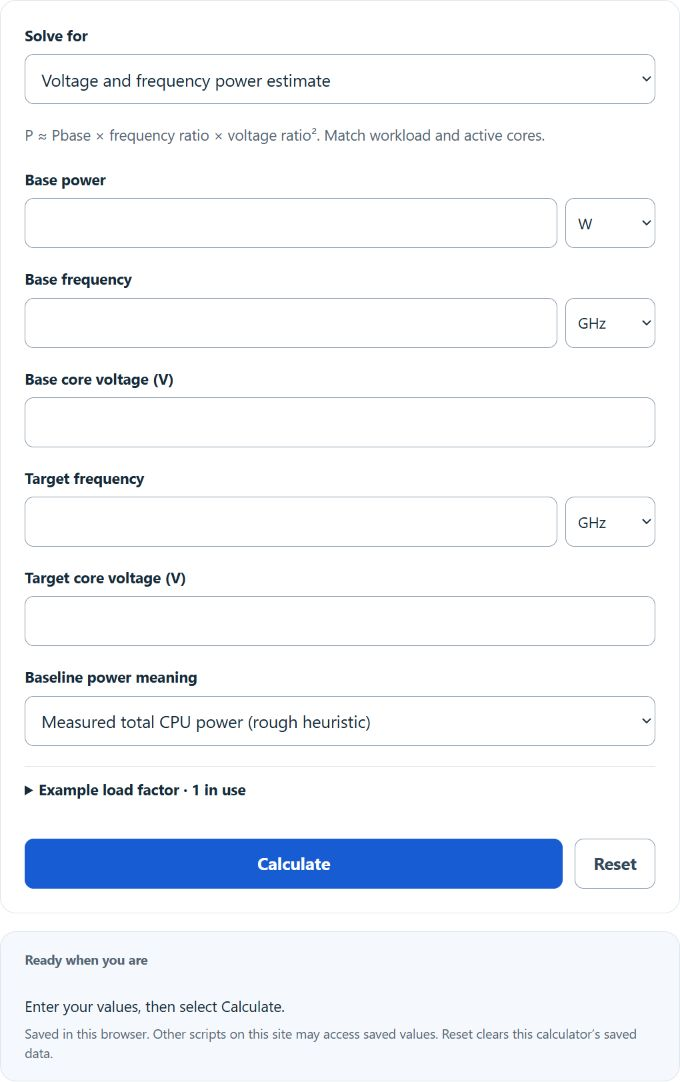
Estimate CPU power with voltage/frequency scaling or an empirical frequency model, and explore temperature, DC capacity margin and wall-energy scenarios using explicit assumptions. These models do not establish safe overclock settings.
CPU Overclock Power Formula
A common first-order estimate for CPU dynamic power is that power scales approximately linearly with clock frequency and roughly with the square of core voltage. Using that approximation, overclocked power can be estimated as:
Variables:
- Poc is estimated dynamic switching power at the target settings (W), or a rough total-power heuristic if a measured total-power baseline is used
- Pb is base dynamic switching power (W). A measured total-power baseline includes leakage and other domains, making direct scaling only a rough heuristic.
- foc is the overclocked frequency (Hz, kHz, MHz, or GHz)
- fb is the base frequency (same units as foc)
- Voc is the CPU core voltage (Vcore) under overclocked settings (V)
- Vb is the CPU core voltage (Vcore) under base settings (V)
To estimate dynamic power, multiply the base dynamic power by the frequency ratio (foc/fb) and the squared Vcore ratio (Voc/Vb)2, assuming unchanged activity, capacitance, workload and active cores. Applying this to total package power scales leakage and other domains as though they behaved identically; that is only a heuristic with no guaranteed error direction. TDP is not automatically measured power.
What is CPU Overclocking?
CPU overclocking is the process of increasing the clock speed of a computer's central processing unit (CPU) beyond the manufacturer's specified rate. This is done to improve the performance of the CPU, allowing it to execute more instructions per second and thus perform tasks more quickly. Overclocking can lead to significant performance gains, especially in tasks that are CPU-intensive, such as gaming, video editing, and 3D rendering. However, overclocking also increases the power consumption and heat output of the CPU, which can lead to stability issues and reduced lifespan if not managed properly with adequate cooling solutions.
How to Calculate CPU Overclock Power?
The following steps outline how to estimate the power consumption of an overclocked CPU.
- Determine base power (Pb) and whether it represents dynamic switching power or measured total CPU power. Use the same workload and measurement scope at both settings.
- Determine the overclocked frequency (foc).
- Determine the base frequency (fb).
- Determine the base Vcore (Vb) and overclocked Vcore (Voc) under load (if available).
- Calculate the estimated overclocked power using Poc ≈ Pb · (foc/fb) · (Voc/Vb)².
- After inserting the values and calculating the result, check your answer with the calculator above.
Example Problem :
Use the following variables as an example problem to test your knowledge.
Example baseline power (Pb) = 65 W; if this is total CPU power, the result is a rough heuristic.
Overclocked frequency (foc) = 4.5 GHz
Base frequency (fb) = 3.5 GHz
Base Vcore (Vb) = 1.15 V
Overclocked Vcore (Voc) = 1.25 V
The voltage/frequency model gives approximately 98.737510 W. The frequency-only model separately supports solving power, base power, either frequency or exponent k; no universal k is assumed.
The thermal model uses ambient temperature plus CPU power times an entered effective thermal resistance for the installed system. Cooler category alone cannot determine that value. The adjustable 88% CPU factor is an illustrative scenario, not a typical-load prediction. DC capacity margin excludes unmodeled transients and is not a complete PSU recommendation. Wall-energy cost divides modeled DC power by PSU efficiency at that load and excludes consumption outside the entered daily hours.