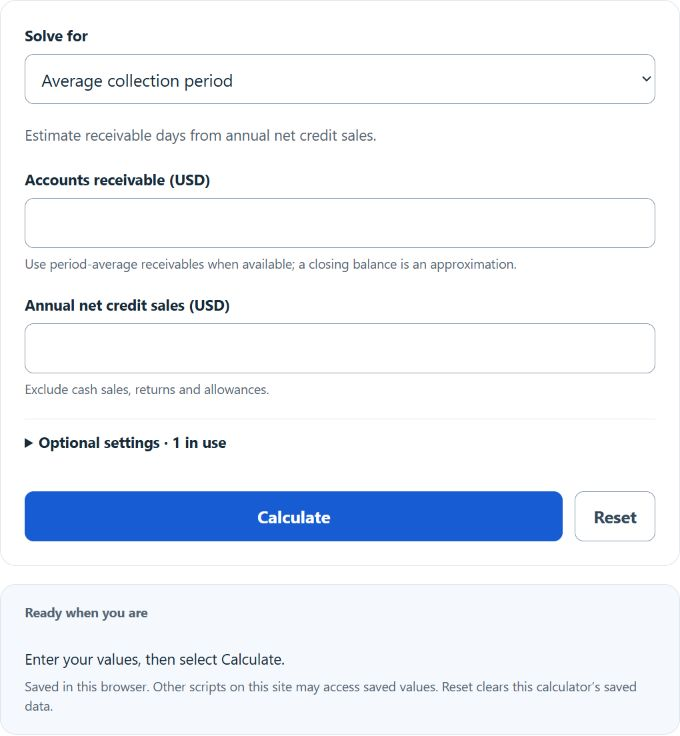
Calculate accounts receivable, net credit sales, or average collection period from any two values in this credit period calculator.
Related Calculators
- Prorated Charges Calculator
- Prorate Factor Calculator
- Net Collection Rate Calculator
- Average Sales Calculator
- All Business Calculators
Credit Period Formula
The calculator estimates average collection period from accounts receivable and annual net credit sales. Use period-average receivables when available; a closing balance gives an approximation. The default annual basis is 365 days, with 360- and 366-day alternatives in Optional settings.
- ACP = average collection period, in days
- AR = average accounts receivable, or a closing-balance approximation
- NCS = annual net credit sales
- 365 = number of days in the year
If you need to solve for unpaid invoices instead, the formula is rearranged as:
If you need to solve for annual net credit sales, the formula is rearranged as:
Select the quantity to solve for and enter the two required values. The following formulas use the default 365-day basis:
- If you enter unpaid invoices and net credit sales, it calculates the average collection period.
- If you enter net credit sales and average collection period, it calculates unpaid invoices.
- If you enter unpaid invoices and average collection period, it calculates annual net credit sales.
Average Collection Period Benchmarks
These are illustrative ranges, not universal benchmarks. Interpret receivable days against matching industry data, prior periods and your customer payment terms.
| Average Collection Period | Common Interpretation |
|---|---|
| Under 30 days | Fast collection, often aligned with short payment terms |
| 30 to 45 days | Compare with stated payment terms; this range alone does not establish late payment |
| 46 to 60 days | Slower collection and possible cash flow pressure |
| Over 60 days | May indicate overdue accounts, weak collection processes, or long customer terms |
| Input | Use This Value |
|---|---|
| Unpaid invoices / accounts receivable | Period-average receivables where available; the closing balance can be used as an approximation |
| Net credit sales | Annual sales made on credit, excluding cash sales, returns, and allowances |
| Average collection period | The average number of days it takes to collect receivables |
Example Problems
Example 1: Calculate the average collection period
You have $50,000 in unpaid invoices and $600,000 in annual net credit sales.
The average collection period is 30.42 days.
Example 2: Calculate unpaid invoices
Your annual net credit sales are $900,000, and your average collection period is 40 days.
The estimated unpaid invoices balance is $98,630.14.
FAQ
What is a credit period?
A credit period is the amount of time customers are allowed or expected to take before paying for a credit sale. In this calculator, it is measured as the average collection period, which shows how many days it takes to collect accounts receivable on average.
Is a lower average collection period better?
Usually, yes. A lower average collection period means you collect customer payments faster, which can improve cash flow. However, the right number depends on your payment terms. If your standard terms are net 60, a 55-day collection period may be reasonable.
Should net credit sales include cash sales?
No. Net credit sales should include only sales made on credit. Cash sales are not part of accounts receivable, so including them can make the average collection period look artificially low.