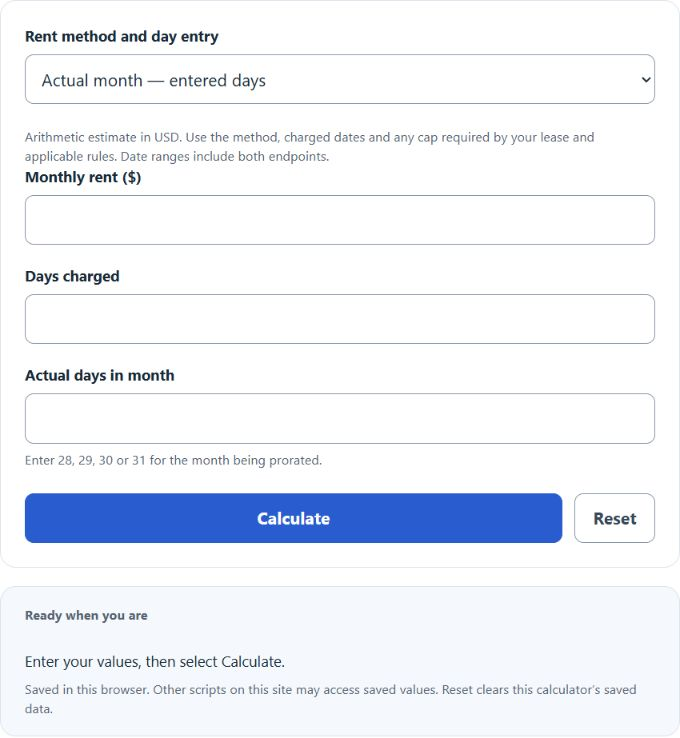
Calculate prorated rent for a partial month using the monthly rent, the number of days charged, and your choice of the actual-days, 30-day, or 365-day method.
Prorated Rent Formula
Prorated rent is the share of a full month’s rent that you owe for the days you actually occupy a unit. The amount depends on which proration method your lease or state requires. The three common methods share the same structure: find a daily rent rate, then multiply by the number of days charged.
\text{Prorated Rent} = \frac{\text{Monthly Rent}}{\text{Days in Month}} \times \text{Days Charged}
\text{Prorated Rent} = \frac{\text{Monthly Rent}}{30} \times \text{Days Charged}
\text{Prorated Rent} = \frac{\text{Monthly Rent} \times 12}{365} \times \text{Days Charged}
Where:
Monthly Rent is the full rent for a complete month.
Days in Month is the actual number of days in the calendar month being prorated (28, 29, 30, or 31). The 30-day method replaces this with a fixed 30, and the 365-day method spreads the annual rent across 365 days.
Days Charged is the number of days you occupy the unit during that partial month. For a move-in, this is the move-in day through the last day of the month. For a move-out, it is the first day of the month through the move-out day. Date entry includes both endpoints; an actual-days range crossing months is calculated separately for each month.
The three methods use different denominators and can produce different totals. Select the convention required by your lease and applicable rules. This calculator applies the stated arithmetic without deciding legal entitlement or imposing a monthly cap.
Daily Rent and Days in Each Month
The table below shows how the daily rate changes with the method for a $1,500 monthly rent, and a reference for the number of days in each month.
| Method | Daily Rate ($1,500 rent) |
|---|---|
| Actual days, 28-day month | $53.57 |
| Actual days, 30-day month | $50.00 |
| Actual days, 31-day month | $48.39 |
| 30-day (banker’s) month | $50.00 |
| 365-day year | $49.32 |
| Days in Month | Months |
|---|---|
| 31 days | Jan, Mar, May, Jul, Aug, Oct, Dec |
| 30 days | Apr, Jun, Sep, Nov |
| 28 or 29 days | Feb (29 in a leap year) |
Example Problems
Example 1. Your rent is $1,200 per month and you move in on June 10. June has 30 days, so you are charged for June 10 through June 30, which is 21 days. Using the actual-days method, the daily rate is $1,200 / 30 = $40.00. The prorated rent is $40.00 × 21 = $840.00.
Example 2. Your rent is $1,500 per month and you move out on March 8, so you are charged for March 1 through March 8, which is 8 days. Using the 30-day method, the daily rate is $1,500 / 30 = $50.00. The prorated rent is $50.00 × 8 = $400.00.
FAQ
Which proration method should you use? Use the method named in your lease. If the lease is silent, check your state or local rules, since some require the actual number of days in the month and others allow a 30-day month. Confirm the required convention rather than assuming a universal default.
Do you count both the move-in and move-out days? For a single partial month you count the move-in day through the end of the month, or the start of the month through the move-out day. You charge each occupied day once, so a full move-in plus move-out in the same period should not double-count any day.
Is prorated rent always cheaper than a full month? Not under every arithmetic convention. The actual-days method equals monthly rent for a complete calendar month, while fixed 30-day and 365-day daily rates can give different totals. A lease may specify full-month billing or a cap.