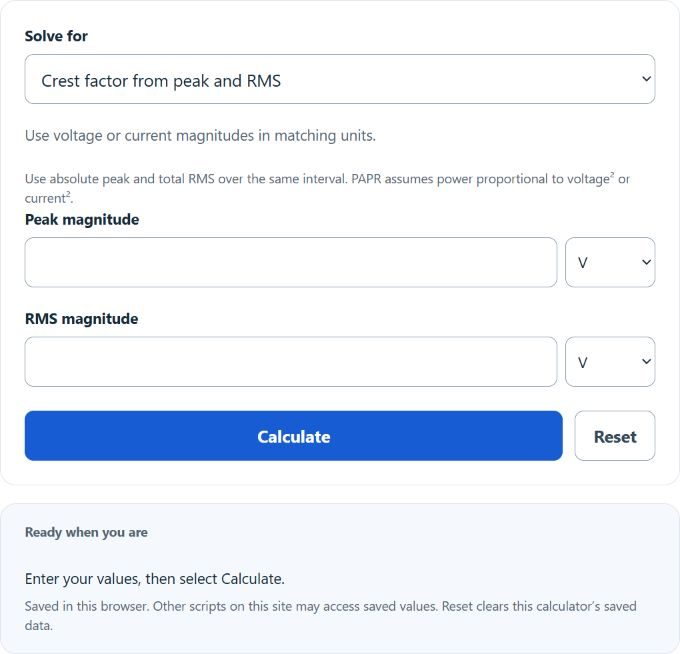
Calculate crest factor, peak, RMS, PAPR and dB values for voltage or current waveforms, including sine, square, triangle, sawtooth and pulse.
Related Calculators
- Slew Rate Calculator
- Amplifier Efficiency Calculator
- Buck Converter Calculator
- Transformer Impedance Calculator
- All Physics Calculators
Crest Factor Formula
The following formula is used to calculate the crest factor:
Variables:
- CF is the crest factor
- Vp is the absolute peak magnitude of the waveform
- Vrms is the root mean square (RMS) value of the waveform
To calculate the crest factor, divide the peak value of the waveform by its RMS value.
What is a Crest Factor?
Crest factor is the ratio of absolute peak magnitude to total RMS over the same measurement interval. It applies to voltage or current and is at least 1 for a nonzero signal. A larger value means a larger peak relative to RMS; it does not by itself measure signal quality or establish equipment safety. For a constant resistive load, PAPR = CF² and the decibel ratio is 20 log10(CF).
How to Calculate Crest Factor?
The following steps outline how to calculate the Crest Factor.
- First, determine the peak value (Vp) of the waveform.
- Next, determine the RMS value (Vrms) of the waveform.
- Use the formula CF = Vp / Vrms to calculate the Crest Factor (CF).
- After inserting the variables and calculating the result, check your answer with the calculator above.
Example Problem:
Use the following variables as an example problem to test your knowledge.
Peak value (Vp) = 5 volts
RMS value (Vrms) = 2 volts