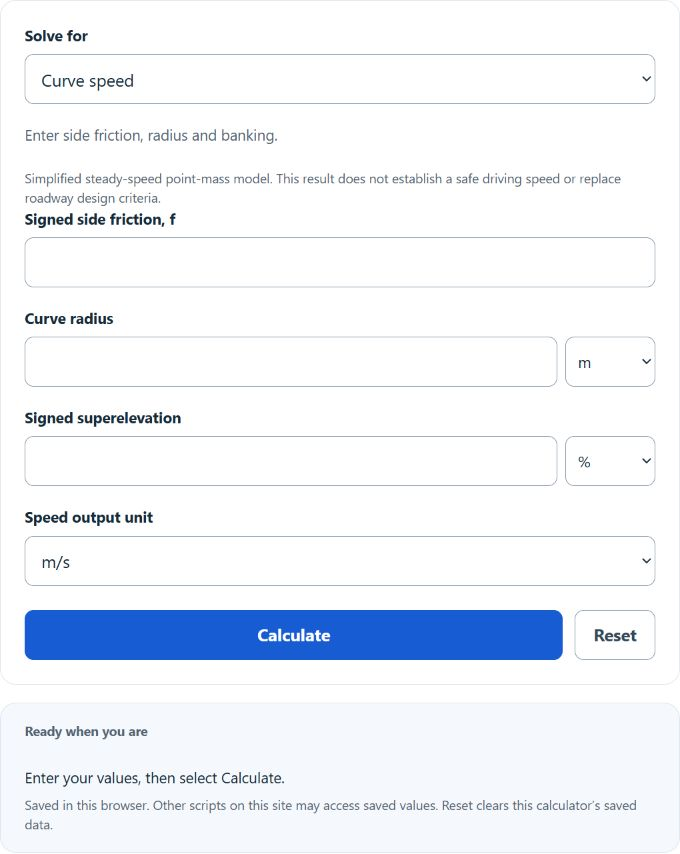
Calculate critical curve speed, friction factor, radius, or superelevation for road curves by selecting the unknown and entering three known values with selectable units. This simplified model does not establish a safe driving speed.
Related Calculators
- Turning Radius Calculator
- Lateral Acceleration Calculator
- Drift Angle Calculator
- Staggered Tire Calculator
- All Automotive Calculators
Critical Curve Speed Formula
The critical curve speed calculation is based on the balance between speed, curve radius, superelevation, and side friction. The calculator uses SI base units internally: speed in meters per second, radius in meters, and superelevation as a decimal.
- V = critical curve speed
- g = acceleration due to gravity, 9.80665 m/s²
- R = radius of curve
- e = superelevation as a decimal
- f = signed side-friction demand factor; positive is toward the curve center
If you enter superelevation as a percent, it is converted to a decimal before calculation.
If you enter superelevation in degrees, it is converted using the tangent of the angle.
- Critical curve speed: select speed, then enter friction factor, curve radius, and superelevation.
- Friction factor: select friction factor, then enter speed, radius, and superelevation.
- Radius of curve: select radius, then enter speed, friction factor, and superelevation.
- Superelevation: select superelevation, then enter speed, friction factor, and radius.
Illustrative Superelevation and Friction Values
These are illustrative numerical examples, not universal road-design limits. Actual design values depend on road type, standards, pavement condition, drainage, vehicle type, and safety requirements.
| Superelevation | Decimal e | Approx. Angle | Common Interpretation |
|---|---|---|---|
| 2% | 0.02 | 1.15° | Low banking |
| 4% | 0.04 | 2.29° | Moderate banking |
| 6% | 0.06 | 3.43° | Illustrative higher banking |
| 8% | 0.08 | 4.57° | High banking |
| Friction Factor f | Relative Side Friction | Use as a Check |
|---|---|---|
| 0.05 | Low | More conservative, lower speed support |
| 0.10 | Moderate | Illustrative side-friction demand |
| 0.15 | Higher | Requires more side friction demand |
| 0.20 | Very high | May be unsuitable for design unless justified |
Example Calculations
Example 1: Calculate critical curve speed
Suppose the radius is 120 m, the friction factor is 0.15, and the superelevation is 6%.
That is about 56.59 km/h or 35.17 mph.
Example 2: Calculate radius of curve
Suppose the speed is 25 m/s, the friction factor is 0.12, and the superelevation is 4%.
FAQ
What does critical curve speed mean?
Critical curve speed is the speed associated with a given curve radius, superelevation, and friction factor. In this calculation, it is the speed at which the combined effect of roadway banking and side friction balances the centripetal demand of the curve.
What happens if superelevation plus friction is too low?
The value of e + f must be greater than zero to calculate speed or radius. If the sum is very small, the model speed will be low or the required radius will be very large. If the sum is zero or negative, the formula cannot produce a valid positive curve speed.
Is superelevation in degrees the same as superelevation percent?
No. Superelevation percent is a slope ratio multiplied by 100. Superelevation in degrees is an angle. The calculator converts degrees using tan(angle). For small angles the values may look similar, but they are not the same unit.