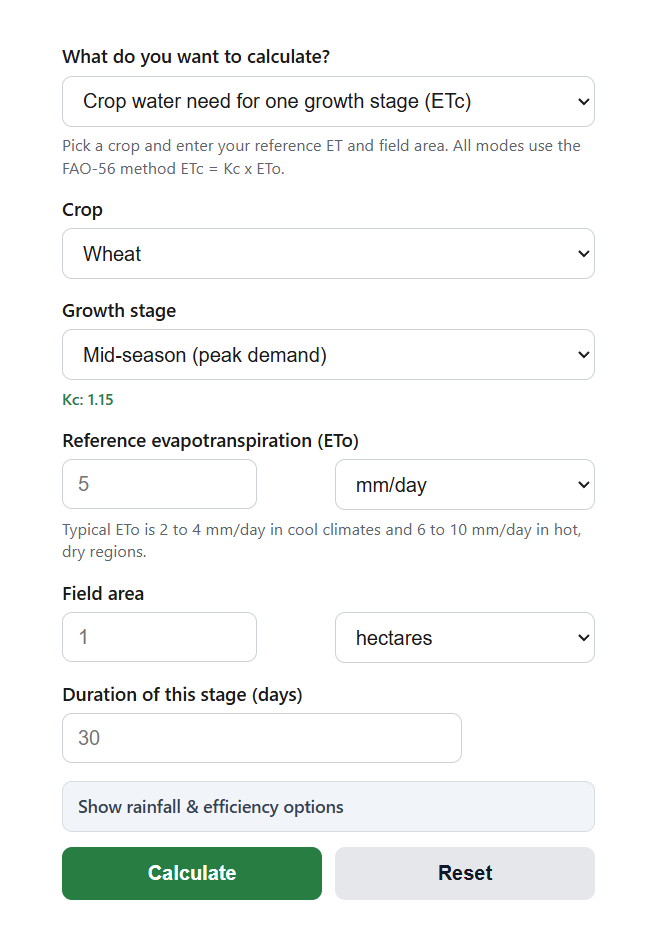
Calculate crop water requirement (ETc) from the crop coefficient and reference ET, plus net and gross irrigation needs and full-season totals.
Crop Water Requirement Formula
The crop water requirement is the depth of water a crop consumes through transpiration and soil evaporation under healthy, unstressed conditions. It follows the FAO-56 single crop coefficient method:
ETc = Kc * ETo
To turn that demand into water you actually apply, account for rainfall and system losses:
NIR = ETc - Pe
GIR = NIR / Ea
For a whole season, sum each growth stage:
ETc(season) = SUM( Kc(stage) * ETo * days(stage) )
- ETc = crop evapotranspiration, the crop water requirement (mm/day)
- Kc = crop coefficient, a dimensionless factor set by crop type and growth stage
- ETo = reference evapotranspiration for clipped grass (mm/day)
- Pe = effective rainfall reaching the root zone (mm/day)
- NIR = net irrigation requirement, the water the crop still needs after rain (mm/day)
- Ea = irrigation application efficiency (decimal fraction)
- GIR = gross irrigation requirement, the depth your system must deliver (mm/day)
The calculator multiplies the crop coefficient by your reference ET to get the daily water need. In irrigation mode it subtracts effective rainfall and divides by the efficiency of your system to give the gross depth to apply, then converts every depth to a field volume using volume (m3) = depth (mm) x area (m2) / 1000. The full-season mode applies the initial, development, mid-season, and late-season coefficients to the days you enter for each stage and adds them into one seasonal total.
Crop Coefficients and Seasonal Water Use
Kc changes across the crop cycle: it is low when the soil is mostly bare, peaks when the canopy fully covers the ground at mid-season, and falls again as the crop ripens. The mid-season value drives peak demand and should size your pump and pipes.
| Crop | Kc initial | Kc mid | Kc end |
| Wheat | 0.30 | 1.15 | 0.30 |
| Maize / corn | 0.30 | 1.20 | 0.35 |
| Rice (paddy) | 1.05 | 1.20 | 0.75 |
| Potato | 0.50 | 1.15 | 0.75 |
| Tomato | 0.60 | 1.15 | 0.70 |
| Citrus | 0.65 | 0.70 | 0.65 |
Because efficiency losses vary widely by delivery method, the same crop water need turns into very different applied depths. The table below shows typical application efficiencies and the full-season depth a crop needs, both of which competitors rarely put in front of you together.
| Irrigation method | Typical efficiency | Extra water vs. ETc |
| Drip / micro | 85 to 95% | about 5 to 18% more |
| Sprinkler | 70 to 80% | about 25 to 43% more |
| Surface / furrow | 55 to 65% | about 54 to 82% more |
| Crop | Typical season length | Full-season water need |
| Wheat | 150 to 180 days | 450 to 650 mm |
| Maize | 125 to 180 days | 500 to 800 mm |
| Rice | 150 to 180 days | 900 to 1,350 mm |
| Sugarcane | 300 to 365 days | 1,500 to 2,500 mm |
Example Calculations
Example 1: daily crop water need. You grow wheat at mid-season (Kc = 1.15) in a climate with an ETo of 5 mm/day. The crop water requirement is ETc = 1.15 x 5 = 5.75 mm/day. Over one hectare (10,000 m2) that is 5.75 x 10,000 / 1000 = 57.5 m3/day, or 57,500 litres per day.
Example 2: gross irrigation. Same wheat field, but 1 mm/day arrives as effective rainfall and you use drip at 90% efficiency. Net irrigation requirement = 5.75 - 1 = 4.75 mm/day. Gross applied depth = 4.75 / 0.90 = 5.28 mm/day, which is 52.8 m3/day per hectare that your system has to deliver.
Frequently Asked Questions
Where do I find my ETo value? Reference evapotranspiration comes from a local weather station, an agricultural extension service, or the FAO CLIMWAT database. As a rough guide, cool humid regions run 2 to 4 mm/day and hot dry regions run 6 to 10 mm/day. Enter it in mm/day, mm/week, or inches/day and the calculator converts for you.
Is the crop water requirement the same as how much I should irrigate? No. ETc is the total demand of the crop. You subtract effective rainfall to get the net irrigation requirement, then divide by your system efficiency to get the gross depth to apply. The irrigation mode does both steps, so the figure it returns is the water your pump and lines actually move.
Why does the value change with growth stage? The crop coefficient tracks canopy size and leaf area. It is small at planting when soil is bare, climbs through the development stage, peaks at mid-season under full cover, and drops in the late season as the crop matures. Using the mid-season coefficient for the whole season overestimates water use, so match the stage to your planning window or use the full-season mode.