Calculate the cross product of two 3D vectors from their X, Y, and Z components and find the resulting vector’s magnitude, with step-by-step results.
Cross Product Formula
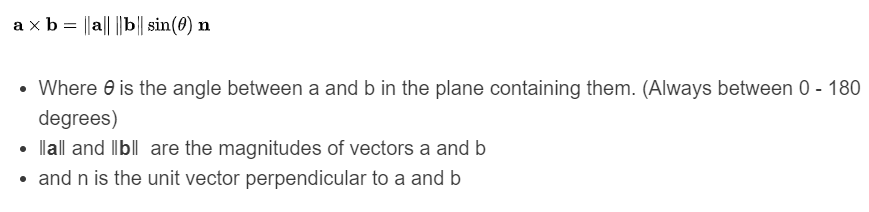
The cross product takes two 3D vectors and returns a new 3D vector that is perpendicular to both input vectors.
- A = first vector, written as (Ax, Ay, Az)
- B = second vector, written as (Bx, By, Bz)
- x = x-component of the cross product, equal to AyBz – AzBy
- y = y-component of the cross product, equal to AzBx – AxBz
- z = z-component of the cross product, equal to AxBy – AyBx
- |A × B| = magnitude, or length, of the resulting cross product vector
The calculator finds each component of A × B separately. It first calculates the x-component, then the y-component, then the z-component. After that, it uses those three values to calculate the magnitude of the resulting vector.
Cross Product Result Patterns
Use this table to interpret common cross product results.
| Result | Meaning |
|---|---|
| A × B = (0, 0, 0) | The vectors are parallel, anti-parallel, or one vector is the zero vector. |
| A × B has nonzero components | The result is a vector perpendicular to both A and B. |
| |A × B| = area of a parallelogram | The magnitude gives the area formed by vectors A and B as adjacent sides. |
| B × A = -(A × B) | Changing the order reverses the direction of the result. |
Unit Vector Cross Products
These common cross products are useful for checking direction by the right-hand rule.
| Cross Product | Result |
|---|---|
| i × j | k |
| j × k | i |
| k × i | j |
| j × i | -k |
| k × j | -i |
| i × k | -j |
Example
Example 1: Cross product of two 3D vectors
Find the cross product of A = (2, 3, 4) and B = (5, 6, 7).
So, A × B = (-3, 6, -3).
Example 2: Cross product with unit vectors
Find the cross product of A = (1, 0, 0) and B = (0, 1, 0).
So, A × B = (0, 0, 1). This matches i × j = k.
FAQ
What does the cross product represent?
The cross product represents a vector that is perpendicular to both input vectors. Its magnitude equals the area of the parallelogram formed by the two vectors. In physics and engineering, this is often used for torque, angular momentum, and surface normal vectors.
Does the order of the vectors matter?
Yes. The cross product is not commutative. In general, A × B is not the same as B × A. Instead, B × A = -(A × B), meaning the vector has the same magnitude but points in the opposite direction.
Why is the cross product only for 3D vectors here?
This calculator uses the standard 3D cross product formula. The result has x, y, and z components, so both input vectors must also have x, y, and z components. For 2D vectors, you can often treat the z-components as 0, which gives a result pointing in the positive or negative z-direction.