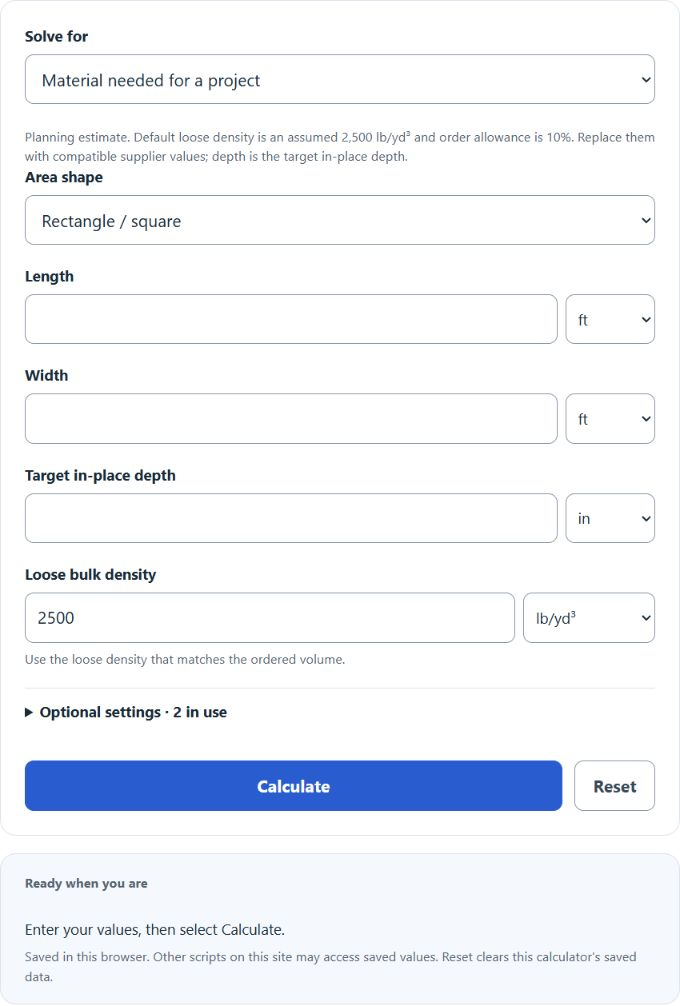
Calculate crusher run tons, cubic yards, truckloads, and cost from length, width, and depth, or solve for the depth or area a set amount of material covers.
Related Calculators
- Paver Calculator – How Many Pavers Do I Need?
- Crushed Shell Calculator
- Sand Filling Quantity + Coverage Calculator
- Playground Mulch Calculator
- Bulk Density Calculator
- All Construction Calculators
Crusher Run Formula
The calculator separates target in-place volume, loose order volume and loose bulk density. Its editable density starts at an illustrative 1.25 short tons per cubic yard (2,500 lb/yd³), with a 10% assumed order-volume allowance. These are not universal material properties. Confirm compatible values with your supplier.
- CR = crusher run needed, in short tons
- L = length, in feet
- W = width, in feet
- D = depth, in inches
- rho = loose bulk density; default assumption 1.25 short tons per cubic yard
- 27 = cubic feet in 1 cubic yard
- 12 = inches in 1 foot
Choose Material needed and an area shape, then enter its dimensions and target in-place depth. The order allowance is applied once.
For length coverage, choose Area from material available and enter an optional strip width. The following rearrangement assumes zero order allowance; otherwise divide available loose volume by (1 + allowance/100) first.
The same geometric relationship can give width from the calculated coverage area divided by a known length. Inverse calculations first remove the chosen order allowance.
Choose Depth from material available to calculate achievable in-place depth. The zero-allowance formula above requires the available loose volume to be divided by (1 + allowance/100) when allowance is nonzero.
For metric tons, the calculator converts between short tons and metric tons using:
Common Crusher Run Depths
These depth ranges are illustrative scenarios, not engineered specifications. Required thickness depends on loads, subgrade, drainage, material and compaction; get a project-specific design.
| Use | Typical Depth | Notes |
|---|---|---|
| Walkway base | 2 to 3 in | Illustrative only; confirm required depth and subgrade preparation. |
| Patio or paver base | 3 to 4 in | Depth may increase for weak soils or poor drainage. |
| Residential driveway top/base layer | 4 to 6 in | Often compacted in lifts for a stronger surface. |
| Heavy-use driveway or road base | 6 to 8 in or more | May require engineering guidance for heavy loads. |
Crusher Run Estimating Values
| Value | Calculator Uses | Meaning |
|---|---|---|
| 1.25 short tons/cubic yard | Yes | Editable illustrative loose-density assumption; confirm with supplier. |
| 27 cubic feet | Yes | Volume in 1 cubic yard. |
| 1 metric ton | 1.102311310924 short tons | Used when metric tons are selected. |
| 1 short ton | 0.90718474 metric tons | Used to convert the calculated result to metric tons. |
Example Problems
Example 1: Find crusher run needed
For this example, assume a 40 ft by 10 ft area, 4 in target depth, 1.25 short tons/yd³ loose density and zero order allowance (change the default 10% to 0%).
The estimated amount is 6.17 short tons. You may round up when ordering to allow for grading, spreading loss, and compaction.
Example 2: Find length covered
For this zero-allowance example, assume 5 short tons, 1.25 short tons/yd³ loose density, 8 ft strip width and 3 in target depth. Choose Area from material available and set allowance to 0%.
At that width and depth, 5 short tons covers about 54 ft of length.
FAQs
How accurate is a crusher run estimate?
The estimate is only as accurate as the density used. This calculator starts with an illustrative 1.25 short tons per loose cubic yard; it is not a verified density for every crusher-run product. Actual crusher run density can change based on stone size, moisture, quarry source, and compaction. If your supplier gives a specific tons-per-yard value, use that for the most accurate order estimate.
Should you order extra crusher run?
A 5% or 10% extra-volume allowance is only a planning scenario, not a universal compaction factor. Use a supplier or designer value consistent with the loose density and target in-place volume. Extra material can account for uneven ground, low spots, spreading loss, and compaction. Larger projects, rough subgrades, and deeper bases may need a larger allowance.
What is the difference between short tons and metric tons?
A short ton is commonly used in the United States and equals 2,000 lb. A metric ton equals 1,000 kg, or about 2,204.62 lb. The calculator converts between them, so the selected output unit only changes how the same estimated material weight is displayed.