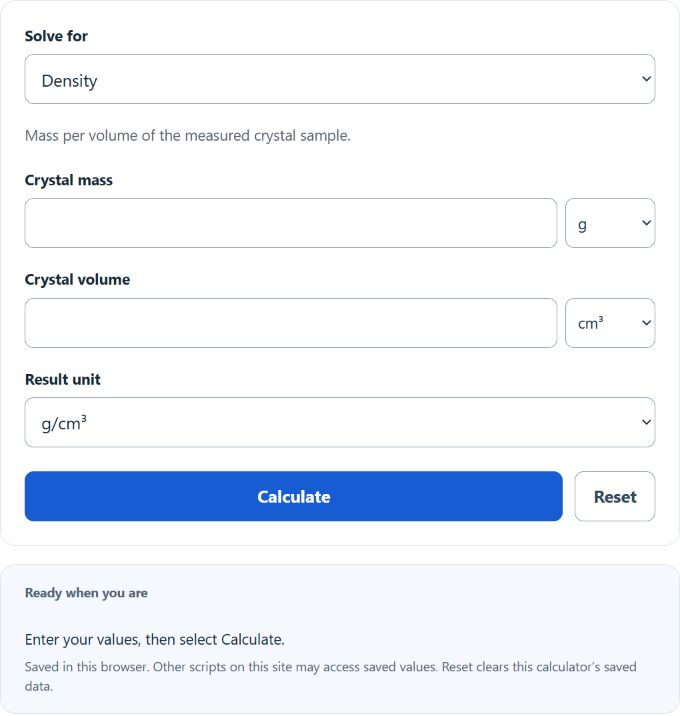
Choose density, mass, or volume, enter the two required measurements, and select the result unit. Supports g, kg, lb, cm³, m³, L, and in³.
Related Calculators
- Specific Gravity Calculator
- Density Calculator
- Heat of Crystallization Calculator
- Tolerance Factor Calculator
- Hydrometer Correction Calculator
- All Chemistry Calculators
Crystal Density Formula
The calculator uses the standard density relationship between mass, volume, and density. Choose the value to solve, then enter the two required measurements to use the matching rearranged formula.
- ρ = density of the crystal
- m = mass of the crystal
- V = volume of the crystal
The calculator first converts the entered mass to grams, volume to cubic centimeters, and density to grams per cubic centimeter. It then applies the correct formula and converts the result back into the unit you selected.
- Density calculation: uses mass divided by volume.
- Mass calculation: uses density multiplied by volume.
- Volume calculation: uses mass divided by density.
Common Crystal Density Values
Use these values as rough references when checking a density result. Natural samples can vary because of impurities, inclusions, and measurement error.
| Material | Typical Density | Notes |
|---|---|---|
| Quartz | 2.65 g/cm³ | Common reference mineral |
| Calcite | 2.71 g/cm³ | Often close to quartz in density |
| Fluorite | 3.18 g/cm³ | Denser than many common silicate minerals |
| Diamond | 3.51 g/cm³ | High density for a carbon crystal |
| Hematite | 5.26 g/cm³ | Iron-rich mineral with high density |
Density Unit Conversions
| Density Unit | Equivalent |
|---|---|
| 1 g/cm³ | 1000 kg/m³ |
| 1 g/cm³ | approximately 62.42796 lb/ft³ |
| 1 kg/m³ | 0.001 g/cm³ |
| 1 lb/ft³ | approximately 0.01601846337 g/cm³ |
Examples
Example 1: Calculate crystal density
A crystal has a mass of 26.5 g and a volume of 10 cm³.
The crystal density is 2.65 g/cm³.
Example 2: Calculate crystal mass
A crystal has a density of 3.18 g/cm³ and a volume of 12 cm³.
The crystal mass is 38.16 g.
FAQ
How do you find the density of a crystal?
To find crystal density, divide the crystal’s mass by its volume. For example, if a crystal has a mass of 50 g and a volume of 20 cm³, its density is 50 ÷ 20 = 2.5 g/cm³.
Why does each calculation need two measurements?
Density, mass, and volume are connected by one equation. Choose the value you want to calculate, then enter the other two positive measurements. The answer appears separately from the inputs.
What units should you use for crystal density?
Grams per cubic centimeter, written as g/cm³, is commonly used for crystals, minerals, and small solid samples. Kilograms per cubic meter and pounds per cubic foot are also valid, but g/cm³ is usually the easiest unit for lab-scale crystal measurements.