Calculate XRD d-spacing from 2θ, reverse a peak angle, or solve cubic hkl spacing with wavelength units, uncertainty, and peak-position sensitivity.
- All Physics Calculators
- Lattice Strain Calculator
- Planar Density Calculator
- Scherrer Formula Calculator
- Crystal Density Calculator
- Theoretical Density Calculator
- Dislocation Density Calculator
Lattice Spacing Formula
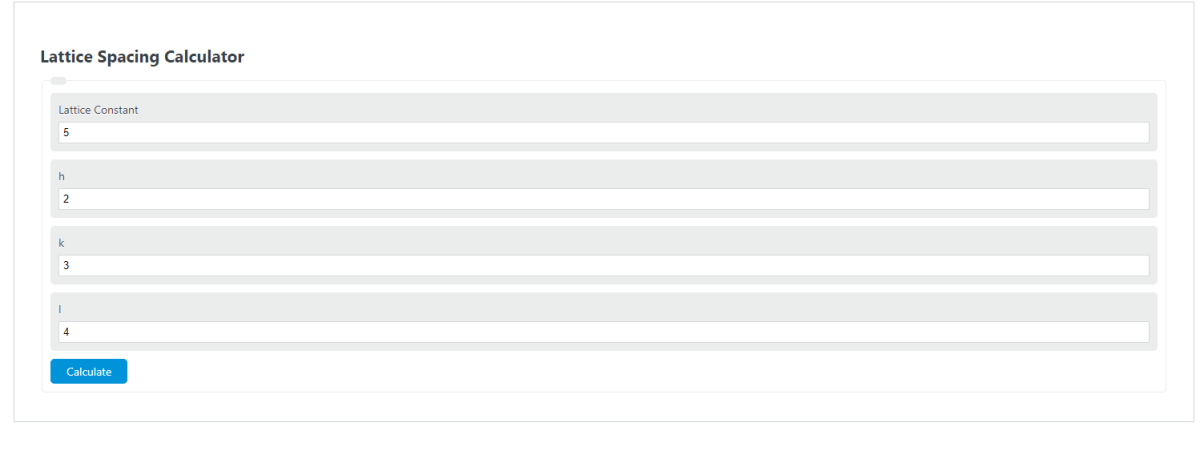
The following equation is used to calculate the lattice spacing for a cubic crystal.
- Where dhkl is the lattice (interplanar) spacing for planes with Miller indices (hkl)
- a is the (cubic) lattice constant
- h, k, and l are the Miller indices
What is a Lattice Spacing?
Definition:
The crystal’s interplanar spacing, or lattice spacing (often called d-spacing), is the perpendicular distance between adjacent, parallel planes of atoms in a crystal. A family of parallel crystallographic planes is labeled by its Miller indices (hkl), which are derived from the plane’s intercepts with the crystallographic axes in the unit cell.
The spacing dhkl is a scalar distance. In reciprocal space, the planes are associated with a reciprocal lattice vector normal to the planes; using the common 2π convention, the magnitude satisfies |ghkl| = 2π/dhkl.
For a given crystal system, different (hkl) planes have different interplanar spacings. Smaller dhkl values mean the planes are closer together (often for higher-index planes), but atomic packing density depends on the full crystal structure and basis, not on a single plane spacing.
Interplanar spacings are commonly measured using X-ray, electron, or neutron diffraction. Diffraction peak positions are related to d through Bragg’s law, and collections of d-spacings are widely used to identify phases and determine lattice parameters.
Terms such as “close-packed” describe specific structures/stackings (for example, FCC or HCP) and are not determined solely by d-spacing. Likewise, whether a solid is metallic, ionic, or covalent depends primarily on bonding and electronic structure rather than interplanar spacing alone.