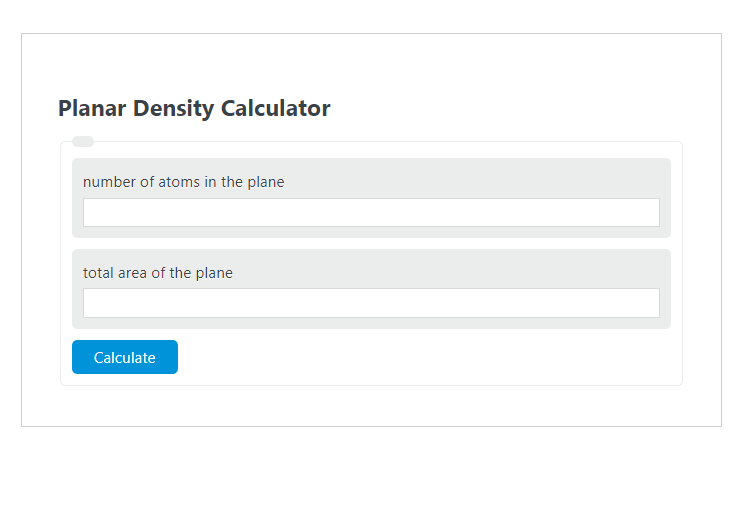
Calculate planar density, area, or number of atoms in a plane by entering any 2 values and choosing sq m, sq ft, or sq yd units.
- All Chemistry Calculators
- Lattice Spacing Calculator
- Linear Density Calculator
- Theoretical Density Calculator
- Crystal Density Calculator
- Dislocation Density Calculator
- Lattice Strain Calculator
Planar Density Formula
Planar density describes how many atoms are associated with a selected plane per unit area of that plane. It is a simple but important quantity in crystallography, materials science, and surface analysis because it tells you how tightly packed a plane is.
Where:
| Term | Meaning | Typical Units |
|---|---|---|
| Planar Density (PD) | The number of atoms per unit area on the chosen plane | atoms/m2, atoms/ft2, atoms/yd2 |
| Number of Atoms (N) | The total effective count of atoms lying in the plane being studied | atoms |
| Plane Area (A) | The total area of the 2D plane section | m2, ft2, yd2 |
If you need to solve for a different variable, rearrange the equation as follows:
How to Calculate Planar Density
- Identify the plane you want to analyze.
- Count the atoms that lie on that plane.
- Determine the total area of the same plane.
- Divide the atom count by the area.
- Express the result in atoms per unit area.
This calculator is especially helpful because it can solve for the missing value when any two of the three variables are known.
How to Use the Calculator Correctly
- Use consistent units. If the area is entered in square meters, the result will be in atoms per square meter.
- Count atoms carefully. In crystal-plane problems, atoms on corners or edges may contribute only a fraction depending on the counting convention being used.
- Match the counted atoms to the exact plane area. The atom count and area must refer to the same geometric region.
- Check scale. A very small area with the same atom count produces a much larger planar density.
Interpreting the Result
A higher planar density means atoms are more closely packed on the plane. A lower planar density means the plane is more open. This makes planar density useful for comparing different lattice planes, estimating relative packing, and understanding surface structure.
- If the number of atoms doubles while area stays the same, planar density doubles.
- If the area doubles while the number of atoms stays the same, planar density is cut in half.
- If both atoms and area change by the same factor, planar density stays unchanged.
Example
If a plane contains 1000 atoms and has an area of 2.5 m2, the planar density is:
The result is 400 atoms/m2.
Common Mistakes
- Using the wrong plane area for the atom count being considered.
- Mixing square feet, square yards, and square meters without converting properly.
- Counting all nearby atoms instead of only the atoms that belong to the selected plane.
- Confusing planar density with linear density or volumetric density.
Planar Density vs. Other Density Measures
Planar density is a 2D measure, so it tells you how many atoms occupy a plane per unit area. This differs from:
- Linear density, which measures atoms per unit length along a direction.
- Volume density, which measures atoms or mass per unit volume.
Because planar density is area-based, it is best used when the geometry of a specific surface or lattice plane matters more than the full 3D structure.
Why Planar Density Matters
Planar density is often used when comparing crystal planes, evaluating surface packing, and analyzing how atomic arrangement changes from one plane to another. In practical terms, it helps describe how crowded or sparse a plane is, which can be useful when studying materials, coatings, microstructure, and surface-related behavior.