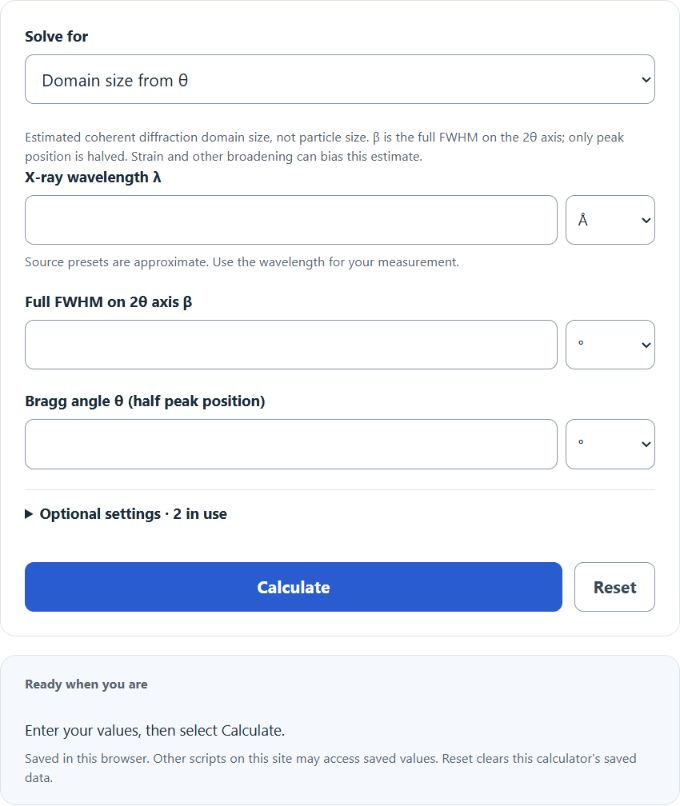
Calculate crystallite size with the Scherrer equation from X-ray wavelength, peak width, Bragg angle, 2θ, and instrumental broadening.
Scherrer Formula
The Scherrer formula is used to estimate the size of crystallites in a material from the broadening of a peak in a diffraction pattern. The formula is given by:
Variables:
- D is the estimated coherent diffraction domain size (ångströms when λ is in ångströms)
- K is the shape factor (0.9 is a common approximation; it depends on reflection, shape and breadth convention)
- λ is the X-ray wavelength (ångströms)
- β is the full size-related FWHM measured on the 2θ diffraction axis, converted to radians without halving the width
- θ is the Bragg angle, half the peak position 2θ; convert it to radians when evaluating cosine numerically
To estimate the coherent domain size, multiply K by the wavelength and divide by the size-related full FWHM in radians and cos θ. D and λ must use the same length unit. For instrument correction, Gaussian widths subtract in quadrature and Lorentzian widths subtract linearly; these pure-profile assumptions do not provide general Voigt deconvolution.
What is the Scherrer Formula?
The Scherrer formula estimates coherent diffraction domain size by attributing the corrected peak broadening to finite domain size. Strain and other sources of broadening can bias the estimate; this single-peak formula does not separate them. A coherent domain is not necessarily the same size as a particle.
How to Calculate Crystal Size using the Scherrer Formula?
The following steps outline how to calculate the crystal size using the Scherrer Formula.
- First, determine the X-ray wavelength (λ) in ångströms.
- Next, determine the size-related full FWHM (β) along the 2θ axis and convert the full width to radians. Do not halve β.
- Next, determine the Bragg angle θ as half the peak position 2θ. Use the chosen angle unit consistently in the calculator.
- Use the Scherrer formula: D = (K * λ) / (β * cos(θ)), where K is approximately 0.9.
- Finally, calculate the crystal size (D) in ångströms.
- After inserting the variables and calculating the result, check your answer with the calculator above.
Example Problem :
Use the following variables as an example problem to test your knowledge.
X-ray wavelength (λ) = 1.5406 ångströms
Full width at half maximum (β) = 0.000290888 radians
Bragg angle (θ) = 22.5 degrees. With K = 0.9, this example gives D ≈ 5,159.3056 Å (515.9306 nm), an estimate under the stated size-broadening assumption.