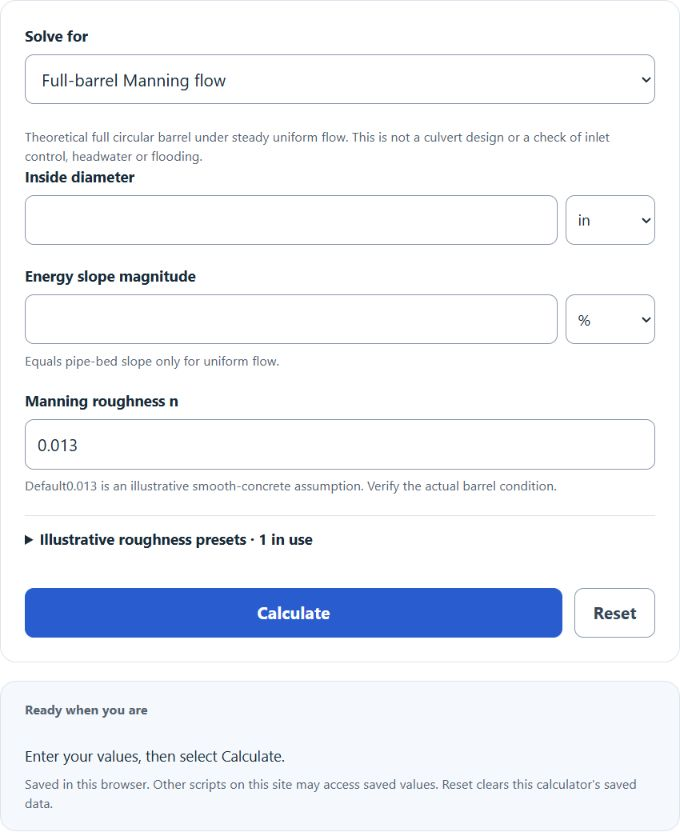
Calculate full-flow circular culvert capacity from diameter, slope, and Manning roughness, or estimate the pipe diameter required for a target flow.
- All Construction Calculators
- Drainage Density Calculator
- Hose Capacity Calculator
- Culvert Flow Calculator
- Manning’s Flow Calculator
- Pipe Flow Calculator
- Water Flow Rate Calculator
Culvert Capacity Formula
The calculator has two modes: a theoretical full circular barrel flow from diameter, energy slope and Manning roughness, or the theoretical diameter for a supplied target flow. Both assume steady uniform flow. It does not calculate watershed runoff or perform inlet/outlet-control design.
- Q = culvert flow capacity, in cubic meters per second before conversion to cfs, L/s, and gpm
- n = the entered Manning roughness coefficient for the actual barrel condition
- A = full pipe cross-sectional area
- R = hydraulic radius for a full circular pipe
- S = energy slope as a decimal, such as 0.01 for 1%; it equals pipe-bed slope only for uniform flow
- D = inside pipe diameter in meters
In full-barrel mode, enter inside diameter, energy slope and Manning n. The initial n of 0.013 is a disclosed illustrative assumption. Optional presets fill an editable n. The calculator uses SI internally and reports ft³/s (cfs), m³/s, L/s and US gpm. This is reference conveyance, not maximum actual culvert capacity.
Supply a target flow from an appropriate hydrologic analysis. Diameter mode inverts the same full-barrel equation using your slope and n; there are no hidden rainfall, drainage-area or slope defaults. The next entry in an illustrative size list is shown only for comparison; confirm actual inside diameter and availability.
Illustrative Manning Roughness Values
These optional preset values are illustrative starting assumptions from the earlier calculator, not universal material specifications. Roughness depends on profile, condition and installation; verify the n used for the actual barrel. The value remains editable and is shown in results.
| Pipe material | Manning n | Effect on capacity |
|---|---|---|
| HDPE smooth / PVC | 0.012 | Higher flow for the same diameter and slope |
| Concrete, smooth | 0.013 | Common design value for smooth culverts |
| Corrugated HDPE | 0.022 | Lower capacity due to rougher wall |
| Corrugated metal pipe | 0.024 | Lowest listed capacity for the same size and slope |
Example Culvert Capacity Calculations
Example 1: Capacity of an 18-inch concrete culvert
Suppose you have an 18-inch smooth concrete culvert at a 1% slope.
- Diameter: 18 in = 0.457 m
- Slope: 1% = 0.01
- Manning n: 0.013
The flow capacity is about 0.297 m³/s, or about 10.5 cfs.
Example 2: Theoretical diameter for a supplied target flow
For a target flow of 0.150 m³/s, n = 0.013 and an energy slope of 0.01, the inverse full-barrel equation gives an inside diameter of approximately 13.92 inches. The next entry in the example inch list is 15 inches. This is not a recommended design size: inlet/outlet control, headwater, tailwater and other project constraints still require analysis.
Culvert Capacity Calculator FAQ
Does a larger culvert always carry more water?
In this full-barrel Manning model, a larger diameter has more reference conveyance if energy slope and roughness stay the same. Actual culvert flow may be controlled by the inlet or downstream conditions. Diameter has a strong effect because the full-pipe Manning formula uses D raised to the 8/3 power. A small increase in diameter can produce a larger increase in flow capacity.
Why does pipe material change the result?
Pipe material changes the Manning roughness coefficient. A smooth pipe has a lower n value, so it offers less resistance to flow. Corrugated pipe has a higher n value, so the same diameter and slope will carry less water than a smooth pipe.
Is the listed diameter a final design size?
No. The result is a full-barrel uniform-flow estimate with a supplied target flow, not a completed culvert design or a runoff analysis. Actual culvert design may also need to account for inlet control, outlet control, headwater depth, tailwater, debris, erosion, road overtopping, local drainage rules, and the capacity of the upstream and downstream ditch or channel.