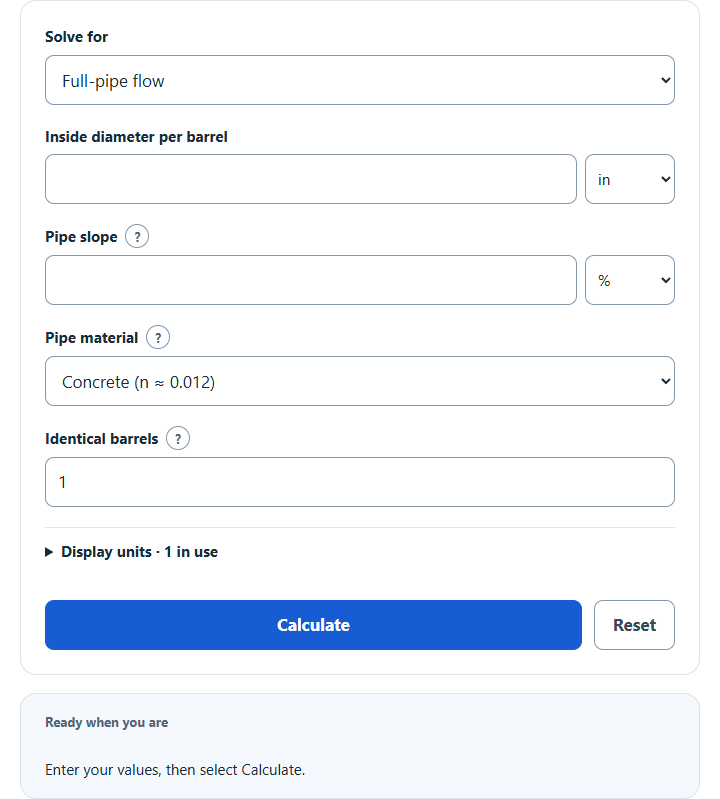
Estimate culvert or pipe flow with Manning’s equation: enter diameter, slope and pipe material for full-barrel flow, or solve for the size or slope needed.
Related Calculators
- Culvert Capacity Calculator
- Water Flow Rate Calculator
- Pipe Flow Calculator
- River Discharge Calculator
- Stream Velocity Calculator
- Benchmark Elevation Calculator
- All Construction Calculators
Culvert Flow Rate Formula
The continuity relation below applies to one barrel. This calculator estimates its velocity with Manning’s equation: V = R(2/3) × √(S) / n, with A = pi × D²/4 and R = D/4 for a full circular section. S is energy slope; bed slope is equivalent only under uniform flow. Total flow equals the per-barrel flow multiplied by the number of identical, equally supplied barrels.
Variables:
- Q is the flow rate through the culvert (cubic feet per second, cfs)
- A is the cross-sectional area of the culvert (square feet, sq ft)
- V is the flow velocity (feet per second, ft/s)
Multiply each barrel’s full cross-sectional area by its mean velocity, then multiply by the number of identical barrels for the assumed total. The calculator also inverts Manning’s equation for diameter per barrel or energy slope from a supplied target total flow. Its initial one-barrel and n = 0.012 values are disclosed assumptions; roughness presets remain editable examples.
What is a Culvert Flow Rate?
Culvert flow rate is the volume of water that passes through a culvert per unit of time. It is an important measure in hydrology and civil engineering for designing drainage systems and for flood control. The flow rate depends on the size and shape of the culvert, the hydraulic gradient, and the roughness of the culvert’s interior surface.
How to Calculate Culvert Flow Rate?
The following steps outline how to calculate the Culvert Flow Rate.
- Select Total full-barrel flow and enter the inside diameter and its unit.
- Enter energy slope and its unit; for uniform flow it equals the barrel-bed slope.
- Enter the number of identical barrels and choose the pipe material, or Custom Manning n to enter your own value.
- Select Calculate to estimate total and per-barrel flow, mean velocity and section geometry.
- Treat the result as theoretical barrel conveyance. Actual design must also check inlet/outlet control, headwater, tailwater, entrance/exit losses, debris, erosion and overtopping.
Example Problem :
For a calculator example, use one full circular barrel with these inputs:
inside diameter = 36 inches; energy slope = 1% (0.01 m/m)
Manning n = 0.012; identical barrels = 1. The model returns approximately 72.252631 ft³/s. This example is not a design recommendation.