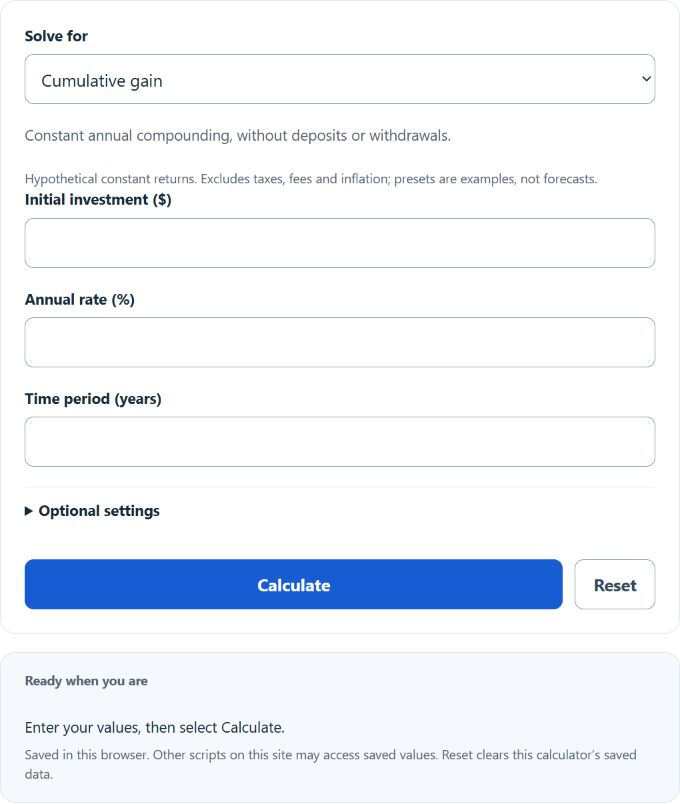
Calculate cumulative gain, an unknown initial investment, annual rate or time, CAGR, and final value with recurring contributions. Choose the calculation above; results appear separately from your inputs.
Cumulative Gain Formula
The following formula is used to calculate the cumulative gain:
Variables:
- CG is the cumulative gain ($)
- P is the initial investment ($)
- r is the constant annual gain rate (expressed as a decimal)
- t is the time period (years)
To calculate the cumulative gain, subtract one from the result of one plus the gain rate raised to the power of the time period, and then multiply by the initial investment.
What is Cumulative Gain?
Cumulative gain is the change in value attributable to returns over the selected period. With recurring contributions, gain excludes both the initial investment and later deposits. The basic formula assumes a constant annual return and no external cash flows; the contributions mode uses a nominal annual rate divided by periods per year and deposits at period ends. These hypothetical estimates exclude fees, taxes and inflation and do not forecast investment performance.
How to Calculate Cumulative Gain?
The following steps outline how to calculate the Cumulative Gain:
- First, determine the initial investment (P).
- Next, determine the annual gain rate (r) and convert it to a decimal by dividing by 100.
- Next, determine the time period (t) in years.
- Next, gather the formula from above = CG = P * ((1 + r)^t – 1).
- Finally, calculate the Cumulative Gain (CG).
- After inserting the variables and calculating the result, check your answer with the calculator above.
Example Problem:
Use the following variables as an example problem to test your knowledge.
Initial Investment (P) = $1,000
Gain Rate (r) = 5% per year
Time Period (t) = 10 years