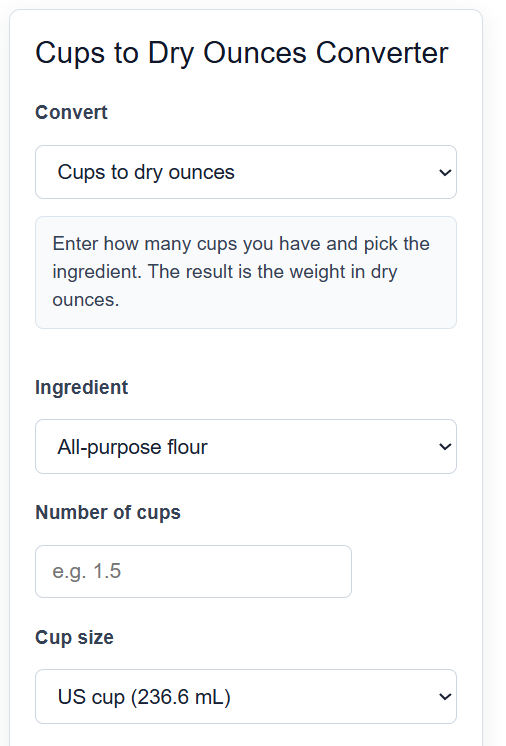
Calculate the dry ounce weight of any cup measurement for flour, sugar, butter, and more, with support for US, metric, and UK cups.
Cups to Dry Ounces Formula
A cup measures volume and a dry ounce measures weight, so the conversion depends on how heavy the ingredient is. Every conversion uses an ingredient density expressed as dry ounces per cup.
To turn cups into dry ounces, multiply the number of cups by the density of the ingredient:
oz = cups * D
To turn dry ounces back into cups, divide the weight by the same density:
cups = oz / D
To convert the result to grams, multiply the dry ounces by the weight of one ounce:
grams = oz * 28.3495
- oz: the weight of the ingredient in dry (avoirdupois) ounces.
- cups: the volume in cups. The calculator supports US cups, metric cups, and imperial UK cups.
- D: the density of the ingredient in dry ounces per cup. A cup of flour weighs about 4.4 oz while a cup of butter weighs about 8 oz, which is why D changes with the ingredient.
- 28.3495: the number of grams in one dry ounce, used only when you want the metric weight.
Pick the ingredient and the calculator supplies the density for you. If your ingredient is not listed, choose Custom and enter your own density in grams or ounces per cup. Changing the cup size scales the density up or down, since a larger cup holds more of the same ingredient.
Dry Ounces per Cup for Common Ingredients
These values are for one level US cup. Halve them for a half cup. Packing or sifting changes the weight, so treat them as close estimates rather than exact figures.
| Ingredient | 1 Cup (oz) | 1 Cup (g) |
|---|---|---|
| All-purpose flour | 4.4 | 125 |
| Bread flour | 4.48 | 127 |
| Granulated sugar | 7.1 | 201 |
| Brown sugar (packed) | 7.05 | 200 |
| Powdered sugar | 4.2 | 119 |
| Cocoa powder | 3.0 | 85 |
| Rolled oats | 3.6 | 102 |
| Chocolate chips | 6.0 | 170 |
| Butter | 8.0 | 227 |
The next table shows how much each cup standard holds, which is why the same ingredient weighs more in a larger cup.
| Cup standard | Volume (mL) |
|---|---|
| US cup | 236.6 |
| Metric cup | 250 |
| Imperial UK cup | 284.1 |
Example Problems
Example 1. You have 2 US cups of granulated sugar and want the weight in dry ounces. The density of granulated sugar is 7.1 oz per cup, so the weight is 2 times 7.1, which equals 14.2 dry ounces. That is about 403 grams.
Example 2. A recipe lists 8 dry ounces of butter and you want to know how many cups that is. Butter has a density of 8 oz per cup, so the volume is 8 divided by 8, which equals 1 cup.
Frequently Asked Questions
Are dry ounces the same as fluid ounces? No. A dry ounce is a unit of weight and a fluid ounce is a unit of volume. They only match for water and a few liquids close to its density. For dry baking ingredients you must use the ingredient density, which is what this converter does. A cup of flour is 8 fluid ounces by volume but only about 4.4 dry ounces by weight.
Why does one cup give a different ounce weight for each ingredient? Because the ingredients have different densities. A cup is always the same volume, but a cup of cocoa powder is light and airy while a cup of sugar is dense and heavy. The weight in dry ounces is the volume multiplied by the density, so heavier ingredients give a larger ounce value for the same cup.
How accurate are these conversions? The densities are good averages for level cups, but real weights shift with humidity, how finely an ingredient is ground, and whether you scoop or spoon it into the cup. Packed brown sugar and sifted flour are the most variable. For baking where precision matters, weigh your ingredients on a scale instead of relying on volume.