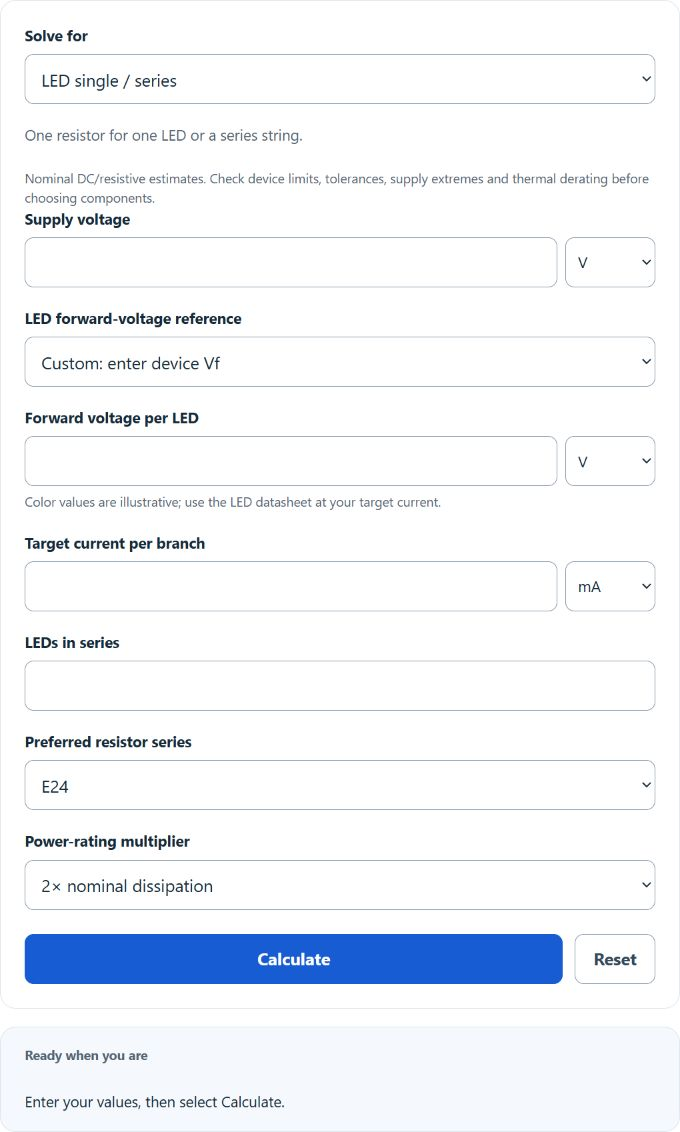
Calculate current-limiting resistor values and power ratings for LED series, parallel, LM317 constant-current, and Ohm's law circuits.
Related Calculators
- Bridge Rectifier Output Voltage Calculator
- Capacitive Current Calculator
- Line To Neutral Voltage Calculator
- Battery Voltage Calculator
- All Physics Calculators
Current Limiter Resistor Formula
The following formula sizes a resistor for one LED; for N series LEDs use R = (V − N × Vf) ÷ If. Each parallel branch needs its own resistor.
Variables:
- R is the resistance of the current limiting resistor (ohms)
- V is the supply voltage (volts)
- Vf is the forward voltage drop across one
- LED (volts); use N × Vf for N series LEDs
- If is the forward current through the LED (amperes)
To calculate the resistance of the current limiting resistor, subtract the forward voltage drop across the LED from the supply voltage. Then divide the result by the forward current through the LED.
What is a Current Limiter Resistor?
A Current Limiter Resistor is a component used in electrical circuits to control or limit the amount of current flowing through the circuit. It provides resistance to limit current under the assumed supply voltage and load drop; this alone does not guarantee component safety. This is crucial in preventing damage to sensitive components within the circuit that may not be able to handle high levels of current. The value of the resistor is chosen based on the desired current limit and the voltage across it.
How to Calculate Current Limiter Resistor?
The following steps outline how to calculate the resistance of a current limiting resistor using the formula: R = (V - Vf) / If.
- First, determine the supply voltage (V) in volts.
- Next, determine the forward voltage drop across the LED (Vf) in volts.
- Next, determine the forward current through the LED (If) in amperes.
- Next, substitute the values of V, Vf, and If into the formula: R = (V - Vf) / If.
- Finally, calculate exact resistance, round up to the selected preferred value, and check actual current and resistor dissipation. Choose a suitable available power rating using manufacturer derating and tolerances.
- After calculating the result, check your answer with the calculator above.
Example Problem:
Use the following variables as an example problem to test your knowledge:
Supply voltage (V) = 12 volts
Forward voltage drop across the LED (Vf) = 2 volts
Forward current through the LED (If) = 0.02 amperes. Exact R = (12 − 2) ÷ 0.02 = 500 Ω; E24 rounds up to 510 Ω, giving approximately 19.608 mA and 0.196 W resistor dissipation. A 2× multiplier gives 0.392 W before manufacturer derating.