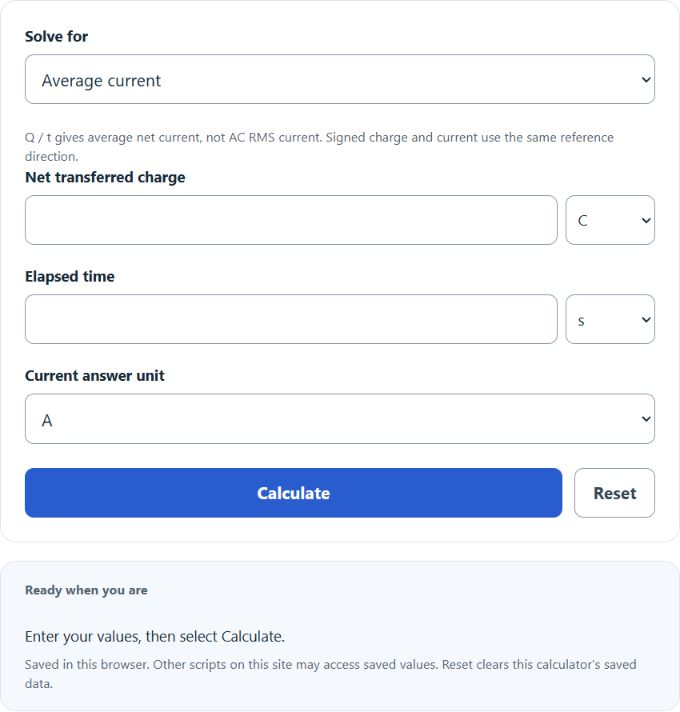
Calculate charge, average current, or elapsed time from Q = I × t with coulombs, amp-hours, seconds, hours, amps, and milliamps.
- All Physics Calculators
- All Electrical Calculators
- Capacitor Charge Current Calculator
- Energy Charge Voltage Calculator
- Inverter Current Calculator
Current From Charge Formula
The formula for calculating current from charge is:
- Where I is the average net electric current over the interval (amperes, A)
- Q is the total electric charge (coulombs, C)
- t is the elapsed time (seconds, s)
This equation can be rearranged to solve for charge (Q = I x t) or time (t = Q / I). In battery contexts, capacity is often given in milliamp-hours (mAh), where 1 mAh = 3.6 coulombs and 1 Ah = 3,600 coulombs.
What Is Electric Current?
Electric current is the net rate at which electric charge moves through a cross-section of a conductor. While the formula I = Q / t treats current as a simple ratio, the physical reality involves billions of charge carriers (typically electrons in metals, ions in electrolytes, or electron-hole pairs in semiconductors) drifting collectively under the influence of an electric field.
Electron drift speed depends on current, carrier density and wire cross-section; 0.1 mm/s is only an illustrative value. Signal propagation is much faster than carrier drift but remains finite and depends on the conductor and surrounding dielectric. This distinction between signal speed and carrier speed is one of the most counterintuitive facts in basic electricity.
By convention, the direction of current flow is defined as the direction positive charges would move, which is opposite to the actual electron flow in a wire. This convention dates back to Benjamin Franklin's experiments in the 1740s, well before the electron was discovered in 1897 by J.J. Thomson.
The Coulomb: SI Definition and Scale
The coulomb (C), named after French physicist Charles-Augustin de Coulomb, is the SI unit of electric charge. Since the 2019 SI redefinition (effective May 20, 2019), the coulomb is defined by fixing the elementary charge at exactly e = 1.602176634 x 10^-19 C. This means one coulomb equals approximately 6.242 x 10^18 elementary charges (electrons or protons).
Prior to 2019, the ampere was defined using a thought experiment involving the force between two infinitely long parallel wires, and the coulomb was derived from it. The modern definition ties the ampere directly to counting elementary charges per second, making it reproducible from a fundamental constant of nature rather than a hypothetical experimental setup.
For scale, transferring 5 C in 0.001 s gives an average net current of 5,000 A; this arithmetic does not determine a lightning peak current. A hypothetical 1.4 Ah battery corresponds to 5,040 C, while 1 microcoulomb is one millionth of a coulomb. Actual lightning, battery and static-discharge quantities vary widely.
Typical Current Draw of Common Devices
The table gives illustrative P/V estimates using 120 V unless 240 V is noted, and assumes power factor 1. Real AC RMS current depends on power factor, efficiency and equipment ratings; motor startup current also varies. USB charger figures refer to the modeled AC input, not USB output current.
| Device | Typical Power (W) | Current (A) |
|---|---|---|
| LED light bulb | 10 | 0.08 |
| Phone charger (USB) | 5 - 25 | 0.04 - 0.21 |
| Laptop charger | 45 - 100 | 0.38 - 0.83 |
| Desktop computer | 200 - 500 | 1.7 - 4.2 |
| Television (LED, 55") | 60 - 90 | 0.5 - 0.75 |
| Refrigerator (running) | 100 - 200 | 0.83 - 1.7 |
| Microwave oven | 600 - 1,200 | 5.0 - 10.0 |
| Hair dryer | 1,000 - 1,800 | 8.3 - 15.0 |
| Electric oven (240 V) | 2,000 - 5,000 | 8.3 - 20.8 |
| EV charger (Level 2, 240 V) | 3,800 - 11,500 | 16 - 48 |
| Illustrative I = P/V at power factor 1; use I = P/(V × power factor) for sinusoidal AC average real power. 240 V devices are noted. Use equipment ratings for actual operating and startup current. | ||
Charge to Current Conversion Table
| Charge (mAh) | Time (hours) | Current (mA) |
|---|---|---|
| 100 | 1 | 100 |
| 200 | 1 | 200 |
| 500 | 1 | 500 |
| 1000 | 1 | 1000 |
| 2000 | 1 | 2000 |
| 500 | 2 | 250 |
| 1000 | 2 | 500 |
| 2000 | 2 | 1000 |
| 3000 | 2 | 1500 |
| 4000 | 2 | 2000 |
| 1000 | 5 | 200 |
| 2000 | 5 | 400 |
| 3000 | 5 | 600 |
| 5000 | 5 | 1000 |
| 1000 | 10 | 100 |
| 2000 | 10 | 200 |
| 2500 | 10 | 250 |
| 3000 | 10 | 300 |
| 1000 | 0.5 | 2000 |
| 2000 | 0.5 | 4000 |
| Uses I = Q / t, with battery units: Current (mA) = Capacity (mAh) / Time (h). Reference: 1 Ah = 3600 C, 1 mAh = 3.6 C, 1 hr = 3600 s, 1 mA = 0.001 A. | ||
DC vs AC Current
The formula I = Q / t applies directly to direct current (DC), where charge flows steadily in one direction. Batteries, solar cells, and USB power supplies all produce DC. In alternating current (AC), the charge carriers oscillate back and forth, reversing direction at a fixed frequency (60 Hz in North America, 50 Hz in most of Europe and Asia). For symmetric AC over a complete number of cycles, the time-averaged net charge transfer is zero, so current is characterized by its root-mean-square (RMS) value rather than a simple Q / t calculation. When an appliance is rated at "10 A," that figure is the RMS current.
For battery and DC circuit problems, the calculator above applies directly. For AC circuits, you can still use I = Q / t to find the average current during a specific interval (for example, the charge transferred during one half-cycle), but steady-state AC analysis typically uses RMS values and phasor methods instead.
Relationship to Other Electrical Quantities
The charge-current relationship connects to the broader framework of electrical engineering through several key equations. Ohm's law (V = I x R) links current to voltage and resistance: once you know the current from I = Q / t, you can determine the voltage drop across a known resistance or the resistance of a component given a measured voltage. For DC, electrical power is P = V x I. For AC, instantaneous power is v(t)i(t), while average real power also depends on phase/power factor. Combining these, you can also express power as P = I^2 x R or P = V^2 / R.
For non-constant current (such as the charging curve of a capacitor), the instantaneous form is I(t) = dQ/dt, the derivative of charge with respect to time. The total charge transferred over an interval is then the integral of I(t) dt. This is relevant in capacitor circuits where current decays exponentially, in neural signaling where ion-channel currents pulse, and in electrochemistry where Faraday's laws tie charge to the mass of material deposited during electrolysis.
Charge and Current in Batteries
Battery capacity is almost always stated in milliamp-hours (mAh) or amp-hours (Ah) rather than coulombs, even though the underlying physics is the same. A 5,000 mAh smartphone battery stores 5,000 mAh x 3.6 = 18,000 coulombs of charge. If that phone draws an average of 500 mA (0.5 A) during active use, the battery lasts about 10 hours (5,000 mAh / 500 mA). An electric vehicle with a 75 kWh battery pack operating at a nominal 400 V stores roughly 187.5 Ah, or about 675,000 coulombs.
The C-rate is a normalized measure of charge or discharge speed relative to battery capacity. A 1C discharge means the battery delivers its full rated capacity in one hour. A 2C discharge drains it in 30 minutes, and a 0.5C discharge stretches it to two hours. For a 3,000 mAh cell, 1C = 3,000 mA (3 A), 2C = 6,000 mA (6 A), and 0.1C = 300 mA. High C-rates generate more internal heat and can reduce usable capacity due to internal resistance losses.