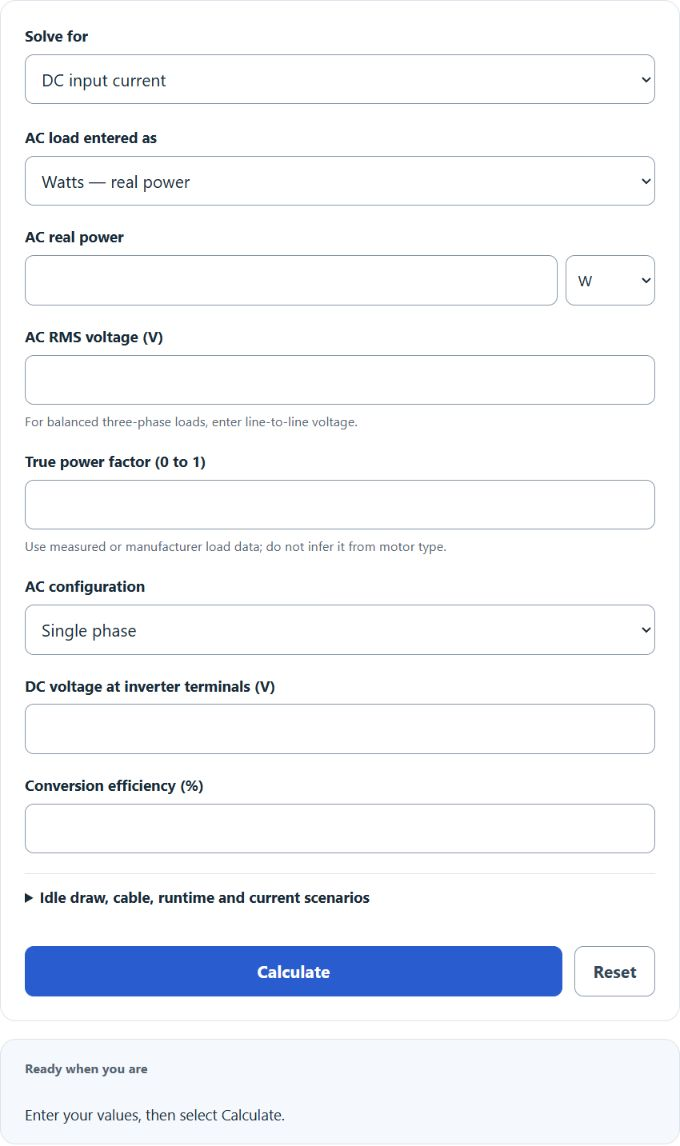
Calculate DC input current, AC output current, an output-power limit or measured efficiency. Compare optional cable, runtime, surge and current-rating scenarios without treating them as wiring or fuse approval.
- All Physics Calculators
- All Electrical Calculators
- Inverter Voltage Calculator
- Inverter Efficiency Calculator
Inverter Current Formula
Choose DC input current for battery draw, AC output current for load current, output at a DC limit, or measured overall efficiency. The AC output relationship below uses real power, RMS voltage and true power factor. DC input current instead depends on terminal voltage and conversion efficiency.
From this relationship, output current increases when load power rises, output voltage falls, or power factor drops. That is why low-voltage systems and low-power-factor loads often draw more current than expected.
Equivalent Forms
If you know any three variables, you can solve for the fourth with these rearranged forms:
Watts, VA, and Power Factor
Real power is measured in watts, while apparent power is measured in volt-amps. Power factor connects the two. Choose the matching watts, VA or RMS-current input basis. The calculator converts VA to watts using the entered true power factor.
A lower power factor means more current is required to deliver the same real power.
Three-Phase Inverter Current
If the inverter output is three-phase, use the total three-phase real power and the line-to-line output voltage:
Choose the AC configuration explicitly. Balanced three-phase mode uses the relation above with total real power, line-to-line RMS voltage and per-line RMS current. Unbalanced systems need a separate analysis.
Input Definitions
| Input | Meaning | Typical Unit |
|---|---|---|
| Inverter Power | Real output power delivered to the load | W |
| Inverter Voltage | Output voltage; use RMS voltage for AC | V |
| Power Factor | Ratio of real power to apparent power; use 1 for DC and nearly resistive loads | Unitless |
| Inverter Current | Output current delivered by the inverter; use RMS current for AC | A |
How to Use the Calculator
- Enter the inverter’s real output power in watts.
- Enter the inverter output voltage.
- Enter the load power factor between 0 and 1.
- Choose AC output current for the example relationship above. For battery current, also enter DC terminal voltage and conversion efficiency, then select Calculate.
- Interpret the result as the inverter’s steady-state output current, not startup surge current.
Example 1
An inverter supplies 1000 watts at 120 volts to a load with a power factor of 0.90.
The inverter output current is approximately 9.26 amps.
Example 2
If that same 1000-watt load is supplied at 230 volts with the same power factor, the current falls because the voltage is higher.
The output current is approximately 4.83 amps.
Output Current vs. Battery/Input Current
The AC output current mode returns load-side RMS amps. The DC input current mode returns battery-side amps and depends on DC terminal voltage and inverter efficiency. Optional idle consumption is added only when it is not already included in the efficiency estimate.
For example, if an inverter produces 1000 watts from a 12-volt DC source at 90% efficiency, the input current is roughly:
This is why low-voltage battery systems often require heavy cables, large fuses, and tight connections even when the AC load current seems moderate.
Common Mistakes
- Using apparent power in VA instead of real power in watts.
- Ignoring power factor for AC loads with motors, compressors, or inductive components.
- Mixing AC output current with DC battery current.
- Using nominal voltage when the actual operating voltage is significantly different.
- Assuming running current and startup or surge current are the same.
- Using the single-phase formula for a three-phase inverter output.
Why This Calculation Matters
Estimating inverter current is useful when checking load compatibility, comparing inverter operating points, and understanding how voltage and power factor affect current draw. It is also a helpful first step when evaluating conductor loading, connection ratings, and expected thermal stress on the output side of the inverter.
Frequently Asked Questions
- What power factor should I enter?
- Use the load’s actual power factor if known. For DC output or nearly resistive loads, a value of 1 is commonly used.
- Why does a lower power factor increase current?
- When power factor drops, more current is needed to deliver the same real power to the load.
- Does this calculator include surge current?
- The main result is steady-state. DC mode can also calculate an optional output-power surge scenario. It is not a verified startup rating; duration, battery/BMS limits and protective-device behavior must be checked separately.
- Can I use this for three-phase output?
- Yes, choose balanced three phase and enter line-to-line RMS voltage. The result is per-line current; unbalanced loads are outside this model.