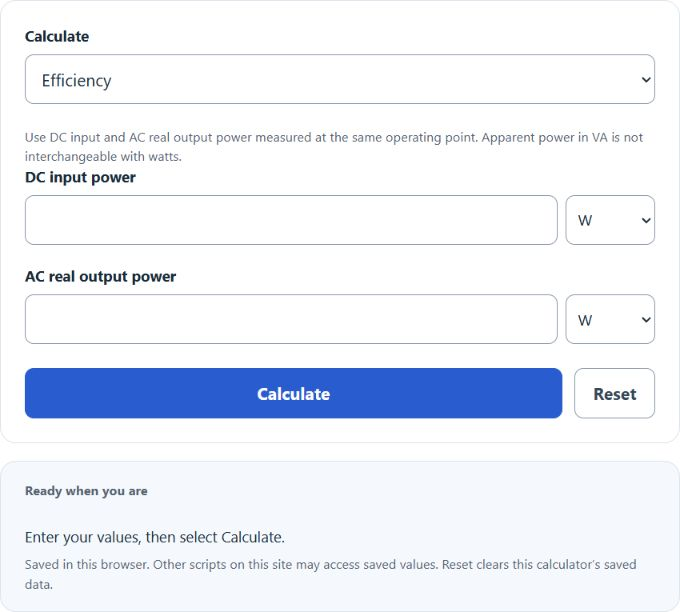
Calculate inverter efficiency, input power, or output power from any two values, with watts, kilowatts, and megawatt units supported.
Inverter Efficiency Formula
The basic inverter efficiency formula compares usable AC output power to DC input power:
The same relationship can be rearranged to solve for the missing value:
- η = inverter efficiency, as a percentage
- Pin = inverter input power, usually DC power supplied to the inverter
- Pout = inverter output power, usually AC power delivered by the inverter
Choose the value to calculate and enter the two displayed inputs. If you enter input power and output power, it calculates efficiency. If you enter input power and efficiency, it calculates output power. If you enter output power and efficiency, it calculates the required input power.
Power values can be entered in watts, kilowatts, or megawatts. The calculation converts the selected units internally so the input and output power can use different units.
Inverter Efficiency Considerations
| Inverter type or use | Efficiency guidance | Notes |
|---|---|---|
| Small portable inverter | Use model specifications at the intended load | Efficiency can drop at very low loads or near maximum load. |
| Modified sine wave inverter | Use model specifications at the intended load | May be less suitable for sensitive electronics or inductive loads. |
| Pure sine wave inverter | Use model specifications at the intended load | Common for solar, battery backup, RV, and off-grid systems. |
| Grid-tie solar inverter | Use model specifications at the intended load | Often highest near its rated operating range. |
Power Unit Conversions
| Unit | Equivalent in watts | Example |
|---|---|---|
| 1 W | 1 W | 500 W = 500 W |
| 1 kW | 1,000 W | 2.5 kW = 2,500 W |
| 1 MW | 1,000,000 W | 0.01 MW = 10,000 W |
Example Calculations
Example 1: Calculate inverter efficiency
You measure 1,000 W going into an inverter and 920 W coming out.
The inverter efficiency is 92%.
Example 2: Calculate output power
An inverter receives 5 kW of input power and operates at 94% efficiency.
The inverter output power is 4.70 kW, or 4,700 W.
FAQ
Can inverter efficiency be over 100%?
No. A real inverter cannot output more power than it receives. If the calculated efficiency is over 100%, the most likely causes are mismatched units, measurement error, using input and output values from different times, or measuring apparent power instead of real power.
Why is output power lower than input power?
Some energy is lost inside the inverter as heat and in the switching electronics, transformer, wiring, cooling fan, and control circuits. Efficiency measures how much of the input power becomes useful output power.
Does inverter efficiency stay constant?
No. Efficiency changes with load, input voltage, temperature, and inverter design. Many inverters are most efficient at a moderate to high load, but less efficient at very light loads or when operating near their limits.