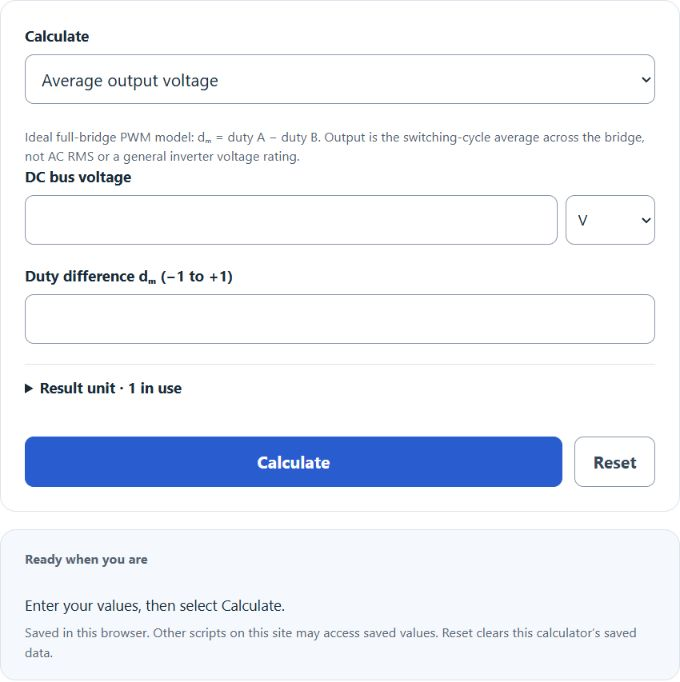
Calculate DC bus voltage, inverter average output voltage, or duty-cycle difference from the selected inputs and units for inverter calculations.
- All Unit Converters
- All Electrical Calculators
- Inductor Voltage Calculator
- Inverter Current Calculator
Inverter Average Voltage Formula
For an ideal full-bridge PWM inverter, the output averaged over one switching cycle is:
- Vavg = signed switching-cycle average output across the bridge, in volts
- Vdc = positive DC bus voltage, in volts
- dA and dB = bridge-leg duty ratios, each from 0 to 1
- dm = dA − dB, from −1 to +1
Choose the output, DC bus, or duty difference to calculate and enter the displayed inputs. The inverse relationships are:
A zero duty difference cannot determine the DC bus. The output and duty difference must have the same sign to obtain a positive DC bus. The average output magnitude cannot exceed the DC bus voltage in this model.
Inverter Voltage Unit Conversions
| Unit | Equivalent in volts |
|---|---|
| 1 mV | 0.001 V |
| 1 V | 1 V |
| 1 kV | 1,000 V |
Inverter Voltage Examples
Example 1: Average output voltage
With a 400 V DC bus and duty difference 0.5, the average output is 400 × 0.5 = 200 V.
Example 2: DC bus voltage
With average output −120 V and duty difference −0.4, the DC bus voltage is −120 / −0.4 = 300 V.
Inverter Voltage FAQ
Is this AC RMS voltage?
No. The result is the switching-cycle average voltage for the stated ideal bridge model. RMS and fundamental voltage depend on the modulation waveform and filtering and cannot be inferred from these two inputs alone.
Can the average output be negative?
Yes. A negative duty difference reverses the average polarity across the bridge while the DC bus remains positive.
What assumptions apply?
The calculation assumes ideal switches and a common DC bus. Dead time, voltage drops, losses, the load and filtering are not modeled. Use the inverter’s documented topology and ratings for actual equipment.