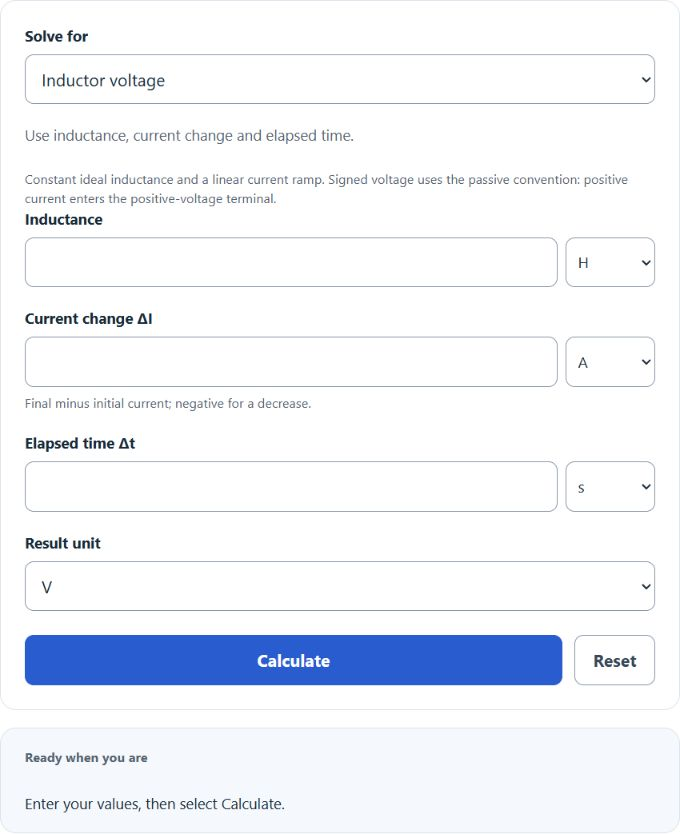
Choose voltage, inductance, current change or elapsed time and enter the three known quantities. The ideal constant-inductance model uses V = L ΔI/Δt, with selectable H, mH, kH, A, mA, V, mV, s and min units.
- All Electrical Calculators
- Ferrite Inductor Calculator
- Inductor Impedance Calculator
- All Physics Calculators
Inductor Voltage Formula
For constant ideal inductance, average voltage over an interval is V = L ΔI/Δt. For a linear current ramp this is also the constant instantaneous voltage. Signed voltage uses the passive convention, with positive current entering the positive-voltage terminal; induced emf around the current loop has the opposite sign. A larger inductance or a faster current ramp produces a larger voltage magnitude.
| Symbol | Meaning | Typical Unit |
|---|---|---|
| VL | Inductor voltage | V |
| L | Inductance | H |
| ΔI | Change in current | A |
| Δt | Change in time | s |
This relationship shows that inductor voltage is tied to the rate of change of current, not simply the current magnitude. If current is constant, the ideal inductor voltage is zero even though the inductor may still be carrying current.
How to Use the Inductor Voltage Calculator
- Enter the inductance value.
- Enter the change in current over the interval being analyzed.
- Enter the change in time for that current change.
- Read the resulting inductor voltage.
Choose the quantity to solve for, enter the three displayed known values and their units, then select Calculate. Expand Calculation details for the substitution and conversions.
Rearranged Forms of the Equation
The same formula can be rearranged to solve for any variable:
How to Interpret the Result
- A rapidly increasing current produces a larger positive voltage for the chosen reference polarity.
- A decreasing current produces a negative value if polarity is defined in the same direction.
- A small time interval can create a large voltage even when the current change is modest.
- A large inductance resists current change more strongly than a small inductance.
In practical circuits, this is why inductors can generate noticeable voltage spikes during switching, startup, shutdown, and pulse-driven operation.
Example 1
An inductor has an inductance of 70 H. The current changes by 14 A over 8 s.
The inductor voltage is 122.5 V.
Example 2
A 15 mH inductor experiences a current increase of 2 A in 0.0005 s. Converting 15 mH to henries gives 0.015 H.
This example shows how a small inductance can still produce significant voltage when current changes very quickly.
Related Concept: Energy Stored in an Inductor
Voltage tells you how strongly the inductor is opposing a change in current at a given moment. Stored energy is a separate concept based on the actual current flowing through the inductor.
This is useful when analyzing relays, solenoids, motor windings, power supplies, filters, and switching converters.
Common Mistakes When Calculating Inductor Voltage
- Using total current instead of the change in current.
- Forgetting to convert millihenries to henries for manual calculations.
- Entering time in minutes or milliseconds without converting to seconds first when solving by hand.
- Ignoring the sign of the current change when current is falling.
- Assuming the formula accounts for winding resistance or core losses in a real inductor.
Practical Notes
- The equation above describes an ideal inductor.
- Real inductors also have resistance, parasitic capacitance, and possible core saturation.
- In switching circuits, very short current transition times can create high transient voltages.
- Protection components such as flyback diodes, snubbers, or clamp circuits are often used when inductive loads are switched.
Quick FAQ
Does a larger current always mean a larger inductor voltage?
No. Inductor voltage depends on how fast the current changes, not just how large the current is.
Why is the voltage zero when current is constant?
Because the change in current is zero, so the ideal inductor has no voltage drop due to inductance at that instant.
Why can an inductor create a voltage spike?
When current is forced to change very quickly, the ratio of change in current to change in time becomes large, which makes the inductor voltage large as well.