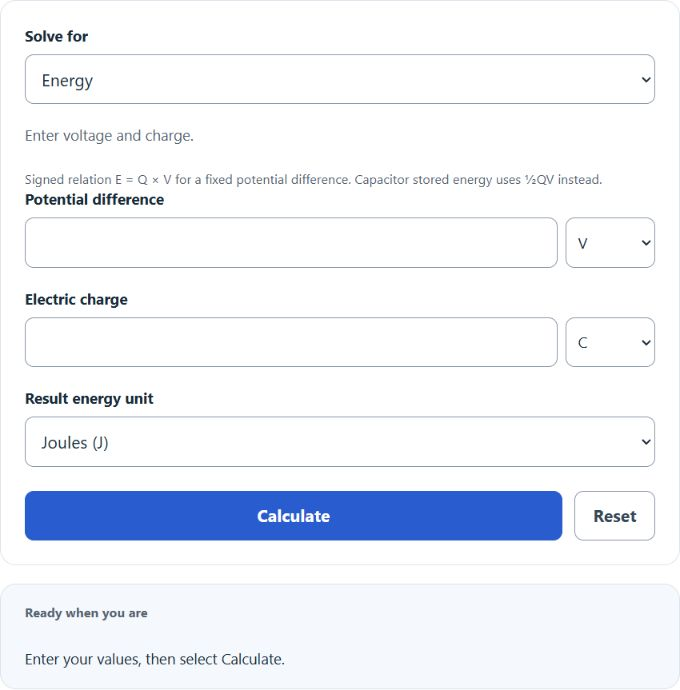
Calculate voltage, charge, or energy from two values using E = V × Q at a fixed potential difference, with unit conversion. This relation differs from the stored energy of a capacitor charged from zero, U = ½QV.
- All Physics Calculators
- Potential Difference Calculator
- Voltage Calculator
- Voltage to Energy Calculator
- Coulombs to Volts Calculator
Energy Charge Voltage Formula
For charge transferred across a fixed potential difference, the signed energy relation is:
The calculator can also rearrange the same formula to solve for voltage or charge:
- E = energy or electric potential-energy change in joules (J)
- V = voltage or electric potential difference in volts (V)
- Q = electric charge in coulombs (C)
Choose Energy, Voltage, or Charge from Solve for, enter the two known values, and select the result unit. For electrostatic potential-energy change, ΔU = QΔV; work done by the electric field has the opposite sign. Keep a consistent sign convention. If voltage changes during charge transfer, energy requires integrating V dQ. An ideal capacitor charged from zero stores U = ½QV = ½CV².
The calculator converts all entered values to base SI units before applying the formula: volts, coulombs, and joules. It then converts the result to the selected result unit.
Common Unit Conversions for Voltage, Charge, and Energy
Use these conversions to check how the calculator handles different units.
| Quantity | Unit | Equivalent base unit |
|---|---|---|
| Voltage | 1 kV | 1,000 V |
| Voltage | 1 MV | 1,000,000 V |
| Charge | 1 mC | 0.001 C |
| Charge | 1 μC | 0.000001 C |
| Energy | 1 kJ | 1,000 J |
| Energy | 1 MJ | 1,000,000 J |
Example Calculations
Example 1: Calculate energy
You have a voltage of 12 V and a charge of 3 C.
The energy is 36 J.
Example 2: Calculate voltage
You have an energy of 2 kJ and a charge of 5 C.
First convert 2 kJ to joules:
Then divide energy by charge:
The voltage is 400 V.
FAQ
What does 1 volt mean in terms of energy and charge?
One volt means one joule of energy is transferred per coulomb of charge. In formula form, 1 V = 1 J/C. For example, if 1 C of charge moves through a potential difference of 1 V, the energy transferred is 1 J.
Can charge or voltage be zero?
To solve V = E/Q or Q = E/V uniquely, the denominator must be nonzero. A zero denominator with nonzero energy is incompatible with E = VQ; with zero energy it leaves infinitely many possible answers. In the energy mode, zero voltage or zero charge gives zero energy. Signed charge, voltage, and energy values are supported.
Why are units converted before calculating?
The formula E = V × Q works directly with joules, volts, and coulombs. If you enter kV, mC, μC, kJ, or MJ, the values must be converted to base units first so the result is consistent. After the calculation, the result can be converted back to your selected output unit.