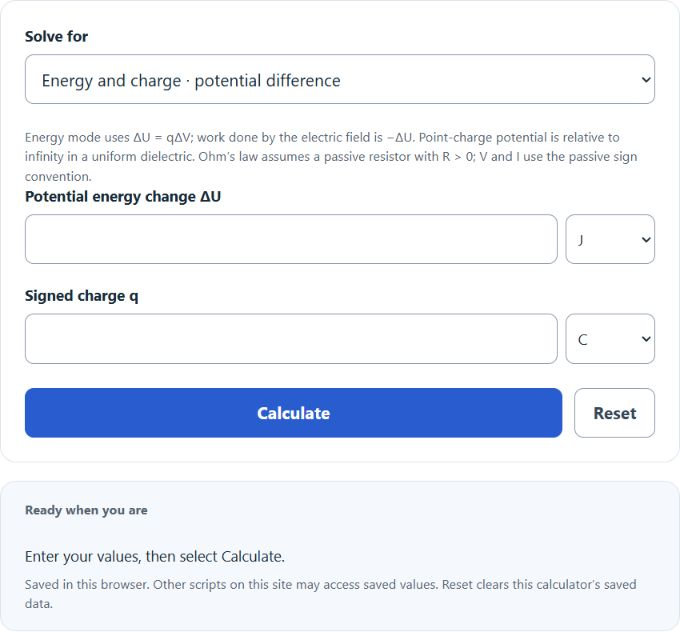
Calculate potential difference from work and charge, electric potential from point charges, and voltage, current, resistance, and power.
- All Physics Calculators
- All Electrical Calculators
- Electric Field Calculator
- Voltage Calculator
- RPD (Relative Percent Difference) Calculator
Potential Difference Formula
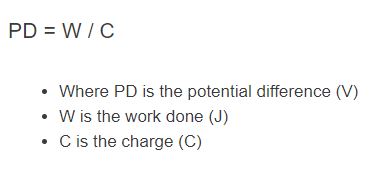
Potential difference, usually called voltage, is the change in potential energy per unit of charge between two points. In the energy modes below, W denotes the potential energy change ΔU = QV. Work done by the electric field has the opposite sign; external work equals ΔU for a quasistatic move with no change in kinetic energy. Select the unknown to solve for voltage, energy change, or charge.
In this relationship:
| Symbol | Meaning | Typical Unit |
|---|---|---|
| V | Potential difference / voltage | volt |
| W | Potential energy change ΔU (quasistatic external work) | joule |
| Q | Electric charge | coulomb |
One volt means one joule of energy is transferred per coulomb of charge.
Rearranged Forms
If the calculator is being used to find energy or charge instead of voltage, the same relationship can be rearranged:
How to Use the Calculator
- Select the model and unknown quantity.
- Enter the requested known values and select their units.
- Use signed energy, voltage and charge consistently. Point-charge modes use zero potential at infinity; place a single unknown in position 1.
- Calculate to find the selected result.
If your values are not already in joules and coulombs, convert them first or use the unit options available in the calculator. Keeping units consistent is the most important step for getting a correct result.
How to Interpret the Result
- A larger magnitude of potential difference means a larger magnitude of energy change per coulomb.
- A smaller magnitude of potential difference means a smaller magnitude of energy change per coulomb.
- In circuit language, potential difference and voltage are usually treated as the same idea.
- If direction matters, the sign depends on which point is chosen as the starting point and which is chosen as the ending point.
Examples
Example 1: Finding potential difference
If the potential energy of a positive 3-coulomb charge increases by 24 joules, the potential difference is:
This means each coulomb transfers 8 joules of energy between the two points.
Example 2: Finding work done
If the potential difference is 9 volts and 5 coulombs move through the system, the energy transferred is:
Example 3: Finding charge
If 60 joules of energy are transferred across a 12-volt difference, the charge is:
Useful Relationships Before Using This Calculator
Sometimes charge or work is not given directly. In that case, you may need one extra step before using the potential difference calculator.
If you know current and time, charge can be found from:
If you know power and time, work can be found from:
That makes this calculator useful in many basic electricity problems, even when the original information is given in a different form.
Potential Difference vs. Related Electrical Quantities
- Potential difference: energy transferred per unit charge.
- Current: the rate at which charge flows.
- Resistance: how strongly a material or component opposes current.
- Power: the rate of energy transfer.
In resistor circuits, voltage is also related to current and resistance by Ohm's law:
This is a different way to calculate the same voltage when current and resistance are known instead of work and charge.
Common Mistakes
- Confusing charge with current: current and charge are related, but they are not the same quantity.
- Mixing power and energy: watts measure the rate of energy transfer, while joules measure total energy transferred.
- Ignoring unit conversions: values must represent compatible energy and charge units.
- Dividing by zero charge: potential difference is undefined if no charge is present in the calculation.
- Dropping the sign convention: in more advanced problems, positive and negative results can carry physical meaning.
Quick Answers
- Is potential difference the same as voltage?
- Yes. In most engineering, physics, and circuit problems, the two terms are used interchangeably.
- What does a higher voltage mean physically?
- It means more energy is transferred for each coulomb of charge moving between two points.
- Can potential difference be negative?
- Yes. A negative value usually indicates the chosen direction or reference point makes the final point lower in electric potential than the starting point.
- When is this calculator most useful?
- It is especially helpful when energy transfer and charge are known directly, or when they can be found from other basic circuit relationships.