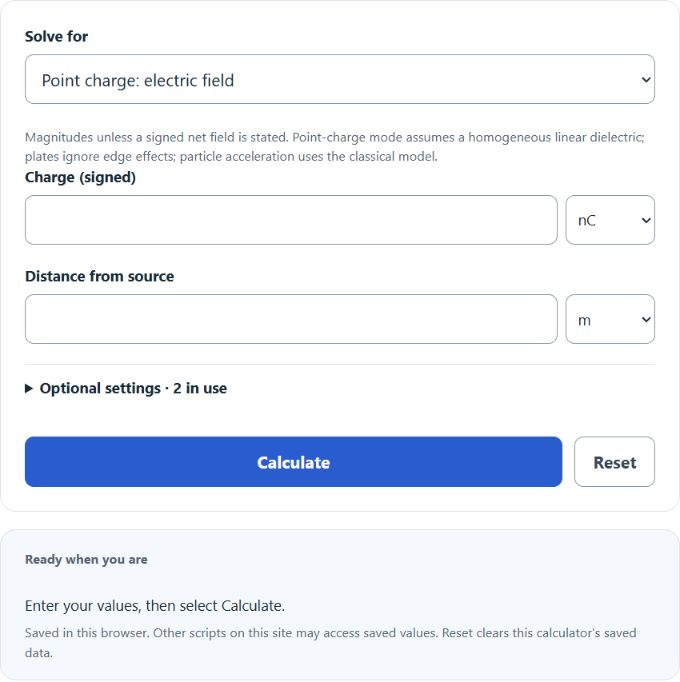
Calculate electric field strength from charge and distance, voltage and plate spacing, force and test charge, or multiple 1D charges.
Electric Field Formula
The electric field calculator uses a different formula depending on the method you select. Electric field strength is reported in newtons per coulomb (N/C), which is equivalent to volts per meter (V/m).
Point Charge
Parallel Plates
Force on a Test Charge
Multiple Charges on a Line
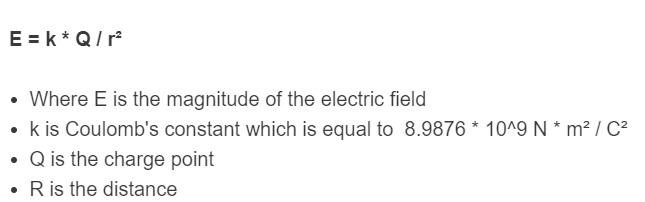
- E = electric field strength, in N/C or V/m
- Enet = signed net electric field from multiple charges along the x-axis
- k = Coulomb constant, approximately 8.987551786 × 10⁹ N·m²/C²
- Q = source charge, in coulombs
- Qi = each individual source charge in the multiple-charge method
- q = test charge, in coulombs
- r = distance from a point charge, in meters
- εr = relative permittivity of the material between the charge and the point being measured
- V = voltage or potential difference, in volts
- d = plate separation, in meters
- F = force on the test charge, in newtons
- xi = position of each charge relative to the observation point at x = 0
In point charge mode, you can enter any two of charge, distance, and electric field to solve for the missing value. The result is a field magnitude, with direction away from a positive charge and toward a negative charge. The dielectric model assumes a homogeneous, linear, isotropic material; permittivity depends on frequency and temperature.
In plates mode, the calculator uses the uniform-field approximation between parallel plates. This is most accurate when the plates are large compared with the separation distance and edge effects are small.
In force mode, the calculator applies the definition of electric field as force per unit charge. If the test charge is negative, the electric field direction is opposite the force direction.
In multiple charges mode, the calculator adds the signed electric field contribution from each charge on a line. A positive net result points in the +x direction, and a negative net result points in the −x direction.
Common Electric Field Units and Conversions
| Unit | Equivalent | Use |
|---|---|---|
| 1 N/C | 1 V/m | Standard SI electric field unit |
| 1 kN/C | 1,000 N/C | Larger field strengths |
| 1 kV/m | 1,000 V/m | Same size as 1 kN/C |
| 1 MV/m | 1,000,000 V/m | Very strong electric fields |
Typical Relative Permittivity Values
| Material | Approximate εr | Effect in point charge formula |
|---|---|---|
| Vacuum | 1 | Reference value |
| Air | About 1 | Usually treated the same as vacuum |
| Glass | About 4 to 10 | Reduces the field compared with vacuum |
| Water | About 80 | Greatly reduces the field in the point charge model |
Electric Field Examples
Example 1: Electric field from a point charge
Find the electric field 0.20 m from a +5 nC charge in air.
Use Q = 5 × 10⁻⁹ C, r = 0.20 m, and εr = 1.
E = (8.987551786 × 10⁹)(5 × 10⁻⁹) / (0.20²)
E ≈ 1123.44 N/C
Because the charge is positive, the field points away from the charge.
Example 2: Electric field between plates
Find the electric field between plates with a 12 V potential difference and a 5 mm separation.
Convert 5 mm to 0.005 m.
E = 12 / 0.005
E = 2400 V/m, which is also 2400 N/C.
Electric Field Calculator FAQ
Is N/C the same as V/m?
Yes. For electric field strength, 1 N/C = 1 V/m. The units come from different ways of describing the same quantity. N/C relates electric field to force on a charge, while V/m relates electric field to voltage change over distance.
Why does the point charge formula use the absolute value of charge?
The magnitude of the electric field is always reported as a nonnegative number, so the formula uses |Q|. The sign of Q tells you the direction. A positive charge creates a field pointing away from itself. A negative charge creates a field pointing toward itself.
When should you use the multiple charges method?
Use the multiple charges method when several charges contribute to the field at the same observation point. The calculator assumes all charges lie on one line and the observation point is x = 0. It adds signed field values, so opposite directions can partially or completely cancel.