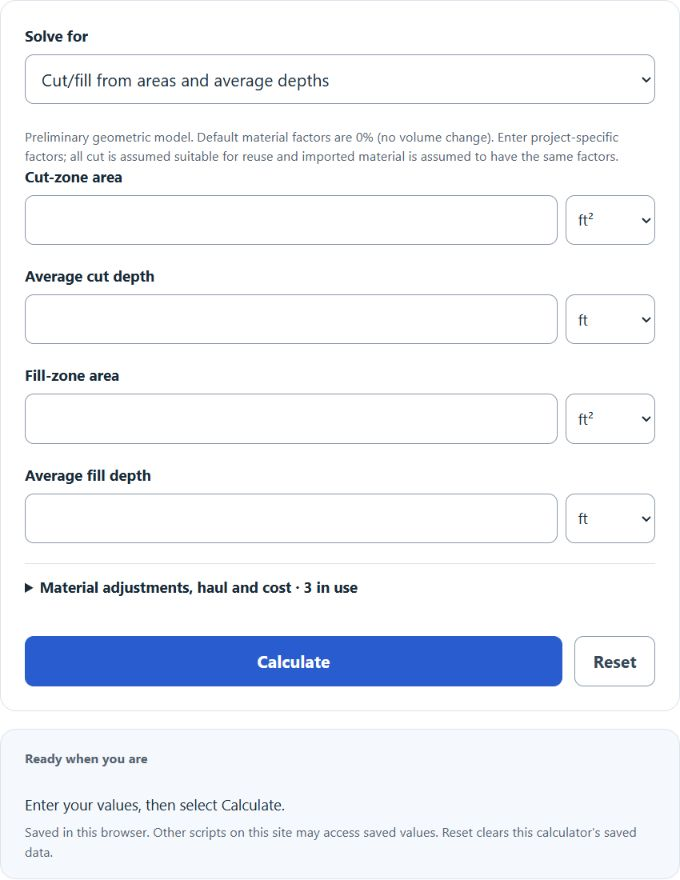
Calculate cut and fill earthwork volumes, net import or export, truck loads, and the balancing finish grade from site area, depths, grid cells, or end areas.
Related Calculators
- Excavation Time Calculator
- Soil Stockpile Volume Calculator
- Ditch Slope Calculator
- Void Ratio Calculator
- All Construction Calculators
Cut And Fill Formula
The following formula is used to calculate the volume of cut and fill in earthwork construction.
Variables:
- Vcut is excavated bank volume; Vfill is required compacted fill volume
- Ac and Af are the separately measured horizontal cut and fill zone areas
- Dc is representative average cut depth
- Df is representative average fill depth; k = 1 − bank-to-compacted loss/100
Compute cut and fill separately, then compare bank cut multiplied by k with compacted fill. A net difference is not the total excavated or placed volume. A positive compacted difference is a surplus; a negative one is a shortfall. Bank equivalent = absolute difference / k; loose haul = bank equivalent × (1 + swell/100). Imported material is assumed to have the same factors and all cut is assumed suitable for reuse.
What is Cut And Fill?
Cut and fill is a construction method used in civil engineering to level or shape the land for building purposes. It involves cutting into the earth to remove excess material and using it to fill in low-lying areas. This process is often used in the construction of roads, railways, and canals, and it helps to minimize the cost and time of transporting excess material. It also helps to maintain the balance between cut and fill, reducing the environmental impact.
How to Calculate Cut And Fill?
Choose average zone depths, equal-cell mean depths, average end areas, or modeled balancing flat grade. Use project-specific volume factors; the explicit 0% defaults assume no volume change. These are not soil recommendations.
- For the average-depth method, measure the cut-zone and fill-zone areas separately.
- Enter representative average cut depth. Use explicit zero area and depth for an absent zone.
- Enter representative average fill depth, with consistent labeled units.
- Calculate zone volumes as area × depth, then apply the entered bank-to-compacted and bank-to-loose factors.
- Inspect separate bank cut, compacted fill, net loose import/export, and any optional volume-only truck or USD cost estimate.
Example Problem:
Use the following variables as an example problem to test your knowledge.
Illustrative cut-zone area Ac = 100 m² and fill-zone area Af = 100 m².
Depth of cut (Dc) = 5 meters
Depth of fill (Df) = 3 meters
With explicit zero material adjustments, bank cut = 500 m³, compacted fill = 300 m³ and modeled net export = 200 m³. Total cut plus fill is 800 m³, distinct from net export. With a 10% bank-to-compacted loss and 20% swell, usable cut is 450 m³, the compacted surplus is 150 m³, and net loose export is (150 / 0.9) × 1.2 = 200 m³.
Equal-cell lists represent complete equal-area mean depths or elevations, not unweighted grid corners. End-area volumes use the approximate average of consecutive areas times uniform spacing; cut and fill lists must match. Balancing grade assumes one flat surface and a uniform factor, not an engineered grading plan. Survey geometry, material suitability and payload constraints need independent assessment; no universal accuracy range is promised.