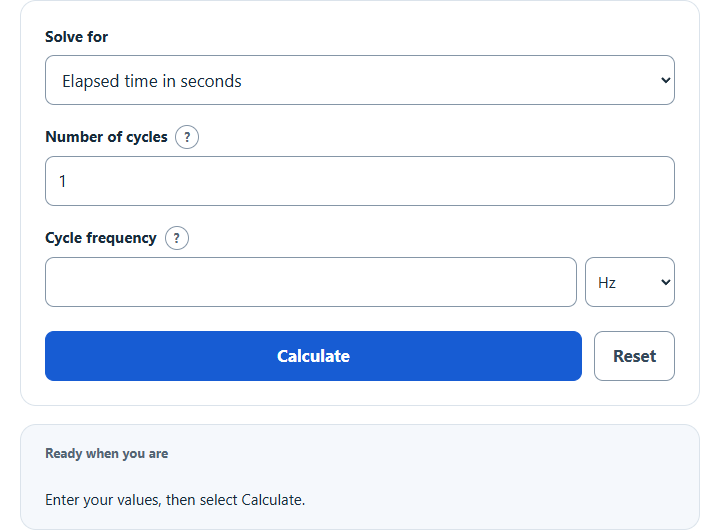
Convert cycles to seconds from frequency in Hz, kHz, MHz or RPM, find the period of one cycle (50 Hz = 0.02 s), or solve for cycles or frequency.
Related Calculators
- Subtract Time Calculator
- CPM To WPM Calculator
- Feet To Minutes Calculator
- Minutes To Miles Per Hour Calculator
- All Unit Converters
Calculator Functions
| Function | What it does | What it requires |
|---|---|---|
| Elapsed time in seconds | Converts a number of cycles into the time they take at a steady frequency | Requires the number of cycles and the cycle frequency in Hz, kHz, MHz, GHz or RPM |
| Number of cycles | Finds how many cycles fit into a length of time at a steady frequency | Requires the cycle frequency and the elapsed time in s, ms, µs, ns, min or h |
| Cycle frequency | Finds the frequency from a count of cycles and the time they took | Requires the number of cycles and the elapsed time |
The number of cycles starts at 1, so entering only a frequency gives the time for one cycle, which is the period. Every result also shows the period, the time in milliseconds, microseconds, minutes and hours, and the frequency in Hz, kHz, MHz and RPM.
Cycles to Seconds Formulas
| t | Elapsed time (seconds) |
| N | Number of cycles |
| f | Frequency in hertz. 1 Hz is one cycle per second [1] |
A frequency in another unit is converted to hertz first: 1 kHz = 1,000 Hz, 1 MHz = 1,000,000 Hz, 1 GHz = 1,000,000,000 Hz and 1 RPM = 1 ÷ 60 Hz, counting one cycle per revolution.
Elapsed time in seconds
The cycle count is divided by the frequency. On 60 Hz power, 1 cycle lasts 1 ÷ 60 = 0.0167 seconds and 20 cycles last 0.3333 seconds. On 50 Hz power, 1 cycle lasts 0.02 seconds. For a 2.5 GHz clock, 500 cycles take 0.0000002 seconds.
Number of cycles
At 60 Hz, half a second holds 60 × 0.5 = 30 cycles, and one second holds 60. At 50 Hz, one second holds 50.
Cycle frequency
5 cycles in 0.5 seconds is 10 Hz. Both the cycle count and the time must be greater than zero.
Hz to Seconds
The period T is the time for one complete cycle, and it is the reciprocal of the frequency [2]. 50 Hz is 0.02 seconds per cycle and 60 Hz is 0.0167 seconds per cycle. A frequency below 1 Hz takes longer than a second per cycle: 0.5 Hz is 2 seconds.
| Frequency | Seconds per cycle |
|---|---|
| 0.05 Hz | 20 |
| 0.1 Hz | 10 |
| 0.2 Hz | 5 |
| 0.5 Hz | 2 |
| 1 Hz | 1 |
| 5 Hz | 0.2 |
| 10 Hz | 0.1 |
| 50 Hz | 0.02 |
| 60 Hz | 0.016667 |
| 100 Hz | 0.01 |
| 1 kHz | 0.001 |
Cycles to Seconds Chart
| Cycles | Seconds at 60 Hz | Seconds at 50 Hz |
|---|---|---|
| 1 | 0.016667 | 0.02 |
| 2 | 0.033333 | 0.04 |
| 3 | 0.05 | 0.06 |
| 5 | 0.083333 | 0.1 |
| 10 | 0.166667 | 0.2 |
| 20 | 0.333333 | 0.4 |
| 30 | 0.5 | 0.6 |
| 60 | 1 | 1.2 |
Limits of This Estimate
- The frequency is assumed to stay constant for the whole interval. A signal that drifts, or a processor that changes its clock speed, will not match the result.
- RPM counts one cycle per revolution. For a machine with several events per revolution, enter the event frequency instead.
- Processor clock cycles are not instructions. Stalls and instructions that take several cycles mean a cycle count does not give a simple run time.
Sources
- NIST Time and Frequency Division, Time and Frequency from A to Z: H: definition of the hertz as one cycle per second
- NIST Time and Frequency Division, Time and Frequency from A to Z: P: the period as the reciprocal of frequency