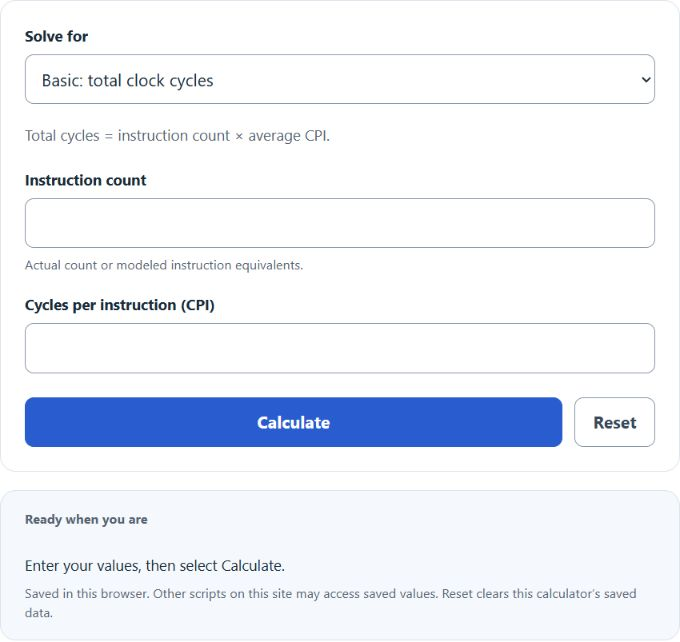
Calculate CPU clock cycles, execution time, MIPS, weighted CPI, Amdahl speedup, and memory stall CPI from instructions, CPI, clock rate, and miss rates.
- All Miscellaneous Calculators
- MIPS Calculator
- Queries Per Second Calculator
- Requests Per Second Calculator
Clock Cycles Per Instruction Formula
Variables:
- CPI is the Clock Cycles Per Instruction (cycles/instruction)
- C is the total number of cycles
- I is the total number of instructions
To calculate Clock Cycles Per Instruction, divide the number of cycles by the number of instructions.
How to Calculate Clock Cycles Per Instruction?
The following steps outline how to calculate the Clock Cycles Per Instruction.
- First, determine the total number of cycles.
- Next, determine the total number of instructions.
- Next, gather the formula from above = CPI = C / I.
- Finally, select Basic: CPI, enter the cycles and instruction count, and select Calculate.
- After inserting the variables and calculating the result, check your answer with the calculator above.
Example Problem :
Use the following variables as an example problem to test your knowledge.
total number of cycles = 6
total number of instructions = 7
FAQs
What is the significance of measuring Clock Cycles Per Instruction (CPI)?
Measuring CPI is crucial for understanding the efficiency of a processor. For the same workload, instruction count and clock rate, a lower CPI means less CPU execution time.
How can improving CPI benefit computer systems?
Reducing CPI can reduce CPU execution time when instruction count and clock rate remain unchanged. CPI alone does not determine power consumption.
Are there any limitations to using CPI as a performance metric?
Measured effective CPI can include memory stalls and instruction-level parallelism. CPI alone omits instruction count and clock rate; compare CPU execution time for the same workload. The memory-stall tool uses an idealized additive model, and the Amdahl tool assumes a fixed workload with no added overhead.
Can CPI vary between different types of instructions?
Yes, different types of instructions may require varying numbers of clock cycles to execute, affecting the overall CPI. Some instructions are more complex and may take more cycles, while simpler instructions might take fewer.