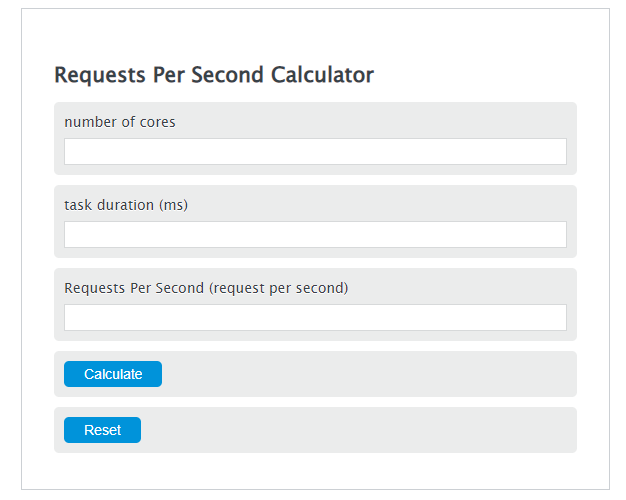
Calculate requests per second from total requests and duration or from concurrent users, plus peak RPS, servers needed, bandwidth and monthly quota use.
Related Calculators
- Call Attempts Per Second Calculator
- Average Rate Calculator
- Rate Per 100 Calculator
- Processing Time Calculator
- All Math and Numbers Calculators
Requests Per Second Formula
The basic formula for requests per second is:
- RPS = requests per second
- N = total number of requests
- T = duration in seconds
To calculate the number of requests, rearrange the formula:
To calculate the duration, rearrange the formula again:
The calculator converts time to seconds before calculating. If you enter minutes, it multiplies by 60. If you enter hours, it multiplies by 3,600.
It also converts request rates to requests per second before solving:
If you leave the requests per second field blank, the calculator divides total requests by duration. If you leave the number of requests blank, it multiplies the rate by the duration. If you leave the duration blank, it divides total requests by the request rate.
Request Rate Unit Conversions
| Rate unit | Convert to requests/s | Example |
|---|---|---|
| Requests/s | No conversion | 50 requests/s = 50 RPS |
| Requests/min | Divide by 60 | 3,000 requests/min = 50 RPS |
| Requests/hour | Divide by 3,600 | 180,000 requests/hour = 50 RPS |
Duration Unit Conversions
| Duration unit | Seconds equivalent | Example use |
|---|---|---|
| Seconds | 1 second | Short benchmark or API test |
| Minutes | 60 seconds | Load test over several minutes |
| Hours | 3,600 seconds | Traffic estimate over a longer period |
Example Calculations
Example 1: Calculate requests per second
You have 12,000 requests over 5 minutes.
The result is 40 requests/s.
Example 2: Calculate total requests
You have a rate of 25 requests/s for 2 hours.
The result is 180,000 requests.
FAQ
What does requests per second mean?
Requests per second means how many requests are handled in one second. It is often used for APIs, web servers, databases, and load tests. A result of 100 requests/s means the system processed an average of 100 requests every second during the measured time period.
Is requests per second the same as throughput?
Requests per second is one common way to measure throughput. Throughput can also be measured in bytes per second, transactions per second, or jobs per minute. If you are counting completed requests, then requests per second is the throughput rate for those requests.
Why does the calculator use seconds as the base unit?
Requests per second uses seconds by definition. Minutes and hours must be converted to seconds before the rate is calculated. This keeps the formula consistent, even if you enter the duration in minutes or hours.