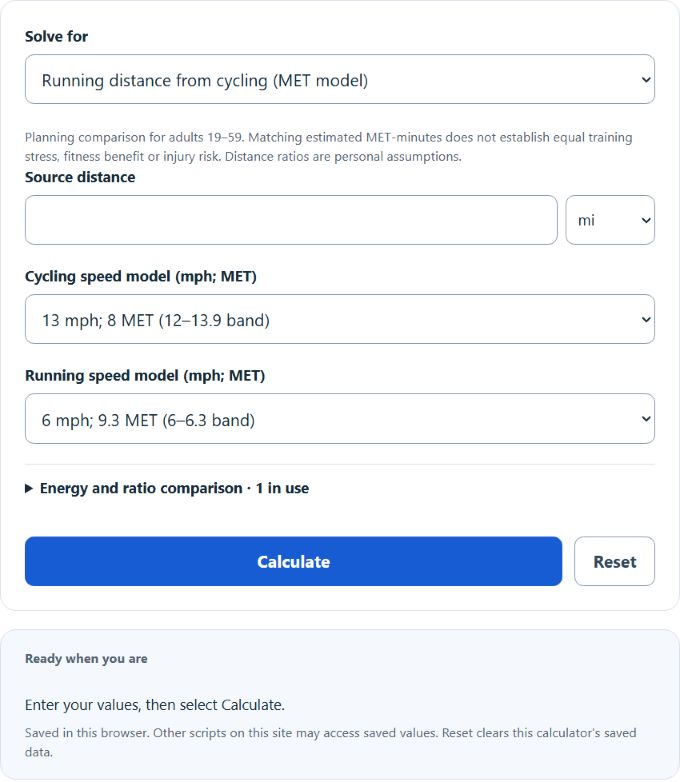
Compare cycling and running distances with an estimated MET-minute model or your chosen distance ratio. Neither method establishes equal training stress.
How Cycling-to-Running Distance Conversion Works
The ratio methods use cycling distance per running distance; 3:1 is an adjustable planning assumption. The factor method accepts separate distance units and also shows the reciprocal running/cycling factor used in the table. The MET methods estimate workout time using explicit speed models, then match estimated MET-minutes. Optional body mass adds gross energy; it does not change the distance estimate.
| Solve target | Required inputs | Relationship |
|---|---|---|
| Running distance | Cycling distance and factor | run = bike × factor |
| Cycling distance | Running distance and factor | bike = run / factor |
| Conversion factor | Cycling and running distances | factor = run / bike |
Why the Conversion Factor Is Adjustable
A distance ratio is a planning shorthand, not a physiological law. Terrain, elevation, wind, drafting, workout intensity, equipment, and individual efficiency can all change the relationship. A factor of 0.3333 represents roughly one unit of running for three units of cycling, but athletes should replace it with a ratio that matches their own training data.
Example Conversion
For a 30-mile ride and a factor of 0.3333, the estimate is about 10 miles of running. If the planned run is 8 miles after that ride, solving the factor gives about 0.2667. The result describes distance only; it does not claim equal duration, calories, or training stress.
Using the Result in Multisport Planning
Use the result to sketch training volume or compare sessions. MET target time = source MET × source time / target MET; target distance = target speed × target time. Optional gross energy = MET-min × 3.5 × body mass in kg / 200. These adult population estimates include resting expenditure and do not prescribe training or predict an individual response.
Sources
2024 Adult Compendium of Physical Activities: bicycling MET values, running MET values, and energy conversion. Speed choices within bands are explicit modelling assumptions; distance ratios are user assumptions.