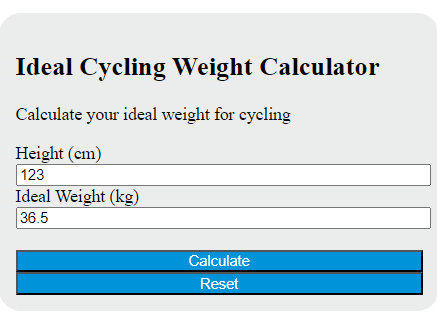
Calculate ideal cycling weight from height, BMI and healthy weight range, plus power-to-weight W/kg and FTP targets for cyclists of all levels.
Ideal Cycling Weight Formula
This comparison shows how rider weight changes watts per kilogram when sustainable power stays fixed.
| Rider weight | Approximate pounds | Power-to-weight |
|---|---|---|
| 50 kg | 110.2 lb | 5.00 W/kg |
| 60 kg | 132.3 lb | 4.17 W/kg |
| 70 kg | 154.3 lb | 3.57 W/kg |
| 80 kg | 176.4 lb | 3.13 W/kg |
| 90 kg | 198.4 lb | 2.78 W/kg |
A lower body weight only improves this ratio when the rider can maintain usable power, recovery, and health.
This calculator uses the following height-based rule of thumb to estimate an “ideal” body weight (it does not account for sex, body composition, or cycling discipline):
Variables:
- Ideal Weight is the estimated body weight for cycling (in kilograms) produced by the formula
- Height is the height of the cyclist in centimeters
To calculate the estimate, subtract 50 from the cyclist’s height in centimeters and divide by 2 to get the ideal weight in kilograms.
What is an Ideal Cycling Weight?
An “ideal cycling weight” is not a single universal number. For performance, a rider’s best weight depends on factors such as height, body composition, health, the type of events they ride (climbing vs. flat vs. time trial), and their sustainable power output. Cyclists often discuss power-to-weight ratio (watts per kilogram), which matters most for climbing, while aerodynamics (CdA) and absolute power can matter more on flatter terrain. Any weight goal should be approached in a healthy, sustainable way, since excessive weight loss can reduce power, impair recovery, and increase health risks.
How to Calculate Ideal Cycling Weight?
The following steps outline how to calculate the Ideal Cycling Weight:
- First, determine the rider's height (in centimeters). If you only have height in inches, continue to the next step.
- Convert the height from inches to centimeters using the formula: height (cm) = height (inches) × 2.54.
- Calculate the estimated ideal weight (in kilograms) using the formula: ideal weight (kg) = (height (cm) − 50) ÷ 2.
- If desired, convert kilograms to pounds using: weight (lbs) = weight (kg) × 2.20462.
- After performing the calculations, check the result with the calculator above.
Example Problem:
Use the following variables as an example problem to test your knowledge.
Rider's height (inches) = 68