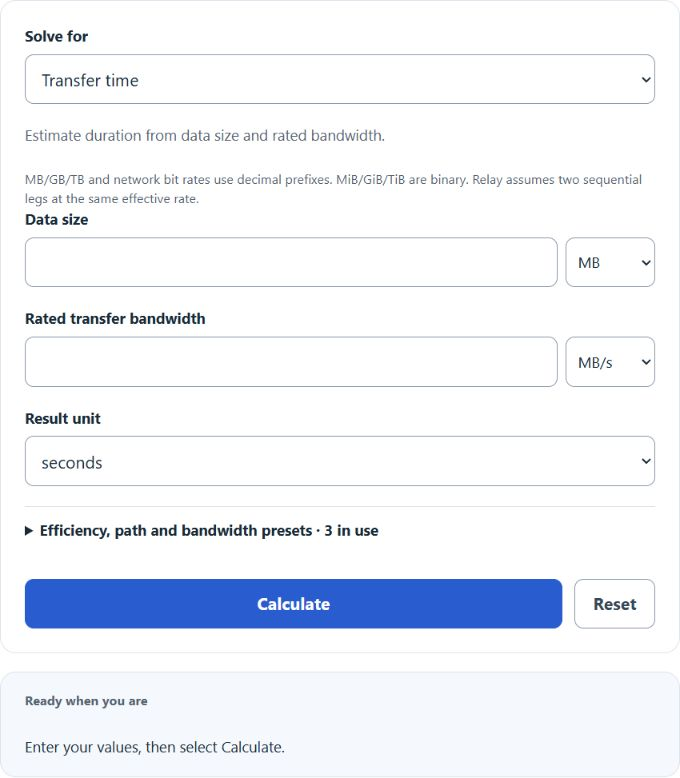
Calculate data replication time, data size, or required bandwidth using transfer size, network speed, efficiency, and direct or cloud relay path.
Data Replication Time Formula
For an ideal direct transfer, the following formula uses data size and bandwidth in matching byte units. MB, GB and TB are decimal; MiB, GiB and TiB explicitly select binary sizes. One byte is eight bits.
Variables:
- T is the data replication time in seconds
- D is the size of data to be replicated in megabytes (MB)
- B is the bandwidth of the network in megabytes per second (MB/s)
With efficiency e and path multiplier p, T = D × p / (B × e). A direct transfer uses p = 1. Relay uses p = 2 and assumes sequential upload then download at the same effective speed. Actual replication may also be limited by latency, storage, retries and ongoing data changes.
What is Data Replication?
Data replication is the process of copying data from one location to another to ensure that the data is consistently available across different systems or locations. This process is crucial for data redundancy, disaster recovery, and improving data accessibility and performance. Data replication can be done in real time or at scheduled intervals, depending on the requirements of the system. It is commonly used in database management, cloud storage, and distributed computing environments.
How to Calculate Data Replication Time?
The following steps outline how to calculate the Data Replication Time.
- First, determine the size of the data to be replicated (D).
- Next, determine the bandwidth of the network (B).
- Choose transfer time, data size or required bandwidth. The ideal direct defaults use T = D / B; optional efficiency and path settings change that model.
- After inserting the values and calculating the result, check your answer with the calculator above.
Example Problem :
Use the following variables as an example problem to test your knowledge.
Size of data to be replicated (D) = 500 MB
Bandwidth of the network (B) = 50 MB/s