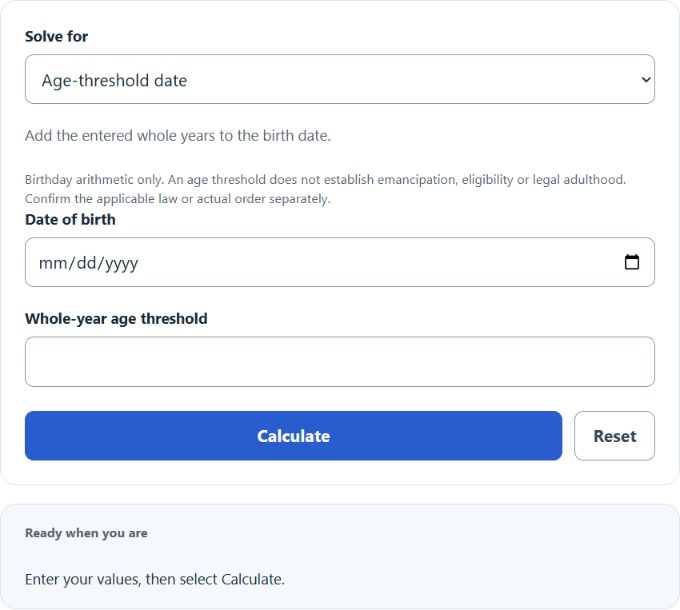
Calculate an age-threshold date from a birth date and whole years, estimate a birth date, or count completed calendar years. Birthday arithmetic does not establish legal emancipation or eligibility.
- Every Day Life And Education Calculators
- Legal Calculators
Date of Emancipation Formula
The following formula calculates a calendar anniversary at an entered whole-year threshold. It does not determine the legally applicable threshold or an actual emancipation date.
DOE = DOB + Y\text{ years}
Variables:
- DOE is the calculated age-threshold date, not a determination of emancipation
- DOB is the date of birth
- Y is the entered number of whole calendar years; verify any legal threshold independently
Enter a birth date and a whole-year threshold to calculate an anniversary, or two dates to count completed whole years. The birth-date mode subtracts calendar years and is an estimate, not a unique inverse after leap-day rollover. February 29 uses March 1 in a non-leap year under this arithmetic convention; legal counting rules may differ.
What is Emancipation?
Emancipation is the legal process by which a minor is freed from the control of their parents or guardians before reaching the age of majority. Once emancipated, the minor gains most legal rights of an adult, and the parents are released from their legal obligations to the child. This is distinct from simply “turning 18,” which is automatic attainment of majority, not a court-granted status.
There are three primary pathways to emancipation in the United States: court order (judicial emancipation), marriage, and enlistment in the armed forces. Roughly half of U.S. states have a formal statutory process for judicial emancipation. The remaining states recognize emancipation only through marriage, military service, or case-by-case court rulings without a dedicated statute.
Age of Majority by U.S. State
The age of majority, the age at which a person is automatically considered a legal adult, is 18 in 47 states and the District of Columbia. Three jurisdictions differ:
- Alabama: 19
- Nebraska: 19
- Mississippi: 21
These general majority ages do not govern every legal purpose. Alabama and Nebraska have contracting provisions for certain 18-year-olds, and Mississippi allows people aged 18 or older to contract for personal property, real property and mortgages under Section 93-19-13. Verify the particular right, obligation and applicable law before selecting a threshold.
Minimum Age for Judicial Emancipation by State
For states that permit a minor to petition a court for emancipation, the minimum filing age varies significantly. Below are notable thresholds among states with formal emancipation statutes:
- Age 14: California, Kansas (case law precedent)
- Age 15: Oregon
- Age 16: Texas, Florida, Illinois, Connecticut, Louisiana, Alaska, Iowa, Michigan, Montana, Virginia, Vermont, West Virginia, Wyoming
- Other jurisdictions: Check the applicable statute and court process. Absence of a stated minimum in a summary does not establish eligibility or a right to petition at any age.
A jurisdiction without a general emancipation petition statute may still recognize emancipation for a specific purpose under case law or another legal process. Consult the relevant court guidance; this calendar calculator does not determine which process is available.
Requirements for Court-Ordered Emancipation
Courts evaluating an emancipation petition typically consider several factors. The minor must demonstrate financial self-sufficiency, meaning they can support themselves through employment rather than public assistance. The minor must already be living apart from their parents or have a plan for independent housing. The minor must show they are capable of managing their own affairs, including healthcare, education, and finances. In most states, parents or guardians must be notified of the petition, and the court holds a hearing where the judge determines whether emancipation serves the minor’s best interest.
Rights Gained and Limitations After Emancipation
An emancipated minor gains the legal authority to sign contracts, lease or purchase property, consent to medical treatment, enroll in school independently, obtain a work permit without parental consent, open bank accounts, and file lawsuits in their own name. However, emancipation does not override age-specific laws set by federal or state statute. An emancipated 16-year-old still cannot vote (must be 18), purchase alcohol or tobacco (must be 21), or purchase a handgun from a licensed dealer (must be 21 under federal law). Compulsory education laws also still apply in most states.
This distinction is critical: emancipation removes parental authority over the minor, but it does not lower the age thresholds embedded in other laws.
Age of Majority Internationally
Outside the United States, the age of majority varies considerably. Most countries set it at 18, aligning with the United Nations Convention on the Rights of the Child, which defines a child as any person under 18 unless national laws set a lower threshold. Notable exceptions include:
- Age 21: Bahrain, Cameroon, Chad, Egypt, Honduras, Lesotho, Madagascar, Singapore
- Japan: Civil Code majority was lowered from 20 to 18 effective April 1, 2022; alcohol and tobacco rules remain separate. South Korea: Civil Act Article 4 sets majority at 19.
- Age 19: Several Canadian provinces including British Columbia, Nova Scotia, New Brunswick, Newfoundland and Labrador, Northwest Territories, Nunavut, and Yukon
- Age 16: Scotland, Kyrgyzstan
For international use, verify the current law for the particular jurisdiction and purpose. The examples above are not a universal eligibility table. The calculator performs calendar arithmetic only and does not select a legal threshold.
Emancipation vs. Age of Majority: Key Differences
These two concepts are frequently confused. The age of majority is the age at which every person in a jurisdiction automatically becomes a legal adult. It requires no action; it happens on a specific birthday. Emancipation, by contrast, is a legal status granted to a minor before they reach the age of majority. It must be initiated (by petition, marriage, or military service) and in most cases approved by a court. A person who reaches the age of majority was never “emancipated” in the legal sense; they simply aged into adulthood. The calculator above finds a birthday threshold only. Entering the completed age at which a minor was emancipated cannot reconstruct the actual order date, which may be any day of that year. Use the actual date and rules of the applicable legal process.
Foster Youth and Aging Out
One of the largest populations affected by emancipation timelines is foster youth. In the United States, approximately 20,000 young people age out of foster care each year upon reaching the age of majority in their state. In California alone, roughly 4,000 foster youth emancipate annually from a system of approximately 65,000 children. Aging out of foster care is sometimes called “emancipation,” though it is technically the automatic end of state wardship at the age of majority rather than a court-granted early emancipation. The Fostering Connections to Success and Increasing Adoptions Act of 2008 gave states the option to extend foster care support to age 21, and many states have adopted extended foster care programs. This means a foster youth’s effective “emancipation date” from state support may be at 18, 19, or 21 depending on the state and whether they opt into extended services.
Related Age Thresholds in the United States
While the age of majority governs general adult legal status, other age thresholds apply to specific rights and activities. These are not affected by emancipation status:
- Voting: 18 (26th Amendment)
- Military enlistment: 17 with parental consent, 18 without
- Alcohol purchase: 21 (National Minimum Drinking Age Act of 1984)
- Tobacco and nicotine purchase: 21 (federal law since December 2019)
- Handgun purchase from licensed dealer: 21 (federal law)
- Car rental (typical industry practice): 25, though not a legal requirement
- Full Social Security retirement age: 67 for those born in 1960 or later
These age thresholds demonstrate that legal adulthood is not a single bright line but a series of graduated permissions spread across different ages.