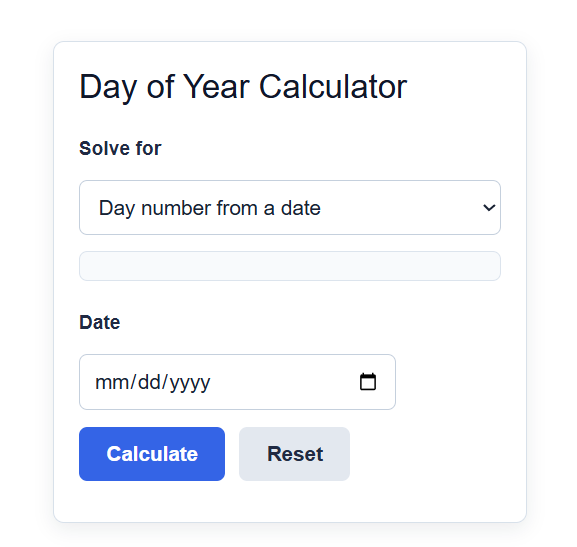
Calculate the day of the year for any date, find the day of the week, days remaining, ISO week and quarter, and convert a day number back into a calendar date.
Day of Year Formula
The day of the year, also called the ordinal date or day number, counts how many days have passed since January 1, including the date itself. January 1 is day 1 and December 31 is day 365, or day 366 in a leap year.
To find the day number from a date, add the days in all completed months to the day of the current month. Add one more day when the year is a leap year and the month is after February.
N = C[m] + d + L
To go the other way and find the days left in the year, subtract the day number from the total days in that year.
Days remaining = T - N
- N = the day of the year, a number from 1 to 365 or 366
- C[m] = the total days in all months before month m in a common year (0 for January, 31 for February, 59 for March, and so on)
- d = the day of the month
- L = 1 when the year is a leap year and the month is March or later, otherwise 0
- T = the total days in the year, 365 in a common year or 366 in a leap year
In date mode you pick a calendar date and the calculator returns its day number, the day of the week, the days remaining, the ISO ordinal date in YYYY-DDD form, the ISO week number, the quarter, and the year progress. In day-number mode you enter a number from 1 to 366 and a year, and it returns the matching calendar date. A year is a leap year when it divides evenly by 4, except for century years, which must divide evenly by 400.
Day Number for the First of Each Month
Use this table to check the day number the calculator returns. It lists the day of the year for the first of each month in both common and leap years. Leap year values shift by one starting in March.
| Month (1st) | Common year | Leap year |
|---|---|---|
| January 1 | 1 | 1 |
| February 1 | 32 | 32 |
| March 1 | 60 | 61 |
| April 1 | 91 | 92 |
| May 1 | 121 | 122 |
| June 1 | 152 | 153 |
| July 1 | 182 | 183 |
| August 1 | 213 | 214 |
| September 1 | 244 | 245 |
| October 1 | 274 | 275 |
| November 1 | 305 | 306 |
| December 1 | 335 | 336 |
Quarters and Year Progress Milestones
This table shows how the day number maps to each quarter and to common progress points in a common year.
| Point in the year | Day number | Year progress |
|---|---|---|
| End of Q1 (Mar 31) | 90 | 24.7% |
| End of Q2 (Jun 30) | 181 | 49.6% |
| End of Q3 (Sep 30) | 273 | 74.8% |
| End of Q4 (Dec 31) | 365 | 100% |
Example Problems
Example 1. Find the day number for April 10, 2026. The year 2026 is not a leap year. The completed months before April hold 90 days (January 31, February 28, March 31), so N = 90 + 10 = 100. April 10, 2026 is day 100, it falls on a Friday, and 265 days remain in the year.
Example 2. Find the date for day 200 of 2024. The year 2024 is a leap year with 366 days. Counting forward, the first 182 days fill January through June, and day 200 lands 18 days into July. Day 200 of 2024 is July 18, 2024, which is a Thursday.
Frequently Asked Questions
What is the day of the year right now? The day of the year is the count of days from January 1 through today, including today. Open the calculator in date mode with the current date selected and it shows the day number, the days remaining, and the year progress.
Does a leap year change the day number? Yes, for dates from March 1 onward. A leap year adds February 29, so every date in March through December has a day number one higher than it would in a common year. Dates in January and February are unaffected.
What is the ISO ordinal date? The ISO 8601 ordinal date writes the year and the day number together as YYYY-DDD, with the day number padded to three digits. For example, April 10, 2026 is written 2026-100. It is used in computing, aviation, and logistics to simplify date math.