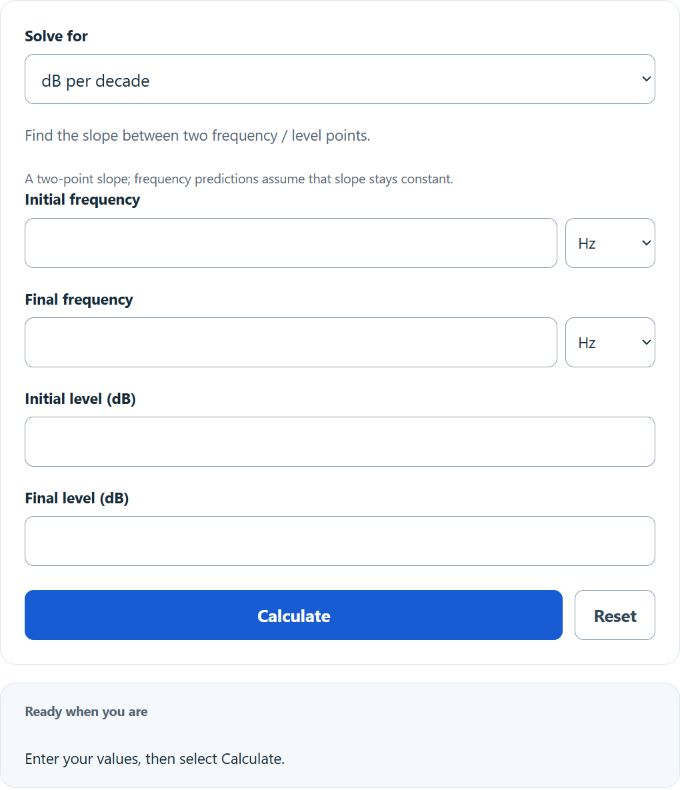
Select the slope, frequency or level to solve, then enter the displayed values. Frequencies can use Hz, kHz or MHz; levels must share a dB reference.
Related Calculators
- Transmission Line Calculator
- Speaker Impedance Calculator
- Ohms To Watts Calculator
- Instantaneous Power Calculator
- All Physics Calculators
dB Per Decade Formula
The dB per decade value is the change in level divided by the number of frequency decades between two points.
Related formulas for solving the other values are:
- f1 = initial frequency, in hertz
- f2 = final frequency, in hertz
- L1 = initial level, in decibels
- L2 = final level, in decibels
- dB/decade = rate of level change for each 10x change in frequency
- log10(f2 / f1) = number of decades between the two frequencies
To calculate dB per decade, enter both frequencies and both dB levels. The calculator finds the number of decades between the frequencies, then divides the dB change by that number.
To calculate a missing final level, it multiplies the dB per decade value by the number of decades and adds that change to the initial level.
To calculate a missing initial level, it subtracts the total dB change from the final level.
When solving for a frequency, the formula uses the dB change and a nonzero dB per decade slope to find the required frequency ratio. Predictions assume a constant slope. Equal frequencies do not define a slope; a zero slope does not determine a unique frequency.
Common dB Per Decade Slopes
| Slope | Meaning | Common interpretation |
|---|---|---|
| 0 dB/decade | No level change as frequency changes | Flat response |
| +20 dB/decade | Level increases 20 dB for every 10x frequency increase | First-order rising response |
| -20 dB/decade | Level decreases 20 dB for every 10x frequency increase | First-order roll-off |
| +40 dB/decade | Level increases 40 dB for every 10x frequency increase | Second-order rising response |
| -40 dB/decade | Level decreases 40 dB for every 10x frequency increase | Second-order roll-off |
Frequency Ratios in Decades
| Frequency ratio f2 / f1 | Decades | Example |
|---|---|---|
| 2 | 0.3010 | 100 Hz to 200 Hz |
| 10 | 1 | 100 Hz to 1,000 Hz |
| 100 | 2 | 100 Hz to 10,000 Hz |
| 0.1 | -1 | 1,000 Hz to 100 Hz |
Examples
Example 1: Calculate dB per decade
You have an initial frequency of 100 Hz, a final frequency of 1,000 Hz, an initial level of 0 dB, and a final level of -20 dB.
The slope is -20 dB per decade.
Example 2: Calculate final level
You have an initial frequency of 200 Hz, a final frequency of 2,000 Hz, an initial level of 6 dB, and a slope of -20 dB per decade.
The final level is -14 dB.
FAQ
What does dB per decade mean?
dB per decade is the change in decibels for every 10x change in frequency. For example, a slope of -20 dB per decade means the level drops by 20 dB when frequency increases from 100 Hz to 1,000 Hz, or from 1,000 Hz to 10,000 Hz.
Is dB per decade the same as dB per octave?
No. A decade is a 10x frequency change, while an octave is a 2x frequency change. A slope of 20 dB per decade is approximately 6.02 dB per octave because one octave is about 0.301 decades.
Can the dB per decade value be negative?
Yes. A negative value means the level decreases as frequency increases. A positive value means the level increases as frequency increases. A value near zero means the level is nearly flat across the selected frequency range.