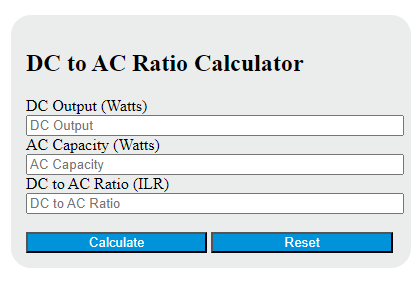
Calculate a solar PV DC-to-AC ratio or solve DC array and inverter ratings in W, kW, or MW. Check oversizing, available-power headroom, and clipping threshold.
DC to AC Ratio Formula
The DC to AC ratio compares the DC power rating to the AC power rating. In solar power systems, this is often used to compare the DC size of a PV array to the AC capacity of an inverter.
- RDC:AC = DC to AC ratio, unitless
- PDC = DC output or DC power rating
- PAC = AC capacity or AC power rating
The calculator lets you enter any two values and solves for the missing one. If DC output and AC capacity are entered, it divides DC by AC to find the ratio. If AC capacity and the ratio are entered, it multiplies them to find DC output. If DC output and the ratio are entered, it divides DC output by the ratio to find AC capacity.
Power units can be entered in W, kW, or MW. The calculator converts power values to watts for the calculation, then converts the answer back to the unit you selected.
Typical DC to AC Ratio Ranges
These ranges are common reference points for solar PV systems. The best value depends on the inverter, module layout, climate, utility rules, and expected clipping.
| DC to AC Ratio | General Meaning | Common Interpretation |
|---|---|---|
| 1.00 | DC rating equals AC capacity | Little inverter oversizing, usually less clipping risk |
| 1.10 to 1.25 | Moderate DC oversizing | Common design range for many PV systems |
| 1.25 to 1.40 | Higher DC oversizing | May improve inverter use, but clipping becomes more likely |
| Above 1.40 | High DC oversizing | Requires careful design review and inverter limit checks |
Power Unit Conversions Used
| Unit | Watts Equivalent | Example |
|---|---|---|
| W | 1 W | 500 W = 500 W |
| kW | 1,000 W | 7.5 kW = 7,500 W |
| MW | 1,000,000 W | 2 MW = 2,000,000 W |
Example Problems
Example 1: Find the DC to AC ratio
You have a solar array with a DC output of 7.8 kW and an inverter AC capacity of 6 kW.
The DC to AC ratio is 1.3.
Example 2: Find the DC output
You know the AC capacity is 50 kW and the DC to AC ratio is 1.2.
The DC output is 60 kW.
FAQ
What does a DC to AC ratio of 1.2 mean?
A DC to AC ratio of 1.2 means the DC rating is 20% larger than the AC capacity. For example, a 12 kW DC array connected to a 10 kW AC inverter has a ratio of 1.2.
Does the DC to AC ratio have units?
No. The DC to AC ratio is unitless because it divides one power value by another power value. The DC output and AC capacity must use compatible power units, but the final ratio has no unit.
Can a high DC to AC ratio cause clipping?
Yes. If the DC array can produce more power than the inverter can convert to AC, the inverter may limit output at its AC capacity. That lost production is called clipping. Some oversizing is normal in PV design, but very high ratios should be checked against inverter limits and expected site conditions.