Calculate electric motor torque, power, or speed from known values, including AC full-load torque and DC voltage, current, and efficiency inputs.
- All Physics Calculators
- HP to Torque Calculator
- Torque to Force Calculator
- Motor Load Calculator
- BLDC Motor Power Calculator
- PPR To RPM Calculator
- RPM to Torque Calculator
Electric Motor Torque Formula
The basic motor torque relationship connects mechanical power, shaft speed, and torque. The calculator converts all entered units to watts, RPM, and newton-meters before calculating the missing value.
- T = torque, in newton-meters (N-m)
- P = mechanical power, in watts (W)
- N = shaft speed, in revolutions per minute (RPM)
- pi = 3.14159265…
- P = mechanical power, in watts (W)
- T = torque, in newton-meters (N-m)
- N = shaft speed, in RPM
- N = shaft speed, in RPM
- P = mechanical power, in watts (W)
- T = torque, in newton-meters (N-m)
For AC motor mode, the full-load torque uses the same power, speed, and torque relationship. Optional user-supplied multipliers calculate starting, breakdown and same-speed service-factor torque scenarios; they do not establish actual motor capability.
- T_FL = full-load torque
- T_start = starting torque
- T_breakdown = breakdown torque
- T_SF = service-factor torque
- M_start = starting torque multiplier
- M_breakdown = breakdown torque multiplier
- SF = service factor
For DC motor mode, the calculator uses voltage, current, efficiency, speed, and torque. Efficiency is entered as a percent, so it is divided by 100 in the formula.
- P_out = mechanical output power, in watts
- V = voltage, in volts
- I = current, in amps
- eta = efficiency, in percent
- T = torque, in newton-meters
- N = speed, in RPM
- T_est = estimated DC motor torque from the linear torque-speed model
- N_est = estimated DC motor speed from the linear torque-speed model
- T_stall = stall torque
- N_no_load = no-load speed
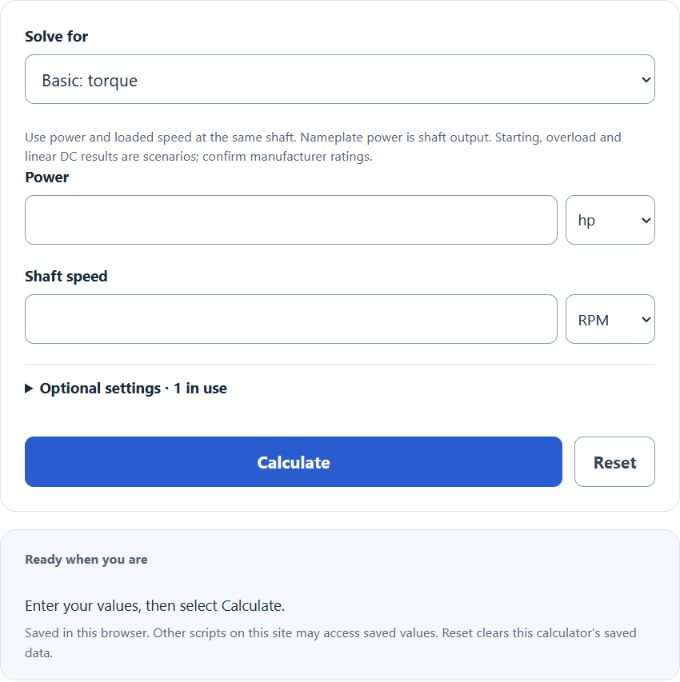
In Basic mode, you enter any two of power, speed, and torque to calculate the third. In AC Motor mode, you enter any two of rated power, rated speed, and full-load torque, with optional multiplier results. In DC running modes, enter the other four values to solve voltage, current, efficiency, speed or torque. Separate linear-model modes use known stall torque and no-load speed at the same supply; they interpolate only within those endpoints and do not infer thermal capability.
Common Motor Torque Unit Conversions
| Quantity | Conversion | Use in the calculator |
|---|---|---|
| Power | 1 kW = 1000 W | Used for W and kW entries |
| Power | 1 HP = 745.699872 W | Used for horsepower entries |
| Torque | 1 lb-ft = 1.355817948 N-m | Used for lb-ft torque entries |
| Torque | 1 lb-in = 0.112984829 N-m | Used for lb-in torque entries |
| Speed | rad/s = RPM*2*pi/60 | Used for RPM and rad/s speed entries |
Typical AC Motor Torque Multipliers
These illustrative ranges vary by motor design and are not ratings for an unknown motor. Use manufacturer torque data. Service-factor torque assumes the same shaft speed; speed and efficiency may change at overload.
| Torque value | Typical range | Meaning |
|---|---|---|
| Starting torque | 1.5 to 2.5 x full-load torque | Torque available when the motor starts from rest |
| Breakdown torque | 2.0 to 3.5 x full-load torque | Maximum torque before the motor pulls out or stalls |
| Service factor | 1.0 to 1.15 is common | Power-loading allowance under specified nameplate conditions; not universally short-term |
Example Problems
Example 1: Calculate torque from power and speed
You have a 5 HP motor running at 1750 RPM. Find the shaft torque.
The torque is about 20.35 N-m, which is about 15.01 lb-ft.
Example 2: Calculate DC motor torque
A DC motor runs at 24 V and 10 A with 80% efficiency at 3000 RPM. Find the output torque.
The torque is about 0.611 N-m, which is about 5.41 lb-in.
FAQ
What is motor torque?
Motor torque is the turning force available at the shaft. Higher torque means the motor can apply more twisting force to a load. Torque is commonly shown in newton-meters, pound-feet, or pound-inches.
Why does torque decrease when speed increases for the same power?
Power is torque multiplied by angular speed. If power stays the same and speed increases, torque must decrease. If speed decreases while power stays the same, torque increases.
What is the difference between full-load torque and starting torque?
Full-load torque is the torque the motor produces at rated power and rated speed. Starting torque is the torque available at zero speed when the motor first starts. For many AC motors, starting torque is expressed as a multiplier of full-load torque.