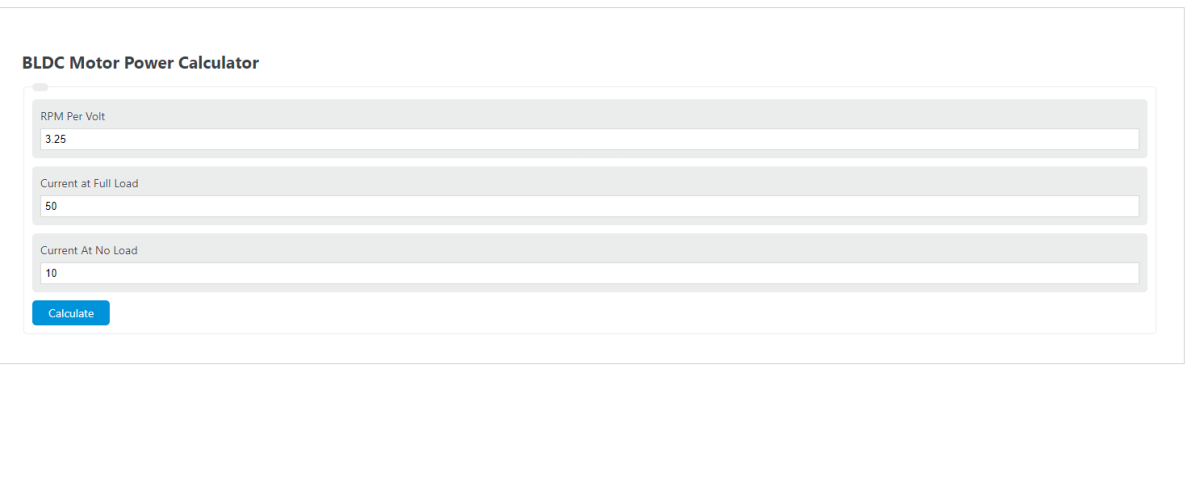
Use the BLDC Motor Power Calculator to solve motor power, voltage, or current and optionally estimate Kv speed, torque constant, and torque.
- Motor Load Calculator
- Motor Efficiency Calculator
- DC Motor Torque Calculator
- Electric Motor Torque Calculator
- PPR To RPM Calculator
- Hoist Motor Power Calculator
- Motor Current Calculator
- Full Load Current Calculator
- All Automotive Calculators
BLDC Motor Power Formula
The main estimate used for BLDC motor output power is based on supply voltage and the current used above no-load current.
- P = estimated BLDC motor power, in watts
- V = supply voltage, in volts
- I = full-load current, in amps
- I_0 = no-load current, in amps
In solve-missing mode, the same formula is rearranged depending on which value you leave blank.
In Kv estimates mode, the calculator also estimates ideal no-load speed, torque constant, and torque.
- Kv = motor speed constant, in RPM per volt
- RPM = estimated no-load speed
- Kt = torque constant, in newton-meters per amp
- T = estimated torque, in newton-meters
The power estimate subtracts no-load current because no-load current is used to overcome internal losses such as bearing friction, windage, and electrical losses. The remaining current is treated as the load-producing current. The Kv tab uses the same power estimate, then adds speed and torque estimates from the motor Kv value.
BLDC Motor Unit Conversions and Typical Input Ranges
Use consistent base units when checking the result by hand. The calculator converts supported units internally.
| Quantity | Base unit used in formulas | Conversion |
|---|---|---|
| Voltage | volts, V | 1 mV = 0.001 V |
| Current | amps, A | 1 mA = 0.001 A |
| Power | watts, W | 1 kW = 1000 W; 1 hp ≈ 745.7 W |
| Motor Kv | RPM/V | RPM ≈ Kv × volts |
| Application type | Common voltage range | Typical Kv pattern |
|---|---|---|
| Small drones and RC aircraft | 7.4 V to 22.2 V | Higher Kv for smaller props, lower Kv for larger props |
| E-bike and scooter motors | 24 V to 72 V | Lower Kv, higher torque design |
| Robotics and automation | 12 V to 48 V | Depends heavily on gearing and load speed |
Example BLDC Motor Power Calculations
Example 1: Estimate motor power
You have a 24 V BLDC motor. The full-load current is 18 A, and the no-load current is 2 A.
The estimated motor power is 384 W, or about 0.515 hp.
Example 2: Estimate speed and torque from Kv
A motor has a Kv of 900 RPM/V, runs on 12 V, has a full-load current of 20 A, and has a no-load current of 1.5 A.
The estimated power is 222 W, the ideal no-load speed is 10,800 rpm, and the estimated torque is about 0.196 N·m.
FAQ
Is this BLDC motor power the same as rated motor power?
Not always. This calculation gives an estimate from voltage and current above no-load current. A motor rating from a manufacturer may include thermal limits, duty cycle, cooling, winding limits, controller limits, and efficiency testing. Use the nameplate or datasheet rating when you need an official continuous power value.
Why is no-load current subtracted from full-load current?
No-load current is the current the motor uses even when it is not driving an external load. Subtracting it gives a rough estimate of the current contributing to useful load power. This makes the estimate more realistic than simply multiplying voltage by full-load current.
Why is actual loaded RPM lower than the Kv speed estimate?
The Kv speed estimate uses RPM ≈ Kv × voltage, which is an ideal no-load estimate. Under load, the motor slows because current, winding resistance, controller behavior, battery voltage sag, and mechanical load all affect speed. Treat the Kv result as a starting estimate, not a guaranteed loaded RPM.