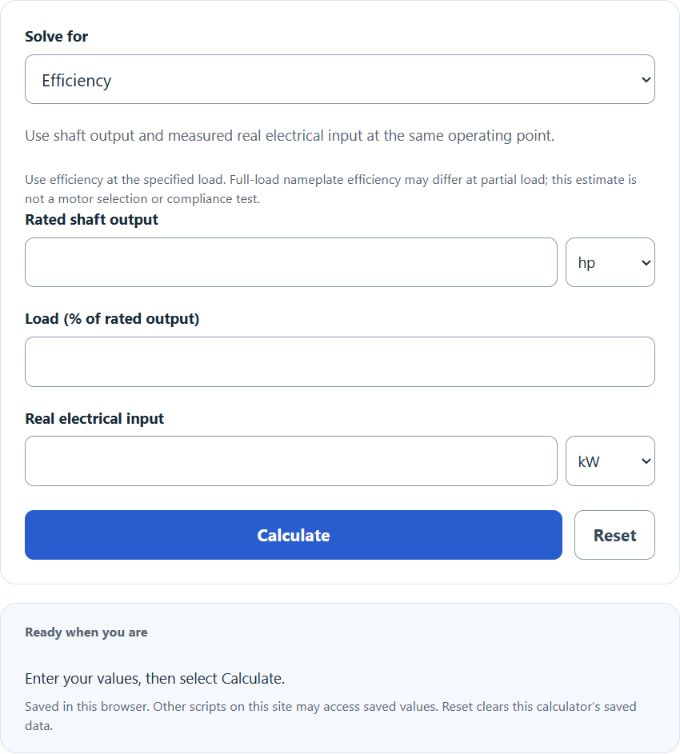
Calculate motor efficiency, rated output, load or input power from any 3 values, and estimate annual electricity cost and losses for motors.
- All Physics Calculators
- All Efficiency Calculators
- Electric Motor Torque Calculator
- Efficiency Ratio Calculator
- HP to Torque Calculator
- CC to HP Calculator
- Motor Load Calculator
- Electric Motor Heat Loss Calculator
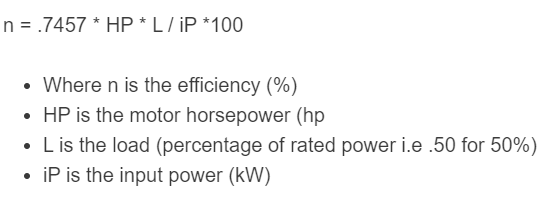
Motor Efficiency Formula
- η = motor efficiency (%)
- HP = rated motor horsepower (hp)
- L = load as a decimal fraction (e.g., 0.75 for 75% load)
- Pin = electrical input power (kW)
- 0.7457 = unit conversion factor (1 hp = 0.7457 kW)
When output power is measured directly: η (%) = (Pout / Pin) x 100, with both values in the same units (watts or kW).
NEMA Premium Efficiency by Motor Size
The premium values below are nominal full-load references for 60 Hz, 4-pole enclosed motors, matching 10 CFR 431.25 Table 5. U.S. minimum efficiencies depend on motor category, rating, construction and manufacture date; IEC classes do not by themselves determine compliance. The other columns are comparison assumptions, not regulatory limits. Illustrative savings use the listed efficiencies as constant operating efficiencies at 75% load; actual savings require each motor’s partial-load efficiency curve.
| Rated HP | NEMA Premium (%) | Energy Efficient (%) | Standard Efficiency (%) | Illustrative Annual kWh Savings vs. Standard (4,000 hrs/yr, 75% load) |
|---|---|---|---|---|
| 1 | 85.5 | 82.5 | 76.8 | ~296 kWh |
| 5 | 89.5 | 87.5 | 84.0 | ~818 kWh |
| 10 | 91.7 | 89.5 | 86.5 | ~1,467 kWh |
| 25 | 93.6 | 92.4 | 90.2 | ~2,252 kWh |
| 50 | 94.5 | 93.0 | 91.7 | ~3,614 kWh |
| 100 | 95.4 | 94.1 | 92.4 | ~7,614 kWh |
| 200 | 96.2 | 95.0 | 93.6 | ~12,919 kWh |
Efficiency at Partial Load
Many induction motors reach peak efficiency near 75% rated load, but the peak and efficient operating range vary by motor. Efficiency often remains fairly flat from 50% to 100% load; larger motors may retain good efficiency below that range. Core, friction and windage losses vary less with load than winding losses at a given voltage, frequency and speed. Use the manufacturer’s efficiency curve for the operating point.
| Load (%) | Efficiency | Practical Note |
|---|---|---|
| 25% | Motor-specific | Investigate sustained underloading; a smaller motor is not automatically more efficient |
| 50% | Motor-specific | Often within a broad efficient operating range |
| 75% | Motor-specific | Near the peak for many induction motors; confirm the curve |
| 100% | Nominal full-load reference | Compare with rated-load test or nameplate data |
A motor consistently running below 50% load may warrant a sizing review. Downsizing savings depend on both motors’ efficiency curves, operating speeds, starting torque and load peaks; a fixed 8 to 12 percentage-point gain cannot be assumed. Verify the application before selecting a replacement.
IEC and NEMA Efficiency Classes
| IEC Class | Efficiency Level | Efficiency Threshold | Regulatory Context |
|---|---|---|---|
| IE1 | Standard | Depends on rating, poles and frequency | Eligibility depends on jurisdiction, scope and exemptions |
| IE2 | High efficiency | Depends on rating, poles and frequency | Required or permitted for certain categories; check applicable rules |
| IE3 | Premium | Depends on rating, poles and frequency | EU in-scope three-phase 0.75–1,000 kW motors generally require IE3, subject to exceptions and IE4 requirements. U.S. rules use category-specific numerical tables. |
| IE4 | Super premium | Depends on rating, poles and frequency | Since 1 July 2023, required for applicable EU three-phase 75–200 kW, 2/4/6-pole motors, excluding brake and explosion-protected motors |
Motor Loss Breakdown
Understanding which losses are fixed versus load-dependent is key to diagnosing motor efficiency issues and making correct sizing decisions.
| Loss Type | Cause | Load Dependent? | Share of Total Losses (motor-specific) |
|---|---|---|---|
| Copper (I²R) | Resistance heating in stator and rotor windings | Yes (proportional to I²) | Depends on motor and operating point |
| Core (Iron) | Hysteresis and eddy currents in laminations | Relatively insensitive to load at fixed voltage and frequency | Depends on motor and operating point |
| Friction and Windage | Bearing friction, cooling fan drag | Mostly no | Depends on motor and operating point |
| Stray Load | Harmonic fields, leakage flux | Yes | Depends on motor and operating point |
Motor Efficiency Definition
Motor efficiency is the ratio of mechanical output power (shaft power) to electrical input power, expressed as a percentage. A motor rated at 92% efficiency converts 92 watts of every 100 watts drawn from the supply into useful shaft work; the remaining 8 watts become heat, noise, and friction losses inside the motor.
Example Problem
How to calculate motor efficiency?
- First, determine the input power.
For this example, we are analyzing an electric motor in a car that receives its power from a battery pack. The input power is 85 kW.
- Next, determine the maximum horsepower.
The maximum rated horsepower of the engine/motor is 150 hp.
- Next, determine the load.
The percentage of the max horsepower that the engine is running at is .65 or 65%.
- Finally, calculate the motor efficiency.
Using the formula above, the motor efficiency is found to be (0.7457 * 150 * 0.65 / 85) * 100 = 85.54 %.