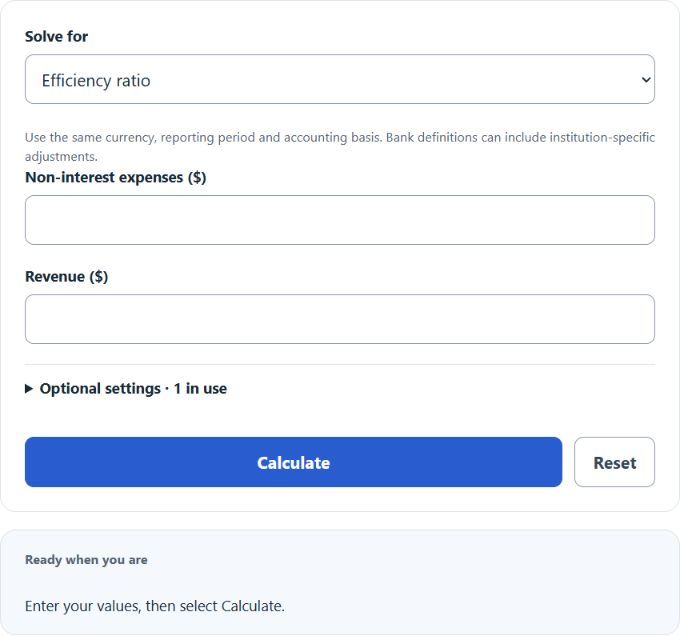
Calculate an efficiency ratio from non-interest expenses and revenue, or use bank income components before provisions. An explicitly labeled alternative can subtract credit-loss provisions.
Related Calculators
- Sales Ratio Calculator
- Cost Income Ratio Calculator
- Wages to Sales Ratio Calculator
- Vertical Analysis Calculator
- All Business Calculators
Efficiency Ratio Formula
The following formula is used to calculate an efficiency ratio of a good or service of a business.
- ER is the efficiency ratio
- NIE is the non-interest expenses ($)
- R is the revenue ($)
To calculate an efficiency ratio, divide the non-interest expenses by the total revenue.
Efficiency Ratio Definition
Efficiency is a financial term used to describe a ratio of non-interest expenses to the total revenue generated through the selling of a service or good. A higher ratio means more non-interest expense per unit of the selected revenue basis; compare consistent definitions and appropriate peers. This is because a high ratio will mean a high amount of expenses relative to the revenue.
Efficiency Ratio Example
How to calculate an efficiency ratio?
- First, determine the non-interest expenses.
Determine the non-interest expenses of the business.
- Next, determine the total revenue.
Measure the total revenue of the same business over the same time period.
- Finally, calculate the efficiency ratio.
Calculate the efficiency ratio with the equation above.
FAQ
An efficiency ratio is a financial term used to describe the efficiency of a business or product. It is a simple ratio of total non-interest expenses to total revenue.