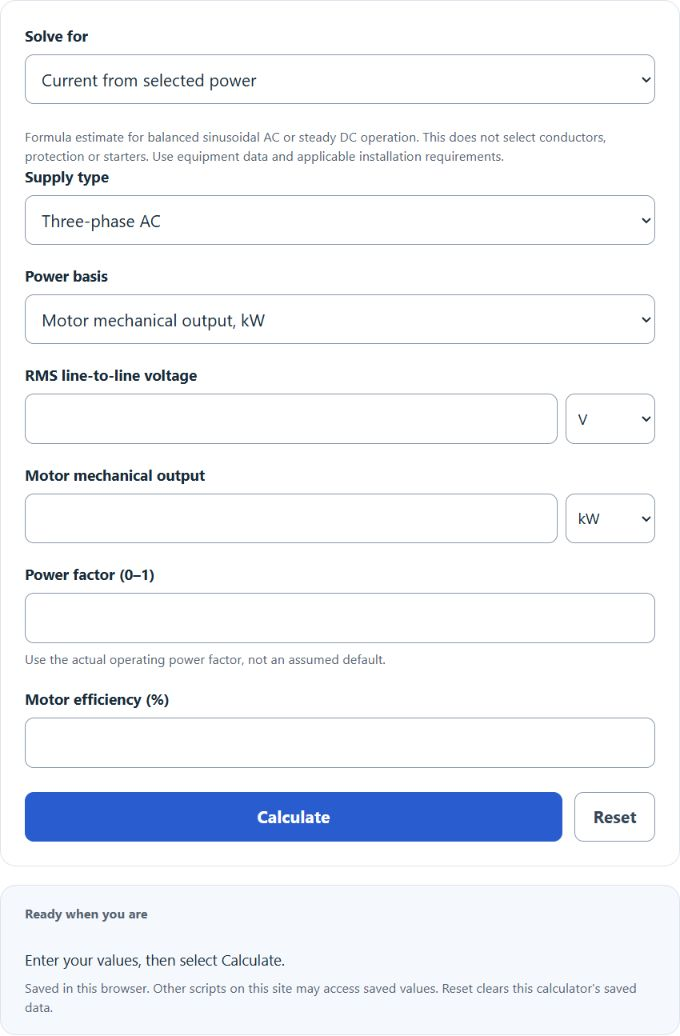
Estimate current from a selected power basis, or estimate that power from current, for DC, single-phase AC or balanced sinusoidal three-phase AC. Supply the voltage and any required power factor or motor efficiency; the calculator does not infer equipment ratings or select conductors or protection.
- All Physics Calculators
- All Electrical Calculators
- Motor Load Calculator
- Motor Current Calculator
- No-Load Current Calculator
- Overload Current Calculator
Full Load Current Formula
The AC formulas below use total electrical real input power P_in in watts, not motor mechanical output. Use RMS voltage and current. For three-phase operation, V_LL is line-to-line voltage and I is line current; the phases are assumed balanced and sinusoidal.
Single-phase AC: I = P_in / (V * PF)
Balanced three-phase AC: I = P_in / (sqrt(3) * V_LL * PF)
- I is the estimated current in amperes; in the three-phase formula it is line current
- P_in is total electrical real input power in watts; P_out is motor mechanical output power in watts
- V is single-phase supply voltage; V_LL is three-phase line-to-line voltage, in volts. PF is power factor, with 0 < PF ≤ 1. Motor efficiency eta is P_out/P_in, with 0 < eta ≤ 1 (divide entered percent by 100).
For motor output, first use P_in = P_out / eta. A kW input is multiplied by 1000 to obtain watts; mechanical horsepower uses approximately 745.699871582 W per hp, which is a different definition from metric horsepower. For constant DC, I = P_in / V and power factor is not used. For AC apparent power S in VA, I = S / (f * V), where f is sqrt(3) with V_LL for balanced three-phase and 1 for single-phase; kVA is multiplied by 1000 to obtain VA. Apparent power alone does not determine real kW or motor output without the missing power factor and efficiency, so the kVA mode does not invent those values. The reverse mode rearranges the selected relationship to estimate its power basis from current. No voltage, PF or efficiency is assumed. This is an electrical estimate; starting current, unbalance, harmonics, derating and installation conditions are not modeled. Use equipment nameplate data and applicable requirements for conductor, overload, fuse, breaker or starter selection.
How to Calculate Full Load Current?
The following hypothetical examples both use balanced sinusoidal three-phase AC, electrical real input power and unity power factor (PF = 1). Voltage is RMS line-to-line voltage. They are not motor-output or equipment-selection examples; no motor efficiency is needed.
Example Problem #1:
- Use total electrical real input power P_in = 67 W. In the calculator, select electrical input kW and enter 0.067; this is not motor output.
- Enter RMS line-to-line voltage V_LL = 8 V and supply PF = 1 for this hypothetical example.
- Finally, calculate the Full Load Current using the formula above:
I = P_in / (sqrt(3) * V_LL * PF)
Inserting the values from above and solving the equation with the imputed values gives:
I = 67 / (sqrt(3) * 8 * 1) = approximately 4.835309 A, or 4.84 A to two decimal places.
Example Problem #2:
Use the same balanced three-phase, electrical-input and unity-PF assumptions for the second hypothetical example:
Electrical real input power P_in = 90 W = 0.090 kW.
RMS line-to-line voltage V_LL = 4 V; PF = 1.
Entering these values into the formula above gives :
I = 90 / (sqrt(3) * 4 * 1) = approximately 12.990381 A, or 12.99 A to two decimal places.