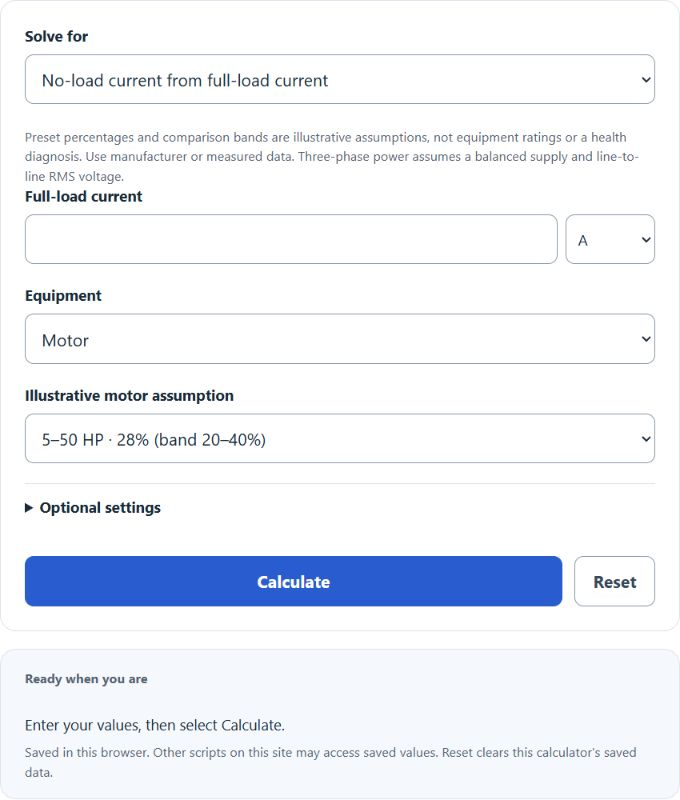
Calculate no-load current in amps for motors and transformers from full-load current and no-load percentage, or from measured no-load power and power factor.
- All Physics Calculators
- All Electrical Calculators
- Full Load Current Calculator
- Motor Load Calculator
No-Load Current Formula (Using % of Full-Load Current)
The no-load current calculator estimates how much current a motor or electrical device draws when it is energized but not delivering its rated mechanical load. This is useful for quick checks during design, troubleshooting, commissioning, and nameplate-to-operating-condition comparisons.
In this relationship:
- No-load current is the current drawn while the machine is running without external load.
- Full-load current is the rated current at the machine’s intended load.
- Percentage ratio is the no-load current expressed as a percent of full-load current.
If you know any two of those values, the third can be found by rearranging the same relationship. Preset percentages and comparison bands in this tool are illustrative assumptions, not manufacturer ratings or validated equipment health limits.
How to Use the Calculator
- Enter the full-load current in amps, milliamps, or kiloamps.
- Enter the no-load current percentage as a percent value. For example, enter 35 for 35%.
- Click calculate to get the estimated no-load current.
- Select the desired solve mode and enter the shown known values; the result field is omitted from the inputs.
Important: select the correct unit for each current input. The calculator converts A, mA and kA to a matching basis and reports current in A.
For measured real power, I = P/(V × PF) for single-phase AC and I = P/(√3 × VLL × PF) for balanced three-phase AC, using line-to-line RMS voltage and total real power. Steady DC uses I = P/V. The assumed PF default of 0.20 must be replaced by the appropriate measured value when available. Sinusoidal in-phase/quadrature estimates do not separately identify physical core-loss or magnetizing currents.
What No-Load Current Represents
No-load current is not the same as zero current. Even with no useful shaft output, a motor still needs current to establish magnetic flux and to cover internal losses such as core loss, friction, and windage. Because of that, the no-load value can remain significant, especially for induction machines.
The percentage used in the calculation is not a universal constant. It changes with:
- motor type and construction,
- motor size,
- supply voltage and frequency,
- bearing and mechanical condition,
- measurement method, and
- actual operating temperature and speed.
As a general rule, smaller induction motors often have a higher no-load current percentage than larger machines. When accuracy matters, use manufacturer data or measured operating values rather than a rough assumption.
Example Calculations
Example 1: A motor has a full-load current of 450 A, and the no-load current is estimated at 52% of full-load current.
The estimated no-load current is 234 A.
Example 2: A motor draws 50.4 A at no load and has a full-load current of 120 A. To determine the no-load percentage:
The no-load current is 42% of the full-load current.
Example 3: A device draws 18 A at no load, and that value is known to be 30% of full-load current. To estimate the full-load current:
The estimated full-load current is 60 A.
Quick Input Guide
| Field | What to Enter | Best Practice |
|---|---|---|
| Full-Load Current | Rated or measured current at full load | Use the value from the nameplate, datasheet, or a verified operating measurement |
| No-Load Current % | The no-load current expressed as a percent of full-load current | Enter the percent as a whole-number style value such as 25, 40, or 55 |
| No-Load Current | Current drawn with the machine running unloaded | Select the matching unit for each field; inputs are converted internally |
Common Mistakes
- Entering a decimal instead of a percent: if the value is 25%, enter 25 rather than 0.25.
- Mixing units: choose the correct A, mA or kA unit for each field; the calculator handles their conversion.
- Using starting current instead of no-load current: inrush and locked-rotor current are different quantities.
- Assuming one ratio fits every motor: the percentage can vary widely across designs and sizes.
- Ignoring supply conditions: voltage and frequency deviations can materially change the measured no-load current.
When This Calculator Is Most Useful
- Estimating idle electrical draw before field measurements are available
- Checking whether a measured no-load current appears reasonable for a known full-load current
- Back-calculating the implied no-load percentage from test data
- Comparing datasheet expectations with commissioning measurements
- Creating fast engineering estimates for controls, protection, and energy discussions
Frequently Asked Questions
Is no-load current supposed to be zero?
No. A motor usually draws noticeable current even without external load because it still has internal electrical and mechanical losses.
Can I use this for any motor type?
Yes, as a mathematical relationship. However, the percentage value should come from the correct datasheet, test result, or engineering assumption for that specific motor type.
Why can the percentage seem high?
No-load current can be a substantial fraction of rated current, particularly in machines where magnetizing current is a large part of total input current.
What if my measured value is much higher than expected?
Check the supply voltage and frequency, confirm the unit conversions, verify that the machine is truly unloaded, and inspect for mechanical or electrical issues that could increase current draw.