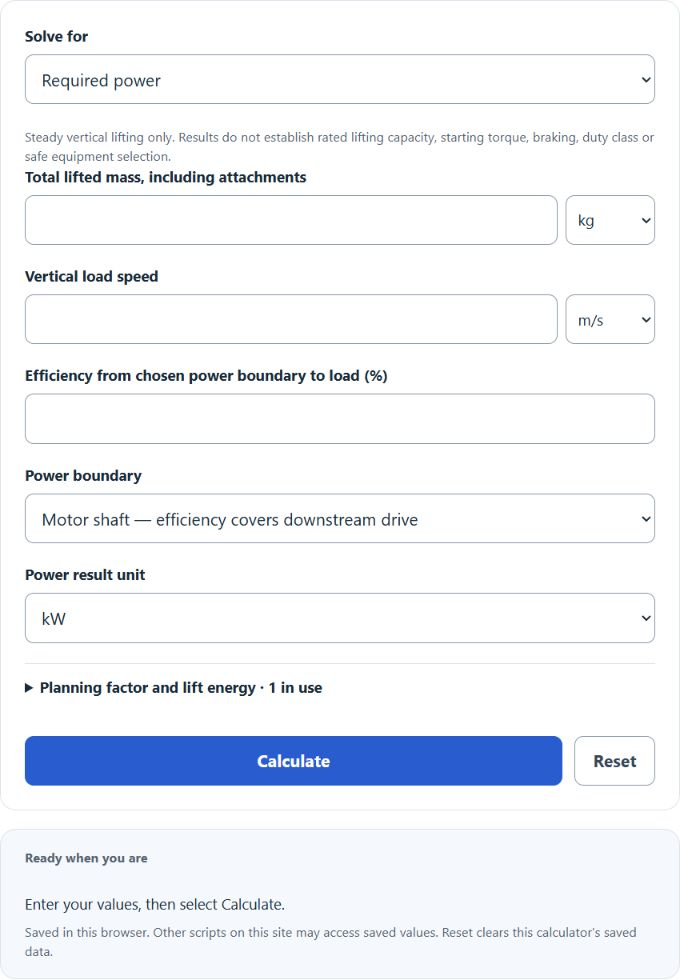
Calculate steady lifting power, the mass or speed implied by that power balance, or efficiency. Choose the shaft or electrical-input boundary; the result does not establish a rated hoist capacity.
- All Construction Calculators
- BLDC Motor Power Calculator
- DC Motor Torque Calculator
- Motor Winding Resistance Calculator
- Centrifugal Compressor Power Calculator
- Torque to Power Calculator
Hoist Motor Power Formula
Useful load power is mgv. Divide by efficiency measured from the selected boundary to obtain either motor shaft power (drive efficiency) or electrical input (motor-and-drive efficiency). Do not compare electrical input directly with a shaft nameplate rating. The calculator estimates steady lifting power; actual hoist selection needs torque, brake, duty and thermal checks.
If efficiency is entered as a percentage for manual calculation, convert it to a decimal first.
| Symbol | Meaning | Typical Unit |
|---|---|---|
| P | Required hoist motor power | W or hp |
| m | Total lifted mass, including attachments | kg in the SI formula; convert lb first |
| g | Acceleration due to gravity | 9.80665 m/s² (standard gravity) |
| v | Vertical raising speed | m/s in the SI formula; convert ft/s first |
| η | Overall hoist efficiency in decimal form | unitless |
How the Formula Works
The load creates a lifting force equal to its weight. Power is force multiplied by vertical speed, then adjusted upward to account for losses. A less efficient hoist requires more motor power to achieve the same lift rate.
- If the load doubles, the required power doubles.
- If the lifting speed doubles, the required power doubles.
- If efficiency decreases, the required motor power increases.
How to Calculate Hoist Motor Power
- Determine the total mass being lifted, not just the payload.
- Measure or specify the vertical raising speed of the hook or load.
- Determine the overall hoist efficiency and convert percent to decimal if calculating manually.
- Multiply mass by gravity and lift speed.
- Divide by efficiency to find the required motor power.
- Convert watts to horsepower if needed for motor comparison.
Example Calculation
Suppose a hoist raises a 10 kg load at 0.25 m/s with an efficiency of 65%.
That is approximately 0.0506 hp. This value represents the theoretical continuous power needed to maintain the lift under the stated conditions.
What This Result Means
The calculated result is best treated as a baseline operating power. Real hoist motor selection often requires additional capacity for startup torque, acceleration, braking, duty cycle, shock loading, temperature rise, and long-term reliability. In practice, the motor chosen is usually larger than the theoretical minimum.
Assumptions Behind This Calculator
- The lift is primarily vertical.
- The load is raised at a steady average speed.
- The entered efficiency reasonably represents total system losses.
- Operating power and lift energy exclude acceleration, impacts and overloads. The optional multiplier affects only the separate sizing comparison; blank uses 1. The finite rating list is illustrative and gives no automatic selection above 315 kW.
Practical Input Tips
- Include hooks, slings, fixtures, and lifting hardware in the total mass.
- Use the actual hook speed or load speed, not the motor shaft speed.
- Use a realistic efficiency value; idealized values can understate power needs.
- When calculating manually, keep units consistent throughout the equation.
- If the hoist uses a reeving arrangement, use the actual load travel speed for the lift.
Common Mistakes
- Using payload mass instead of total lifted mass.
- For manual calculation, forgetting to convert 65% efficiency to 0.65.
- Using horizontal travel speed instead of vertical lifting speed.
- Assuming the formula alone is enough for final motor sizing in heavy-duty applications.
Frequently Asked Questions
Does a heavier load always require more power?
Yes. With speed and efficiency unchanged, required hoist motor power increases in direct proportion to the lifted mass.
Does lifting faster require more power?
Yes. Power rises linearly with lifting speed, so faster lifting requires proportionally more motor power.
Why does efficiency matter so much?
Efficiency accounts for the losses between the motor and the load. As efficiency drops, the motor must supply more input power to deliver the same useful lifting power.
Is this calculator for motor sizing or power estimation?
It is primarily a power estimation tool. It gives a strong first-pass estimate, but final hoist motor selection should also consider torque, thermal limits, duty classification, and safety margin.