Convert encoder PPR and pulse frequency to RPM, reverse-solve frequency or PPR, and check quadrature counts, gearing, pulse period, and frequency headroom.
- All Unit Converters
- Electric Motor Torque Calculator
- DC Motor Torque Calculator
- Motor Load Calculator
- Kv to RPM Calculator
PPR To RPM Formula
The following equation is used to calculate RPM from encoder pulses per second (PPS) and pulses per revolution (PPR). If you are converting between two different shafts (for example across a gearbox), include the speed ratio (SR) between the shaft whose RPM you want and the encoder shaft.
- Where RPM is the revolutions per minute of the shaft you want
- PPS is the pulses received per second
- PPR is the pulses per revolution (of the encoder shaft)
- SR is the speed ratio = (RPM you want) ÷ (encoder-shaft RPM). For a 12:1 reduction gearbox: if the encoder is on the output and you want motor/input RPM, SR = 12; if the encoder is on the motor/input and you want output RPM, SR = 1/12.
To calculate RPM, multiply the pulses received per second by 60, divide by the pulses per revolution to get the encoder-shaft RPM, then multiply by the speed ratio (SR) if you need the RPM of a different shaft.
| Pulses Per Second (PPS) | Revolutions Per Minute (RPM) |
|---|---|
| 1 | 0.060 |
| 5 | 0.300 |
| 10 | 0.600 |
| 20 | 1.200 |
| 50 | 3.000 |
| 60 | 3.600 |
| 100 | 6.000 |
| 200 | 12.000 |
| 300 | 18.000 |
| 500 | 30.000 |
| 600 | 36.000 |
| 800 | 48.000 |
| 1000 | 60.000 |
| 1200 | 72.000 |
| 1500 | 90.000 |
| 2000 | 120.000 |
| 2500 | 150.000 |
| 5000 | 300.000 |
| 10000 | 600.000 |
| 20000 | 1200.000 |
| * Rounded to 3 decimals. Formula: RPM = (PPS × 60 / PPR) × SR. Here PPR = 1000 and SR = 1, so 1 PPS ≈ 0.06 RPM. | |
What is PPR?
Definition:
Pulses Per Revolution (PPR) is a value used to describe the resolution of some types of rotary encoders (especially incremental encoders). An encoder is a device that converts mechanical motion into electrical signals. Rotary encoders are used as feedback devices in many applications, such as machine tools and robotics.
PPR is the number of output pulses produced for one full revolution of the encoder shaft. For example, if an encoder has 100 PPR, then it produces 100 pulses for each full revolution. A higher PPR generally provides finer position/speed measurement resolution, though overall accuracy also depends on the mechanical setup, alignment, and tolerances.
Linear distance is not inherently determined by PPR alone. To convert rotation to linear travel, you must know the circumference of the wheel/pulley (and any belt/gear ratios). For example, if an encoder is attached to a wheel with a 1-meter circumference, then one wheel revolution corresponds to 1 meter of travel; a 100 PPR encoder would then produce 100 pulses per meter in that specific setup.
Incremental rotary encoders are used in situations where speed or position needs to be measured precisely over time. In machine tools and robots, for example, high-resolution encoders can track small changes in position or speed very accurately over long periods of time.
How to Calculate RPM from PPR?
Example Problem:
The following example outlines the steps and information needed to calculate RPM from PPR.
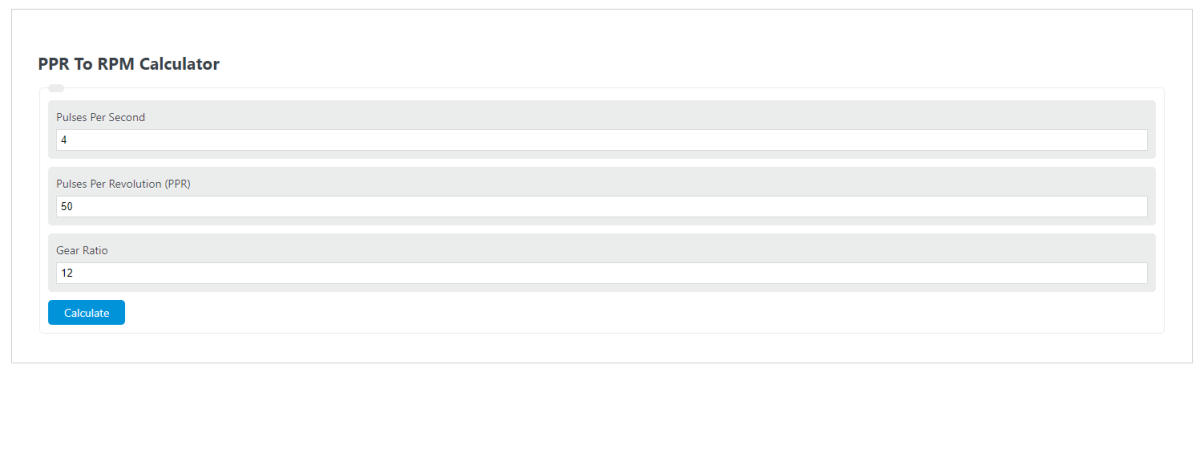
First, determine the pulses received in 1 second. In this case, 4 pulses are received in 1 second (PPS = 4).
Next, determine the PPR. The PPR for this example is 50.
Next, determine the speed ratio (SR) between the shaft whose RPM you want and the encoder shaft. In this example, assume a 12:1 reduction gearbox and the encoder is mounted on the gearbox output shaft, but you want the motor/input RPM. In that case, the motor rotates 12 times for each output revolution, so SR = 12.
Finally, calculate the RPM using the formula above:
RPM = (PPS × 60 / PPR) × SR
RPM = (4 × 60 / 50) × 12
RPM = 57.6